Have you ever seen a tattoo of a woman with snakes for hair? That striking image is Medusa, a figure from ancient Greek mythology. Her story is much deeper than most people realize.
The medusa tattoo meaning has changed a lot over time. This guide is for anyone curious about this popular tattoo, whether you’re considering getting one or just want to understand what it represents.
By the end, you will know:
- The real myth behind Medusa
- What the tattoo symbolizes today
- Why this design has become so popular
- What to think about before getting one
Quick Answer
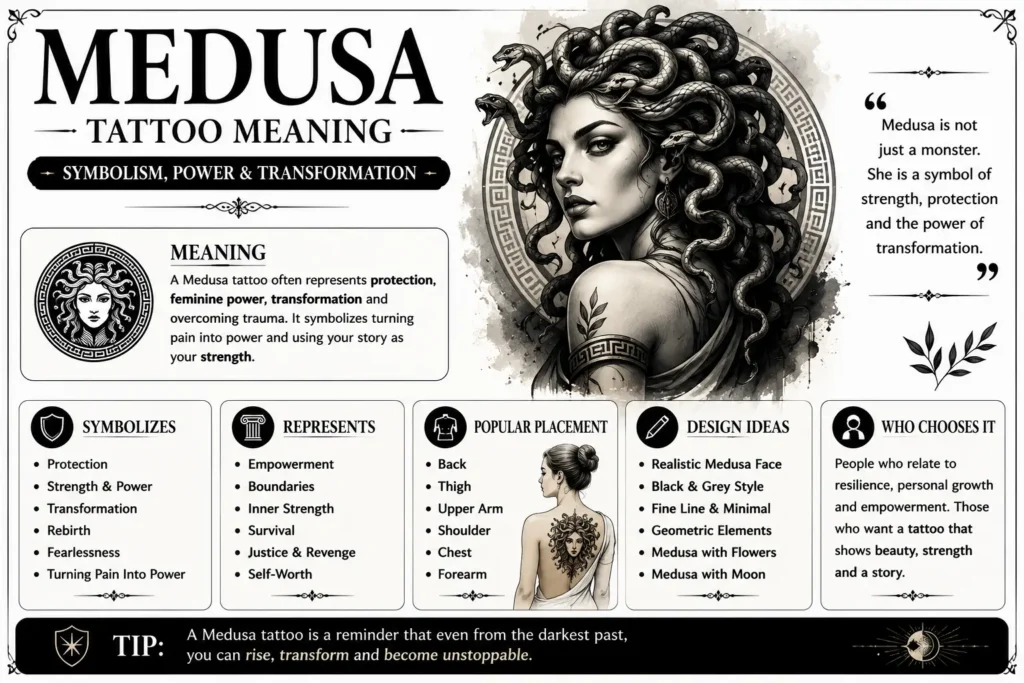
The medusa tattoo meaning today often represents strength, protection, and survival after hardship. Medusa’s story in Greek mythology involves being wronged and then feared for something that was not her fault. Many people now choose this tattoo to represent turning pain into power, especially as a symbol tied to female strength.
Table of Contents
What Does a Medusa Tattoo Mean?
At its core, a medusa tattoo meaning represents transformation. Medusa was once a woman who suffered something unfair, then became a powerful, feared figure afterward.
Because of this, the tattoo often carries meanings like:
- Strength after hardship
- Protection from harm
- Reclaiming personal power
- Standing strong despite being misunderstood
To fully understand why the tattoo carries these meanings, it helps to know Medusa’s original story.
The Original Myth: Who Was Medusa?
Medusa is a figure from ancient Greek mythology, a collection of old stories from ancient Greece about gods, heroes, and legendary creatures.
In the myths, Medusa was known for having snakes instead of hair, and her gaze could turn people to stone. She is one of three sisters called the Gorgons.
Different ancient versions of her story exist, but one especially well-known telling comes from the Roman poet Ovid, written centuries after the earliest Greek myths.
Medusa’s True Story Explained Simply
In this version of the story, Medusa was originally a beautiful young woman. She served in the temple of Athena, the Greek goddess of wisdom.
According to the myth, Medusa was assaulted by Poseidon, the god of the sea, inside Athena’s temple. Instead of punishing Poseidon, Athena punished Medusa, turning her hair into snakes and cursing her gaze to turn others to stone.
This part of the story is important. It shows Medusa as someone who suffered something unfair, then was blamed and transformed because of it.
Why This Matters
Understanding this background helps explain why so many people today see Medusa differently than the “monster” label she was often given in later retellings. Many modern audiences view her as a survivor, not simply a villain.
Why Medusa’s Story Matters for the Tattoo’s Meaning
This deeper understanding of Medusa’s myth is a major reason the tattoo has grown so meaningful for many people today.
Instead of focusing only on fear or danger, many now see Medusa’s story as one of:
- Injustice turned into strength
- A painful past transformed into protection
- Refusing to be silent or powerless
This shift in perspective is part of why medusa tattoo meaning have become especially popular among people looking to symbolize resilience, the ability to recover strongly from hardship.
Medusa Tattoo Meaning Today
While ancient myths described Medusa as frightening, many modern tattoo wearers reclaim her image with a different meaning in mind.
Common modern meanings include:
- Empowerment – Especially connected to female strength and resilience.
- Protection – Some believe Medusa’s fierce image wards off negativity.
- Survival – Representing overcoming a difficult or painful experience.
- Standing your ground – A reminder not to be intimidated by others.
A Balanced Note
Not everyone interprets the tattoo the same way. Some choose it purely for its striking visual design, without attaching deep symbolic meaning. Both approaches are completely valid, since tattoo meaning is often personal.
Medusa as a Symbol of Protection
In ancient Greece, images of Medusa’s face, called a “Gorgoneion,” were placed on shields, buildings, and armor. This was believed to ward off evil or danger, using her fearsome image as protection.
This ancient use is part of why many modern medusa tattoo meaning are still linked to protection today, carrying that same old symbolism forward into a new form.
Popular Medusa Tattoo Styles
Medusa tattoos come in many artistic styles, allowing plenty of room for personal expression.
| Style | Description |
| Realistic | Detailed, lifelike portrait style |
| Neo-traditional | Bold lines with rich color |
| Fine line | Delicate, minimal detail |
| Black and grey | Shaded, dramatic contrast |
| Illustrative | Artistic, painting-like appearance |
Expert Tip
Choosing a style often comes down to personal taste and how detailed you want the design to be. A skilled tattoo artist can help translate your chosen meaning into the right visual style.
Common Placements for Medusa Tattoos
medusa tattoo meaning are popular in several placements, often chosen based on size and visibility preference.
- Forearm – A popular spot for medium-sized designs.
- Thigh – Common for larger, more detailed pieces.
- Back – Ideal for bigger, elaborate designs.
- Chest – A bold, prominent placement choice.
- Calf – A visible yet easily coverable option.
Things to Think About Before Getting a Medusa Tattoo
Getting any tattoo is a big decision. Here are helpful things to consider first.
Best Practices
- Research your tattoo artist’s portfolio, especially for detailed mythological designs.
- Think about size and placement based on your comfort with visibility.
- Consider how the design might age over time, especially with fine details.
- Ask your artist about aftercare instructions specific to your skin type.
A Note on Safety
Always choose a licensed, professional tattoo studio that follows proper hygiene and sterilization practices. This helps protect your skin and overall health.
Quick Checklist
- [ ] Have I researched a reputable, licensed tattoo artist?
- [ ] Do I understand the placement and size I want?
- [ ] Have I thought about what this tattoo personally means to me?
- [ ] Am I prepared for proper aftercare?
Common Mistakes People Make
Mistake 1: Choosing a Design Without Understanding the Symbolism
Some people pick a Medusa design purely for its look, without realizing the story behind it. Learning the myth first can lead to a design that feels more personally meaningful.
Mistake 2: Not Researching the Artist’s Experience
Detailed mythological tattoos, like Medusa, require skill. Choosing an experienced artist helps ensure the final result matches your vision.
Mistake 3: Ignoring Placement and Size Considerations
A highly detailed design may lose clarity if placed somewhere too small. Discussing size and placement with your artist beforehand helps avoid this issue.
Expert Tips for Choosing Your Design
- Bring reference images to your consultation, but stay open to your artist’s creative input.
- Ask your artist how the design might look after several years, since skin and ink change slightly over time.
- If the tattoo holds personal meaning, consider sharing your reasoning with your artist. This can help them tailor the design’s expression and tone.
More Words Worth Knowing
Medusa’s story is really about transformation and reclaiming power, themes that connect to other emotionally rich words. If that resonated with you, you might enjoy the resonate meaning, poignant meaning, and aura meaning, the energy or presence someone gives off.
Ancient myths and symbols often carry deep history, much like Medusa. You might also enjoy eunuch meaning, revenant meaning, ether meaning, and namaste meaning, all rooted in centuries-old traditions.
Medusa’s fierce protective symbolism connects to other words about standing your ground, like don’t tread on me meaning and animosity meaning (strong, lasting tension, the kind Medusa’s myth was born from).
Medusa was unfairly blamed and hidden behind a fearsome image, similar to the idea of facade meaning (a false outer appearance) and jaded meaning (feeling worn down after repeated hardship).
Some people process their own hard stories privately before sharing them, much like Medusa’s story took centuries to be reclaimed. This is close to the idea behind The Unsent Project, a space for messages that are never sent. A few related guides:
- Curious if it’s worth trying? See is the Unsent Project real, safe, and legit.
- Colors can express strength and identity too. Learn what the colors mean in the Unsent Project.
- Writing things down has real value. Read the emotional benefits of this kind of reflection.
- Want to know where the idea began? Check out the history of the Unsent Project.
- Looking for similar spaces? Try these Unsent Project alternatives.
- Curious how it works? Here’s how the Unsent Project actually works.
- Want to share your own reflection? You can submit your story here.
Stories about survival and reclaiming power often involve complicated feelings and misunderstood reputations, connecting to words like enigma meaning (a mystery, hard to understand), surreal meaning, ennui meaning, nonchalant meaning, naive meaning, ethereal meaning, epiphany meaning, solace meaning, and manifest meaning.
Some readers who reflect on symbols and hidden meaning also enjoy the 666 angel number meaning and dystopian meaning, a word describing imagined worlds built on unfairness, much like Medusa’s original story.
Words describing being misjudged or feared unfairly connect to personality and behavior terms too, such as pedantic meaning, condescending meaning, patronize meaning, facetious meaning, unhinged meaning, diabolical meaning, grifter meaning, debauchery meaning, masochist meaning, hubris meaning (excessive pride, a theme common in Greek mythology), and complacent meaning.
Relationship and identity words are common searches too, including platonic meaning, demisexual meaning, sapiosexual meaning, fidelity meaning, monogamy meaning, celibate meaning, and submissive meaning.
If you enjoy learning about unexpected twists of fate, ironic meaning explores outcomes that are the opposite of what’s expected, fitting for a story like Medusa’s.
A few practical, everyday words are worth knowing too: caveat meaning, contingent meaning, in lieu of meaning, endeavor meaning, blue collar meaning, ethos meaning, et al. meaning, per diem meaning, their meaning, smut meaning, FUPA meaning, elope meaning, godspeed meaning, selah meaning, inshallah meaning, touche meaning, redacted meaning, albeit meaning, APY meaning, sabbatical meaning, and WFH meaning.
And when you want to share your new tattoo or its story with a friend, these shorthand terms are handy for a quick text: SMH meaning, TLDR meaning, SOS meaning, ASL meaning, OFC meaning, ETA meaning, IYKYK meaning, WTW meaning, IMO meaning, SMS meaning, ISTG meaning, IIRC meaning, DITTO meaning, OTOE meaning, WYLL meaning, HUZZ meaning, AFK meaning, ICYMI meaning, FWIW meaning, MIA meaning, and AWOL meaning.
Frequently Asked Questions
1. What is the simplest medusa tattoo meaning? It often represents strength, protection, and survival after hardship, especially connected to reclaiming personal power.
2. Is the Medusa tattoo only for women? No. While it’s especially popular as a symbol of female empowerment, people of any gender choose Medusa tattoos for its themes of strength and resilience.
3. Does a Medusa tattoo always symbolize something negative? Not usually. While Medusa was originally described as a fearsome figure, most modern tattoo meanings focus on empowerment and protection, not villainy.
4. Can the Medusa tattoo represent female empowerment? Yes. This is one of the most common modern meanings, tied to Medusa’s story of injustice and reclaiming strength afterward.
5. Do people see the Medusa tattoo as protection? Yes. This connects to ancient Greek tradition, where Medusa’s image was used on shields and buildings believed to ward off danger.
6. Are there different styles of Medusa tattoos? Yes. Popular styles include realistic, neo-traditional, fine line, black and grey, and illustrative designs.
7. What are the most common positions for a Medusa tattoo? Common placements include the forearm, thigh, back, chest, and calf, depending on desired size and visibility.
8. How do I choose the right medusa tattoo meaning design for me? Consider what part of her story resonates with you most, then discuss your ideas and reference images with an experienced tattoo artist.
The Takeaway
The medusa tattoo meaning goes far beyond its striking visual design. Rooted in an ancient myth about injustice and transformation, it has become a powerful modern symbol of strength, protection, and survival.
Whether you’re drawn to Medusa’s story of resilience or simply love the artistic design, understanding her full history can help you choose a tattoo that feels truly meaningful. If you’re considering this design, take time to research your artist, reflect on your own reasons, and choose a version that feels personally right for you.