Have you ever heard someone describe a song, a dress, or a sunset as “ethereal” and wondered exactly what that meant? It sounds like a magical, dreamy word, and it actually is.
Understanding the ethereal meaning helps you use this beautiful word with confidence, whether you are writing a poem, describing art, or just trying to explain a feeling that seems hard to put into words.
This guide is for anyone curious about this word. Maybe you saw it in a book. Maybe you heard it describing music or fashion. Either way, you are in the right place.
By the end of this guide, you will fully understand the ethereal meaning, where it comes from, how it is used, and how it compares to similar words.
Quick Answer
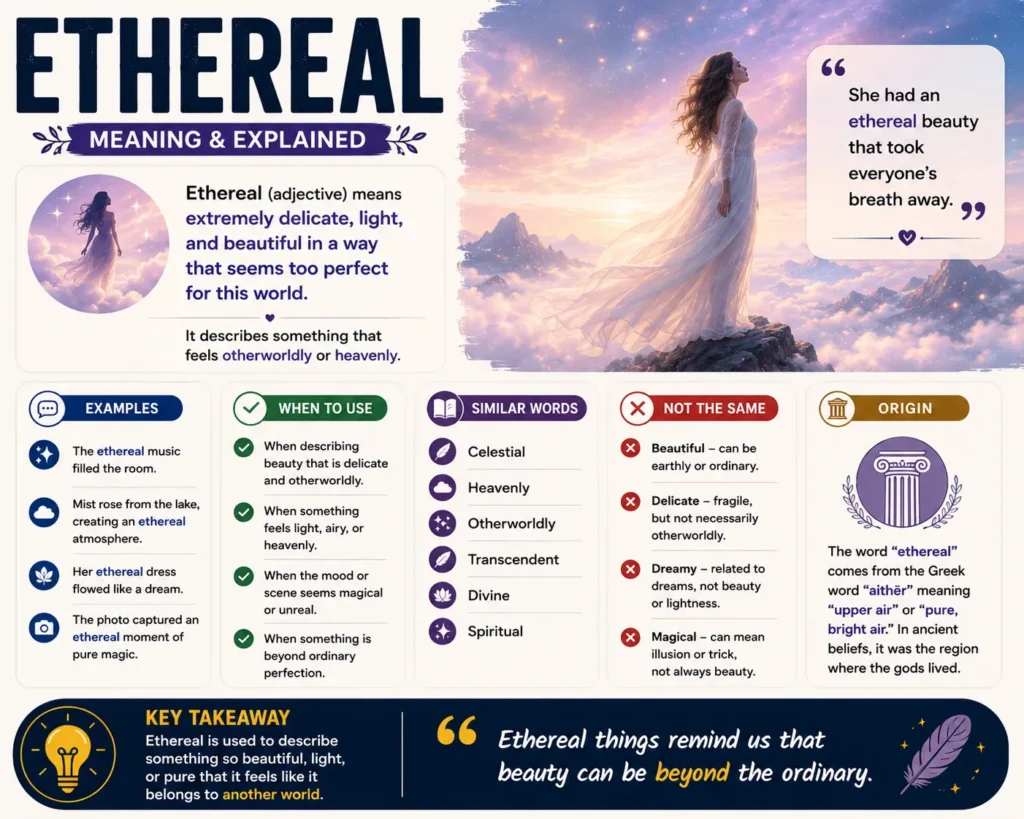
“Ethereal” describes something so light, delicate, or beautiful that it feels almost otherworldly, like it belongs more to dreams or the heavens than to everyday life. It is often used to describe music, light, fabric, or art that feels soft, floaty, and almost magical. The word can also carry a scientific meaning, related to gases or the upper sky.
Table of Contents
What Does “Ethereal” Mean?
Let’s start simply. The ethereal meaning centers on one idea: something so light and delicate that it feels almost unreal.
When something is described as ethereal, it feels soft, floaty, and dreamlike. It often feels too beautiful or too delicate to belong entirely to the ordinary, physical world.
The word is usually used as an adjective, meaning it describes something else, like a voice, a light, a piece of clothing, or a scene in nature.
Here is a simple way to picture it: if “pretty” is a nice compliment, “ethereal” describes something that feels almost magical, like it drifted in from a dream.
Where Does the Word “Ethereal” Come From?
Every meaningful word carries a story. Understanding where “ethereal” comes from helps explain its dreamy, almost heavenly feeling.
The word comes from the Latin word aetherius, based on the Greek word aither, which referred to the clear upper sky, the pure air believed to exist above the clouds, closer to the heavens.
In ancient times, many cultures believed this upper air, or “ether,” was different from the air people breathed on the ground. It was thought to be lighter, purer, and closer to the divine.
Over time, English speakers began using “ethereal” to describe anything that felt just as light, pure, and heavenly as that ancient idea of the upper sky.
How Is “Ethereal” Used in Everyday Language?
Beyond its origins, “ethereal” is very common in modern conversation, especially in creative and descriptive language. Here is how it typically shows up.
- Describing music: “Her voice had an ethereal meaning quality, almost like a whisper from a dream.”
- Describing fashion: “The dress featured ethereal meaning layers of soft, flowing fabric.”
- Describing nature: “The morning fog created an ethereal meaning glow over the mountains.”
- Describing art: “The painting had an ethereal meaning softness to its colors.”
In each case, “ethereal” adds a dreamy, delicate feeling, something beyond ordinary beauty.
The Scientific Meaning of Ethereal
Beyond poetic and everyday use, “ethereal” also holds an older scientific meaning connected to its origins.
In science and older writing, “ethereal” can relate to “ether,” a term once used to describe a mysterious substance scientists believed filled outer space. It has also historically been used to describe extremely light, airy gases.
Today, this scientific use is far less common than the poetic, descriptive meaning. Most modern readers encounter “ethereal” in creative writing, fashion, or music, rather than in scientific contexts.
Ethereal vs. Similar Words
Some words feel close to “ethereal,” but they are not exactly the same. This table clears up the differences.
| Word | Simple Meaning | Example |
| Ethereal | Light, delicate, and almost otherworldly | “The singer’s ethereal meaning voice felt like a dream.” |
| Delicate | Fragile or finely made | “She wore a delicate lace veil.” |
| Angelic | Resembling an angel, often pure or heavenly | “His angelic smile lit up the room.” |
| Dreamy | Soft, hazy, or reminiscent of a dream | “The film had a dreamy, slow-motion quality.” |
“Ethereal” and “dreamy” are close in feeling, though “ethereal” often carries a slightly more elegant or poetic tone.
Word Forms Related to Ethereal
Words often shift shape depending on the sentence. Here are the related forms of this word.
- Ethereal (adjective): describes something light, delicate, or heavenly. Example: “The music had an ethereal meaning beauty.”
- Ethereally (adverb): describes how something is done or appears. Example: “The dancer moved ethereally across the stage.”
- Etherealness (noun, less common): the quality of being ethereal. Example: “The painting captured a rare sense of etherealness.”
Most commonly, you will see “ethereal” used as an adjective, describing music, light, fashion, or art.
Ethereal in Real Life: Example Sentences
Seeing this word in real sentences helps it stick in your memory. Here are a few examples.
- The choir’s harmony felt truly ethereal, almost like it came from another world.
- Morning mist gave the forest an ethereal, magical atmosphere.
- Her wedding dress had an ethereal, floating quality.
- The photograph captured an ethereal light just before sunrise.
- The film’s soundtrack had a soft, ethereal tone throughout.
Who Uses This Word, and When?
This word shows up in a few specific creative contexts. Knowing where to expect it helps you recognize it quickly.
- Music reviews: Writers often describe soft, dreamy vocals or instrumentals as ethereal.
- Fashion and design: Flowing, delicate fabrics are frequently described this way.
- Poetry and literature: Writers use it to describe beauty that feels almost beyond reality.
- Photography and art: Soft lighting, fog, or pastel colors are often called ethereal.
It is generally used in creative, descriptive writing, rather than casual, everyday conversation.
Common Mistakes People Make
Even confident writers slip up with this word sometimes. Here are common mistakes worth avoiding.
- Mistake 1: Using it for anything simply pretty. “Ethereal” carries a specific, dreamy, almost otherworldly quality. Save it for things that feel delicate and magical, not just nice-looking.
- Mistake 2: Mispronouncing the word. It is pronounced “ih-THEER-ee-uhl,” not “eh-thuh-real,” which trips up many first-time readers.
- Mistake 3: Overusing it in casual writing. Since it carries such a specific poetic tone, using it too often can make writing feel less genuine.
- Mistake 4: Forgetting its connection to lightness. The word almost always implies something light, soft, or delicate, not something heavy or bold.
Expert Tips for Using Ethereal Correctly
Here are a few tips to help you use this word with confidence.
- Use “ethereal” for things that feel delicate, soft, and dreamlike, not just generally attractive.
- Pair it naturally with words like “glow,” “voice,” “light,” or “beauty.”
- Save it mainly for creative or descriptive writing, rather than everyday casual conversation.
- Read the sentence aloud. If it feels soft and almost magical, “ethereal” likely fits well.
Myths About the Word Ethereal
A few myths about this word are worth clearing up.
- Myth: “Ethereal” is only used in fantasy or fairy tale writing. Fact: It is widely used in real-world contexts too, including music reviews, fashion articles, and photography.
- Myth: The word only describes appearance. Fact: It can also describe sound, atmosphere, and even emotional impressions, not just visual beauty.
- Myth: “Ethereal” and “angelic” mean exactly the same thing. Fact: They are related, but “angelic” specifically evokes angels, while “ethereal” more broadly suggests lightness and otherworldliness.
Related Words You Might Want to Learn Next
If this guide helped, here are more word meanings worth exploring:
- Curious what makes something otoe? Learn the history behind this Native American nation’s name.
- Wondering what aura means, from personality vibes to modern slang? Take a look.
- Curious what sapiosexual means? Learn about attraction driven by intelligence.
- Wondering what solace means? Learn about this word for comfort during hard times.
- Curious what a ditto is? Learn how that word works in conversation.
- Wondering what iirc means in a text? Learn how that abbreviation works too.
- Curious what a masochist is? Discover the word’s real definition.
- Not sure what istg means in texting? We break it down.
- Curious what imo means in a text? Learn how that abbreviation works too.
- Wondering what wtw means? See how that texting greeting compares.
- Learn what sms stands for and how it relates to texting.
- Curious what naive means? Discover this common describing word.
- Wondering what an epiphany is? Learn about this sudden moment of clarity.
- Not sure what nonchalant means? We explain it simply.
- Curious what makes something feel surreal? Discover the word’s dreamlike meaning.
- Wondering what iykyk means in modern slang? Learn how that phrase works too.
- Curious what smh means in a text? We break it down.
- See what tldr meaning stands for and when to use it.
- Learn what sos really means in messages and real emergencies.
- Curious what asl means in a chat? We explain it clearly.
- Find out the friendly meaning behind ofc in texts.
- Wondering what eta stands for? Learn it here.
- Curious about the inshallah meaning behind this widely used phrase? Discover its roots.
- Wondering what ennui means? Discover this word for deep boredom.
- Not sure what debauchery means? We explain it clearly.
- Curious what a grifter is? Learn where that word comes from.
- Learn the fidelity meaning behind staying true and loyal.
- Wondering what makes something diabolical? Discover the word’s dramatic meaning.
- Learn what a caveat is and why people add them to statements.
- Curious what it means when someone is condescending? Learn how that tone works.
- Explore the celibate meaning and how it describes a personal choice.
- Curious what it means for something to be contingent on something else? Find out here.
- Explore the platonic meaning behind close, non-romantic relationships.
- Not sure what demisexual means? We explain it simply.
- Learn what submissive means in everyday language.
- Wondering what an enigma is? Learn what makes something mysterious.
- Curious what it means to be pedantic? Learn how that word works too.
More From Unsent Project Pro
Words help us express feelings we do not always say out loud. That idea is at the heart of The Unsent Project. If you are curious, take a look:
- New here? Start with what The Unsent Project actually is.
- Curious how it works? Read how The Unsent Project actually works.
- Want to know if it can be trusted? See is The Unsent Project real, safe, and legit.
- Ever wondered about the colors on the messages? Read what the colors mean in The Unsent Project.
- Interested in why people find it healing? Learn about the emotional benefits of sharing unsent messages.
- Curious how it all began? Read the history of The Unsent Project.
- Looking for similar sites? See our list of best Unsent Project alternatives.
- Ready to share your own words? You can submit yours here.
FAQ
1. What is the simplest ethereal meaning? It means something so light, delicate, or beautiful that it feels almost otherworldly, like it belongs to dreams rather than everyday life.
2. How do you pronounce “ethereal”? It is pronounced “ih-THEER-ee-uhl.”
3. Where does the word ethereal come from? It comes from the Latin word aetherius, based on the Greek word aither, referring to the pure upper sky.
4. Is ethereal used to describe sound as well as appearance? Yes. It is commonly used to describe music, voices, and atmosphere, not just visual beauty.
5. What is the difference between ethereal and angelic? “Angelic” specifically evokes angels, while “ethereal” more broadly describes lightness and a dreamlike, otherworldly quality.
6. Is ethereal a formal or casual word? It leans more formal and poetic, often used in creative writing rather than everyday casual conversation.
7. Can ethereal describe a person? Yes. It is often used to describe someone’s appearance, voice, or presence as delicate and dreamlike.
8. Does ethereal have a scientific meaning too? Yes, historically it relates to “ether,” an old scientific term for extremely light gases or the upper atmosphere.
9. What are good synonyms for ethereal? “Delicate,” “dreamy,” and “angelic” are close synonyms, though each carries a slightly different tone.
10. Why do people use ethereal to describe fashion and music? Because it captures a soft, floaty, almost magical quality that feels more elevated than simply calling something “pretty.”
Conclusion
So, what is the ethereal meaning at its heart? It describes something so light, delicate, and beautiful that it feels almost otherworldly, like it drifted in from a dream.
Understanding this word helps you describe beauty more precisely, whether you are writing about music, fashion, art, or a quiet moment in nature.
Next time you experience something that feels magical and hard to explain, you will have the perfect word for it: ethereal.