Have you ever heard someone described as “a total grifter” and wondered exactly what that meant?
Maybe it showed up in a news article about a scam. Maybe it was used to describe a shady salesperson, or a character in a true crime documentary. This word carries a strong, negative punch, and it points to a very specific kind of dishonest behavior.
Understanding grifter meaning helps you recognize dishonest schemes and describe them clearly, whether you’re reading the news or just trying to understand a conversation. This guide is for curious readers, students, and anyone who has heard the word without ever getting a full explanation. By the end, you will know exactly what it means, where it came from, and how to spot one.
Quick Answer
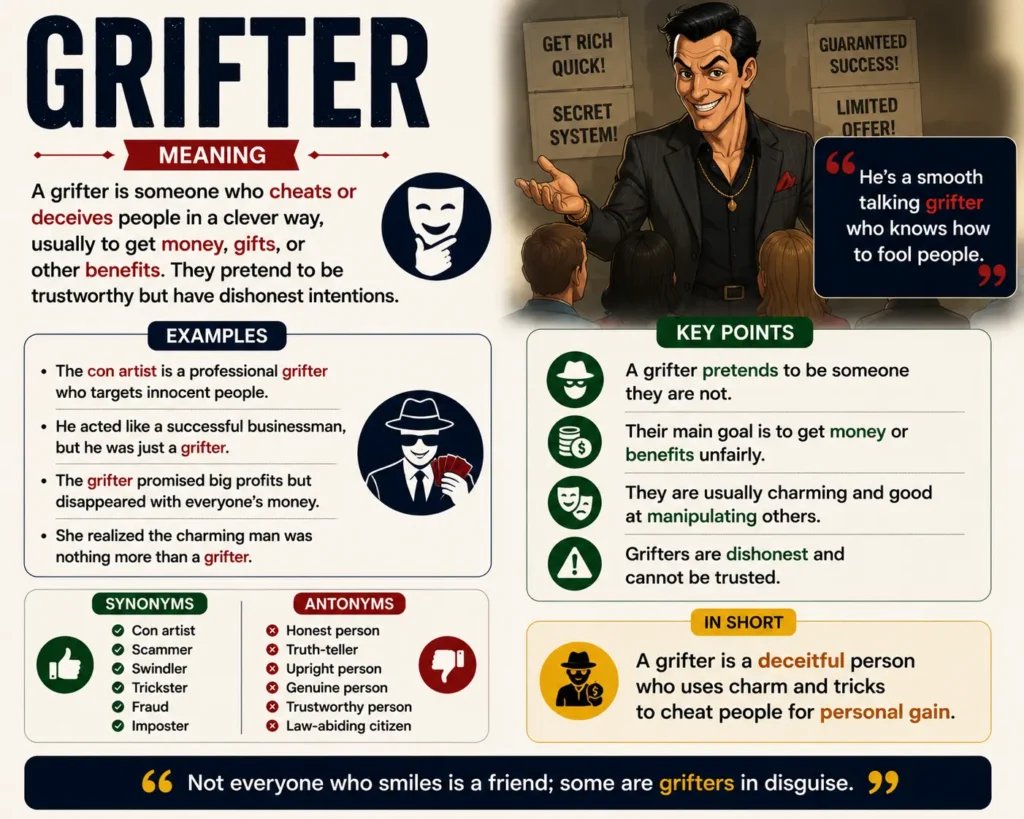
A grifter meaning is someone who tricks people out of money or trust through scams, cons, or dishonest schemes. Grifters often use charm, confidence, and clever lies to gain someone’s trust before taking advantage of them. The word usually describes a pattern of behavior, not just one isolated lie.
Table of Contents
What Does Grifter meaning?
This word describes someone who makes a living, or gains something valuable, by tricking or deceiving other people, usually for money.
It typically involves a pattern of dishonest behavior, not just a single lie or mistake. Someone earning this label usually relies on charm, confidence, and manipulation to earn someone’s trust, before using that trust to take advantage of them.
Here is an easy way to picture it. Imagine someone who shows up in a new town, quickly makes friends, convinces people to invest in a business that doesn’t really exist, and then disappears with their money. That pattern, charm followed by deception followed by disappearing, captures the heart of what this word describes.
It’s worth noting that this behavior is usually deliberate and repeated. Someone who makes one honest mistake isn’t automatically deserving of this label. The word points to a consistent, intentional pattern of deception.
Is Every Dishonest Person a Grifter?
Not exactly. Someone can lie occasionally without fitting this description. This label usually applies to people who build an entire strategy, or even a whole lifestyle, around deceiving others for personal gain, rather than someone who simply told one lie.
Where Does the Word Come From?
Words often carry interesting histories, and this one traces back to American slang from the early 1900s.
It’s believed to come from the verb “to grift,” which described running a con or a swindle, especially among traveling con artists and carnival workers. The exact origin is debated, but many word historians connect it to older slang terms describing small-time criminals and scam artists.
That history still shapes how the word feels today. It carries a slightly old-fashioned, almost theatrical energy, evoking images of smooth-talking swindlers working a crowd, rather than a more modern, faceless type of online scam.
This Word vs Con Artist: What Is the Difference?
These two terms are often used interchangeably, but they carry slightly different flavors.
A con artist is a broader term for anyone who deceives people for personal gain, often through a single, elaborate scheme. This particular word tends to suggest an ongoing lifestyle or pattern of small, opportunistic scams, rather than one big, carefully planned con.
Here is a table to help make the difference clear:
| Feature | This Term | Con Artist |
| Implies an ongoing lifestyle | Often, yes | Not always |
| Usually involves smaller, repeated schemes | Yes | Can be one large scheme |
| Carries an old-fashioned, informal tone | Yes | More neutral, formal tone |
| Involves deliberate deception | Always | Always |
Both terms describe genuine dishonesty, but this word leans toward a pattern of smaller, ongoing scams, while “con artist” can describe either a small-scale or a large, one-time scheme.
Common Tactics Used
Understanding the typical tactics used by someone like this can help you recognize the pattern before it’s too late.
Building fast, fake trust. Someone acting this way often moves quickly to seem likable, trustworthy, or impressive, before asking for anything in return.
Creating urgency. Many schemes rely on pressuring someone to act fast, before they have time to think things through or ask questions.
Name-dropping and false credentials. Claiming fake connections, degrees, or achievements is a common way to appear more trustworthy than they actually are.
Small requests that escalate. A scheme often starts small, like borrowing a little money, before slowly asking for larger and larger amounts over time.
Disappearing when questioned. Someone genuinely acting this way often avoids direct questions, changes the subject, or vanishes entirely once real scrutiny begins.
Examples of This Word Used in a Sentence
Seeing this word in real sentences helps the meaning click faster. Here are several everyday examples.
Example 1 “The documentary followed a grifter meaning who convinced dozens of investors to fund a fake company.”
Example 2 “Neighbors later realized he was a grifter, always borrowing money he never intended to repay.”
Example 3 “She warned her friend that the smooth-talking stranger seemed like a classic grifter.”
Example 4 “The article described the group as small-time grifters running fake charity scams.”
Example 5 “His charming personality made it easy to overlook the grifter meaning tactics hiding underneath.”
Notice how this word almost always appears alongside a specific scheme or pattern of dishonesty, rather than a single vague accusation.
Signs You Might Be Dealing With One
Sometimes it helps to see clear warning signs broken down. Here are common red flags associated with this kind of behavior.
- They seem unusually charming or persuasive, especially early in a relationship.
- Their stories about their past or credentials don’t quite add up.
- They frequently ask for money, favors, or trust, often with a sense of urgency.
- They avoid direct questions or become defensive when pressed for details.
- Other people who trusted them ended up losing money or feeling deceived.
- Their promises rarely seem to match their actual follow-through.
If several of these signs show up together, it’s worth stepping back and looking more closely before trusting the person further.
Common Myths About This Type of Person
Because this word gets thrown around casually, a few myths have grown around it. Here’s what’s actually true.
Myth: “Grifters are always obviously shady.” Truth: Many are extremely charming and likable, which is exactly what makes them effective at deceiving people in the first place.
Myth: “Only uneducated or naive people fall for these schemes.” Truth: Smart, experienced people fall for convincing schemes all the time. Skilled manipulation doesn’t rely on the victim being unintelligent.
Myth: “This only happens with large sums of money.” Truth: Small-scale schemes, involving modest amounts of money or favors, are extremely common and often go unnoticed for a long time.
Myth: “It’s easy to spot one right away.” Truth: Many operate for months or even years before anyone realizes what’s actually happening.
Common Mistakes People Make With This Word
Even a fairly common word like this one gets misused sometimes. Here are a few mistakes worth clearing up.
Mistake 1: Using it for simple mistakes or misunderstandings. This word implies deliberate, repeated deception, not a single honest error or miscommunication.
Mistake 2: Assuming it only applies to strangers. Some of the most damaging schemes come from people already inside someone’s trusted circle, like a friend, coworker, or family member.
Mistake 3: Confusing it with simple rudeness or dishonesty. This label specifically involves deception for personal gain, not just general bad behavior or occasional white lies.
Mistake 4: Assuming a charming personality rules out this label. As covered earlier, charm is often the exact tool that makes someone effective at this kind of deception.
Expert Tips for Protecting Yourself
Fraud experts and financial advisors often share a few simple habits that help people avoid falling for schemes like this.
- Verify claims independently. Don’t rely solely on someone’s word about credentials, connections, or past achievements.
- Slow down before big decisions. Real opportunities rarely require an immediate, pressured decision.
- Watch for inconsistent stories. Details that grifter meaning shift or don’t quite add up are a strong warning sign.
- Trust your gut, but verify with facts. A nagging feeling of doubt is worth investigating further, rather than ignoring.
- Talk to others before committing money. A second opinion from someone outside the situation can spot red flags you might miss.
These small habits help protect people from falling for convincing, well-practiced schemes, without becoming overly suspicious of everyone they meet.
Why Recognizing This Pattern Matters
Understanding dishonest patterns like this one protects real trust, real relationships, and real financial security.
Recognizing manipulation early can carry real emotional benefits, because catching a pattern of deception sooner, rather than later, helps prevent deeper emotional and financial harm down the line.
That idea of protecting real trust connects to something bigger too. Some people carry painful feelings for years after being deceived by someone they once trusted deeply. That is exactly what The Unsent Project is about: a space where people finally share honest, unsent messages, sometimes to someone who once broke their trust.
If you are curious, you can learn how the project actually works, including how these personal messages get submitted and shared with others. Many people also ask whether the project is real, safe, and legit before getting involved, which is a fair and sensible question, especially for anyone who has been burned before.
Each shared message is often paired with a color, and it turns out the colors mean something specific about the feeling behind the words. The project also has a meaningful past, and you can read about the history of The Unsent Project to see how it first began.
If this kind of honest storytelling interests you, there are also other alternatives to The Unsent Project worth exploring. And if you ever want to share your own words, you can always submit your message here.
Recognizing dishonesty ties closely to recognizing honest, trustworthy fidelity in the people around you. Clear, honest communication looks nothing like manipulation. A quick OFC, short for “of course,” settles something instantly, while SMH shows genuine frustration instead of a fake smile. A short TLDR respects someone’s time honestly, and typing SOS is a genuine, urgent call for help, not a manipulative trick. Understanding a platonic friendship, solving a personal enigma, learning what it means to be demisexual or celibate, noticing submissive or condescending behavior, checking someone’s ETA, avoiding a pedantic correction, adding an honest caveat to a promise, understanding an offer that’s contingent on something else, spotting truly diabolical intentions, or asking a simple ASL question all come down to the same idea: honest words build real trust, while dishonest ones only borrow it.
Frequently Asked Questions
What does grifter meaning mean in simple words? It means someone who deceives people out of money or trust through scams, cons, or dishonest schemes.
Is a grifter meaning the same as a scammer? They’re closely related. This word often implies an ongoing lifestyle of smaller schemes, while “scammer” can describe a single act of deception too.
Where does the word grifter meaning come from? It’s believed to come from early 1900s American slang, connected to the verb “to grift,” meaning to run a con or swindle.
Are grifters always easy to spot? No. Many are extremely charming and convincing, which is exactly what allows them to deceive people successfully for a long time.
Can someone close to me, like a friend, be one? Yes. Some of the most damaging schemes come from people already trusted inside someone’s personal or professional circle.
Is it illegal to be a grifter? Many of the specific actions involved, like fraud or theft, are illegal, though the word itself is more of a description than a legal term.
How can I protect myself from someone like this? Verifying claims independently, slowing down before big decisions, and getting a second opinion are all effective, practical protections.
Can this word apply to online scams too? Yes. While the term has older, in-person roots, it’s commonly used today to describe online scams and digital cons as well.
Conclusion
Now you understand the true grifter meaning: someone who deceives others out of money or trust through ongoing scams, charm, and manipulation.
Recognizing this pattern early protects your trust, your relationships, and your finances. The next time you notice the warning signs, unusual charm, urgent requests, or inconsistent stories, you’ll know exactly what you might be dealing with, and exactly how to protect yourself.