Have you ever come across this word in a classic novel or a history book and had to stop and figure out exactly what it meant?
Maybe it showed up describing a wild party in an old story. Maybe it appeared in a description of a historical ruler known for reckless, excessive living. This word carries a strong, dramatic weight, and it shows up often in literature, history, and formal writing.
Understanding debauchery meaning helps you read classic books, historical accounts, and formal writing with real confidence. This guide is for students, readers, and anyone who has come across the word without ever getting a clear, simple explanation. By the end, you will know exactly what it means, where it came from, and how it’s typically used.
Quick Answer
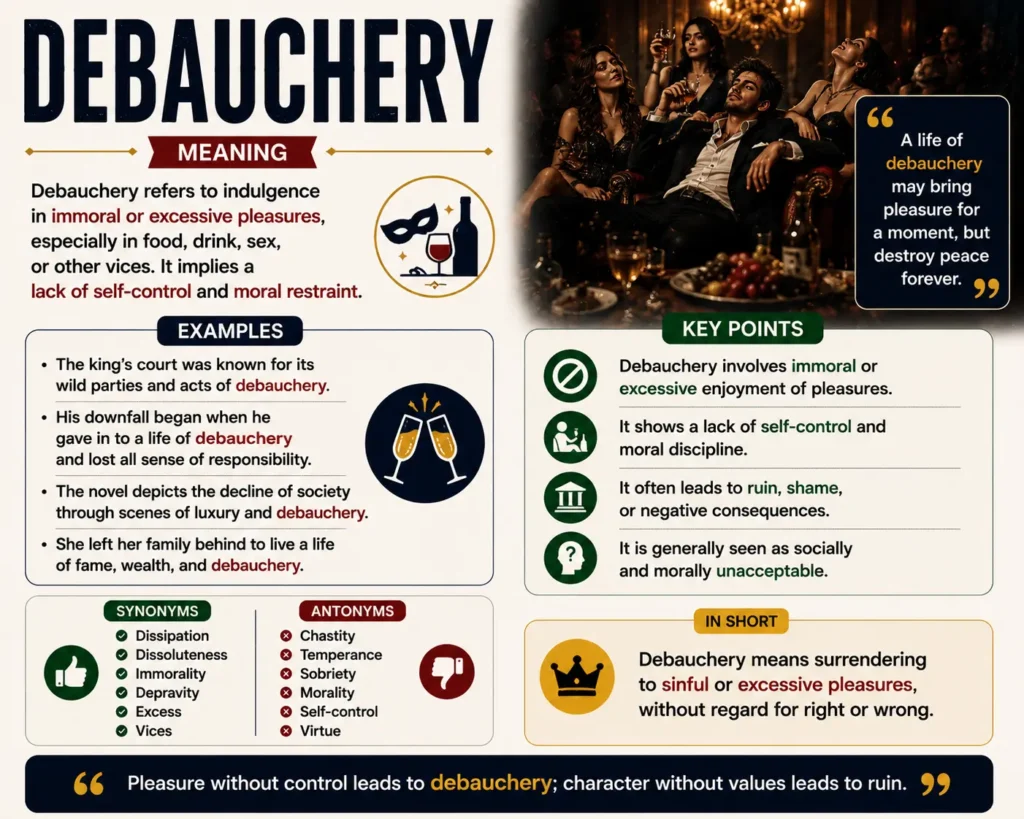
Debauchery meaning describes excessive, reckless indulgence in pleasure, often involving overindulgence in food, drink, or other pleasures, taken to an extreme, harmful degree. It usually suggests a loss of self-control or moral restraint, rather than simple, harmless fun. The word carries a serious, often disapproving tone.
Table of Contents
What Does Debauchery Mean?
This word describes excessive, reckless indulgence in pleasure, usually taken to a harmful or morally questionable extreme.
It often involves things like heavy drinking, excessive partying, or a broader pattern of reckless, pleasure-focused living that ignores responsibility or self-control. The word almost always carries a judgmental or disapproving tone, suggesting the behavior has gone too far.
Here is an easy way to picture it. Imagine a historical account describing a ruler who spent years hosting extravagant, reckless parties, ignoring his responsibilities entirely in favor of endless pleasure and excess. A historian might describe that lifestyle using this exact word, capturing both the excess and the moral disapproval behind it.
It’s worth noting that this word usually describes a pattern of behavior, not a single event. One night of celebration wouldn’t typically earn this label. It’s the extended, repeated nature of the excess that gives the word its full weight.
Where Does the Word Come From?
Words often carry interesting histories, and this one traces back to French and Latin roots.
It comes from the French word “débauche,” which itself came from the Old French verb “desbaucher,” meaning “to lead astray” or “to entice away from duty.” That root ties directly into the modern meaning: someone being led away from responsibility and self-control, into a life of reckless indulgence instead.
That origin helps explain why this word carries such a serious tone. It isn’t just about having fun. It’s specifically about being led away from duty, responsibility, or moral behavior, toward something reckless and excessive instead.
Is Debauchery meaning the Same as Simply Having Fun?
Not quite. Ordinary fun or celebration doesn’t automatically qualify. This word specifically implies excess, recklessness, and often a disregard for consequences or responsibility, going well beyond typical, harmless enjoyment.
Debauchery meaning vs Indulgence: What Is the Difference?
These two ideas are related, but they aren’t quite the same.
Indulgence usually describes allowing yourself a pleasure or treat, often in moderation, like enjoying a rich dessert or taking a relaxing day off. This word describes something far more extreme, involving a loss of control and often serious, lasting consequences.
Here is a table to help make the difference clear:
| Feature | This Word | Indulgence |
| Level of excess | Extreme, often reckless | Moderate, often harmless |
| Implies loss of control | Usually, yes | Not necessarily |
| Carries moral judgment | Almost always | Rarely |
| Common setting | Literature, history, formal writing | Everyday conversation |
Both words describe enjoying pleasure, but this word specifically points to excess that has crossed into recklessness, while indulgence usually stays within a much more reasonable, controlled range.
How This Word Is Used in Literature and History
This word appears frequently in classic literature and historical writing, often describing characters, rulers, or entire eras known for reckless excess.
In classic novels, authors sometimes use this word to describe a character’s downfall, showing how a reckless, pleasure-focused lifestyle eventually leads to real consequences. It often signals a turning point in a story, where a character’s choices catch up with them.
In historical writing, this word frequently describes entire courts, empires, or historical figures known for extravagant, excessive living, especially when that excess contributed to a larger downfall, like the collapse of a kingdom or an empire’s reputation.
Understanding this pattern helps readers recognize the word’s deeper purpose in a story or historical account. It’s rarely just describing a party. It usually signals a much bigger theme about excess, consequences, and moral downfall.
Examples of the Word Used in a Sentence
Seeing this word in real sentences helps the meaning click faster. Here are several everyday examples.
Example 1 “The novel described the count’s descent into debauchery after he inherited his family’s fortune.”
Example 2 “Historians often point to years of debauchery within the royal court as a sign of the coming collapse.”
Example 3 “The character’s reckless debauchery eventually cost him his career and his closest friendships.”
Example 4 “The article criticized the excessive debauchery on display at the exclusive, unregulated event.”
Example 5 “Years of debauchery had clearly taken a toll on his health and his relationships.”
Notice how this word almost always appears alongside real consequences, like lost health, lost relationships, or a larger downfall. That pattern reflects the word’s serious, disapproving tone.
Common Mistakes People Make With This Word
Even a dramatic word like this one gets misused sometimes. Here are a few mistakes worth clearing up.
Mistake 1: Using it for ordinary fun or celebration. A birthday party or a relaxing weekend doesn’t usually qualify. This word specifically implies reckless excess, not typical, harmless enjoyment.
Mistake 2: Assuming it only applies to historical settings. While it appears often in literature and history, the word can absolutely describe modern behavior too, as long as it involves genuine excess and recklessness.
Mistake 3: Overusing it for minor indulgences. Enjoying a second dessert or sleeping in late isn’t dramatic enough for this word. It’s reserved for genuinely excessive, reckless behavior.
Mistake 4: Missing the moral judgment built into the word. Unlike more neutral words like “celebration” or “indulgence,” this word almost always carries real disapproval. Using it casually can unintentionally sound harsher than intended.
Expert Tips for Using Debauchery meaning Correctly
Writers and English teachers often share a few simple tips for using strong, dramatic vocabulary words like this one well.
- Reserve it for genuine excess. Save this word for behavior that’s truly reckless, not everyday fun or relaxation.
- Consider the tone of your writing. Because the word carries real judgment, it fits formal or literary writing better than casual conversation.
- Pair it with specific consequences. Mentioning what the excess actually cost someone helps the word land with real impact.
- Avoid overusing it in the same piece. A word this dramatic works best when it isn’t repeated too often.
- Use it thoughtfully in historical or literary analysis. It’s especially useful for describing patterns of excess tied to a larger downfall or turning point.
These small habits help writers and speakers use the word with real precision, instead of applying it to any minor moment of fun.
Why Strong Words Like This One Matter
Words with real weight, like this one, help writers and speakers capture exactly how serious or extreme a situation truly was.
Choosing precise, accurate words can carry real emotional benefits, because clear language helps people express complicated feelings and situations honestly, instead of settling for a vague description that doesn’t quite capture what actually happened.
That idea of finding exactly the right words connects to something bigger too. Some people carry complicated feelings for years about a relationship or a period of their life that spiraled out of control. That is exactly what The Unsent Project is about: a space where people finally share honest, unsent messages, once they find the right words to describe what really happened.
If you are curious, you can learn how the project actually works, including how these personal messages get submitted and shared with others. Many people also ask whether the project is real, safe, and legit before getting involved, which is a fair and sensible question.
Each shared message is often paired with a color, and it turns out the colors mean something specific about the feeling behind the words. The project also has a meaningful past, and you can read about the history of The Unsent Project to see how it first began.
If this kind of honest storytelling interests you, there are also other alternatives to The Unsent Project worth exploring. And if you ever want to share your own words, you can always submit your message here.
Strong, precise words show up in small, everyday communication too. A quick OFC, short for “of course,” settles something instantly, while SMH captures real frustration in three letters. A short TLDR sums up something long and complicated, and typing SOS makes urgency instantly clear. Understanding a platonic friendship, solving a personal enigma, learning what it means to be demisexual or celibate, noticing submissive or condescending behavior, checking someone’s ETA, avoiding a pedantic correction, adding an honest caveat to a promise, understanding an offer that’s contingent on something else, spotting truly diabolical intentions, valuing real fidelity in a relationship, recognizing a grifter before it’s too late, or asking a simple ASL question all rely on the same basic skill: choosing the right word for exactly what happened.
Frequently Asked Questions
What does debauchery meaning mean in simple words? It means excessive, reckless indulgence in pleasure, usually involving overindulgence in food, drink, or other excesses, taken to a harmful extreme.
Is debauchery meaning the same as having fun? No. Ordinary fun or celebration doesn’t qualify. This word specifically implies recklessness and excess that goes well beyond typical enjoyment.
Where does the word debauchery meaning come from? It comes from a French word meaning “to lead astray” or “to entice away from duty,” tracing further back to Old French roots.
Is this word used in modern writing, or only historical texts? It’s common in historical and literary writing, but it can absolutely describe modern excessive behavior too.
Does debauchery meaning always involve alcohol? Not necessarily. While heavy drinking is a common example, the word can apply to any pattern of reckless, excessive indulgence.
Is it rude to use this word to describe someone? It carries real judgment, so it should be used thoughtfully. It’s a strong, disapproving word, not a neutral or lighthearted one.
What’s the difference between this word and simple indulgence? Indulgence usually describes moderate enjoyment, while this word describes excess that has crossed into recklessness, often with real consequences.
Can a single event be described this way, or does it require a pattern? It usually describes an extended pattern of behavior, rather than a single isolated event, though an especially extreme event can sometimes qualify too.
Conclusion
Now you understand the true debauchery meaning: excessive, reckless indulgence in pleasure, usually involving a serious loss of self-control or moral restraint.
This word carries real weight in literature, history, and formal writing, capturing far more than simple fun or celebration. The next time you come across it in a classic novel or a historical account, you’ll know exactly what it signals, and exactly why the author chose such a strong, dramatic word.