Have you ever felt bored, but in a deeper, heavier way than just “there’s nothing to do”?
Maybe everything around you feels a little flat, even things you usually enjoy. Maybe you’ve read this exact feeling described in a novel, using one specific word that sounds almost as elegant as the feeling itself is heavy. That word shows up often in literature, art, and philosophy, and it captures something regular boredom doesn’t quite reach.
Understanding ennui meaning helps you read classic literature, poetry, and thoughtful writing with real clarity. This guide is for students, readers, and anyone who has come across the word and wanted a clear, simple explanation. By the end, you will know exactly what it means, where it came from, and how it’s typically used.
Quick Answer
ennui meaning describes a deep, heavy feeling of boredom, often paired with a sense that life feels dull, pointless, or unsatisfying. It goes beyond simple boredom, often including restlessness and a vague sense that nothing feels meaningful right now. The word is often used in literature to describe a character’s inner emptiness.
Table of Contents
What Does Ennui Mean?
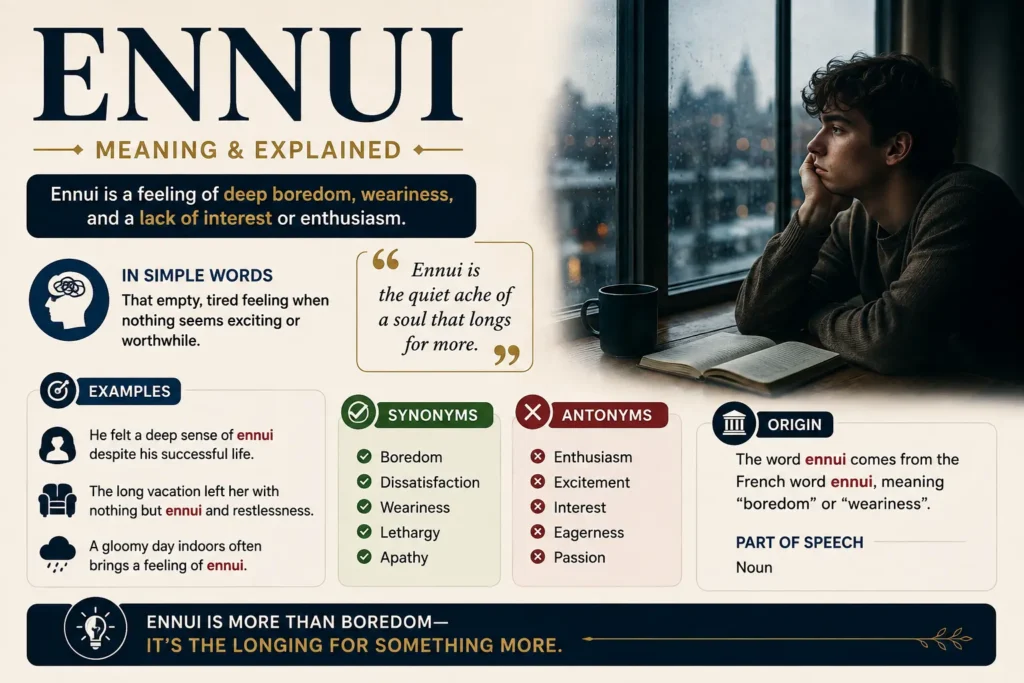
This word describes a deep, lingering feeling of boredom, often mixed with a sense that life feels flat, pointless, or unsatisfying.
It’s more than just having nothing to do. It usually involves a restless, dissatisfied feeling, even when there are plenty of things a person could be doing. Nothing quite feels interesting or meaningful, and that flatness can settle in for hours, days, or sometimes much longer.
Here is an easy way to picture it. Imagine someone who has everything they thought they wanted, a comfortable life, good friends, plenty of free time, but still feels vaguely dissatisfied and restless, unsure why nothing feels exciting anymore. That heavy, hard-to-explain flatness is exactly what this word captures.
It’s worth noting that this word usually describes a mood or a temporary state, not a permanent personality trait. Someone can experience this feeling during a specific season of life, without it defining who they are overall.
Where Does the Word Come From?
Words often carry interesting histories, and this one comes directly from French.
It comes from the French word “ennui,” meaning “boredom” or “annoyance,” which itself traces back to the Old French phrase “enui,” related to the Latin phrase “mihi in odio est,” roughly meaning “it is hateful to me.” Over time, English borrowed the French word directly, keeping both its spelling and its distinctly literary, slightly elegant feel.
That French origin explains why the word still feels a little different from everyday English boredom words. It carries a certain sophistication, often associated with philosophy, poetry, and thoughtful reflection on the emptier moments of life.
Is Ennui the Same as Feeling Lazy?
Not really. Laziness usually describes a lack of motivation to do a specific task. This word describes something deeper: a broader sense that nothing feels meaningful or interesting right now, regardless of motivation or energy levels.
Ennui vs Boredom: What Is the Difference?
These two words are closely related, but they aren’t identical.
Ordinary boredom usually describes a short-term, situational feeling, like waiting in a long line or sitting through a slow class. This word tends to describe something deeper and longer-lasting, often connected to a broader sense that life itself feels flat or unsatisfying, not just one specific moment.
Here is a table to help make the difference clear:
| Feature | This Word | Boredom |
| Typical duration | Longer, sometimes lingering | Usually short-term |
| Depth of feeling | Deeper, often existential | Usually surface-level |
| Common setting | Literature, philosophy, reflection | Everyday conversation |
| Connected to meaning or purpose | Often, yes | Not necessarily |
Both words describe a lack of interest or stimulation, but this word carries a heavier, more reflective weight, often tied to bigger questions about meaning and purpose.
How This Word Is Used in Literature and Art
This word appears often in classic literature, poetry, and philosophy, especially in works exploring deeper questions about meaning and purpose.
Nineteenth-century French writers, in particular, used this word frequently to describe characters experiencing a kind of restless emptiness, despite having comfortable lives. It became closely associated with certain literary movements that explored themes of alienation, dissatisfaction, and the search for meaning.
In broader art and philosophy, this word is often discussed alongside existential questions, exploring why comfort and success don’t always translate into genuine satisfaction or purpose. Writers use it to capture a very specific, recognizable kind of emotional flatness that simpler words like “boredom” don’t fully express.
Recognizing this word in literature often signals a deeper theme the author is exploring, rather than a passing, surface-level mood.
Examples of the Word Used in a Sentence
Seeing this word in real sentences helps the meaning click faster. Here are several everyday examples.
Example 1 “Despite his wealth and success, a deep sense of ennui meaning followed him through every comfortable day.”
Example 2 “The novel captured the character’s ennui meaning perfectly, describing her restless dissatisfaction with an otherwise pleasant life.”
Example 3 “After weeks of the same routine, a quiet ennui meaning settled over the entire office.”
Example 4 “The poem explored themes of ennui, describing a life that felt technically full but emotionally empty.”
Example 5 “She described her Sunday afternoons with a strange sense of ennui, restless but unmotivated to change anything.”
Notice how this word almost always appears alongside a contrast, comfort paired with dissatisfaction, or fullness paired with emptiness. That contrast is part of what gives the word its distinctive emotional weight.
Common Mistakes People Make With This Word
Even a well-known literary word like this one gets misused sometimes. Here are a few mistakes worth clearing up.
Mistake 1: Using it for simple, short-term boredom. Waiting for a bus or sitting through a slow meeting doesn’t usually reach the depth this word implies. It’s reserved for something heavier and longer-lasting.
Mistake 2: Mispronouncing the word. The word is pronounced “ahn-WEE,” with emphasis on the second syllable, not “EN-oo-ee” as some readers might guess from the spelling.
Mistake 3: Assuming it always signals something seriously wrong. While the feeling can be uncomfortable, experiencing this mood occasionally is a normal part of being human, not automatically a sign of a deeper problem.
Mistake 4: Overusing it in casual conversation. Because this word carries a formal, literary tone, using it constantly in everyday chatting can sound overly dramatic. Simpler words like “restless” or “bored” often fit casual conversation better.
Expert Tips for Using Ennui Correctly
Writers and English teachers often share a few simple tips for using elegant, literary vocabulary words like this one well.
- Save it for deeper, longer-lasting feelings. Reserve this word for genuine emotional flatness, not brief, situational boredom.
- Pair it with contrast. Mentioning comfort alongside dissatisfaction helps the word land with its full emotional weight.
- Practice the pronunciation. Getting “ahn-WEE” right helps the word feel natural rather than awkward in conversation.
- Use it thoughtfully in reflective or literary writing. It fits beautifully in personal essays, poetry, or thoughtful analysis.
- Avoid stacking it with too many similar words. Using “boredom,” “restlessness,” and this word all in one sentence can feel repetitive rather than precise.
These small habits help writers and speakers use the word with real precision, instead of reaching for it every time they simply feel a little bored.
Coping With the Feeling Behind the Word
Understanding this word matters beyond vocabulary, since the feeling itself is genuinely common and worth understanding.
Recognizing and naming a feeling like this can carry real emotional benefits, because putting a clear word to a vague, uncomfortable mood often makes it easier to understand and work through, rather than just sitting with an unnamed, unsettled feeling.
That idea of naming complicated feelings connects to something bigger too. Some people carry a quiet sense of restlessness or unfinished business for years, without ever fully putting it into words. That is exactly what The Unsent Project is about: a space where people finally share honest, unsent messages, once they find the words for feelings that had been sitting unspoken for a long time.
If you are curious, you can learn how the project actually works, including how these personal messages get submitted and shared with others. Many people also ask whether the project is real, safe, and legit before getting involved, which is a fair and sensible question.
Each shared message is often paired with a color, and it turns out the colors mean something specific about the feeling behind the words. The project also has a meaningful past, and you can read about the history of The Unsent Project to see how it first began.
If this kind of honest storytelling interests you, there are also other alternatives to The Unsent Project worth exploring. And if you ever want to share your own words, you can always submit your message here.
Naming a feeling clearly, whether it’s this word or something else, connects to how people communicate more broadly. A quick OFC, short for “of course,” settles something instantly, while SMH captures real frustration in three letters. A short TLDR sums up something long and complicated, and typing SOS makes urgency instantly clear. Understanding a platonic friendship, solving a personal enigma, learning what it means to be demisexual or celibate, noticing submissive or condescending behavior, checking someone’s ETA, avoiding a pedantic correction, adding an honest caveat to a promise, understanding an offer that’s contingent on something else, spotting truly diabolical intentions, valuing real fidelity in a relationship, recognizing a grifter before it’s too late, understanding a life of reckless debauchery, or asking a simple ASL question all rely on the same basic skill: putting the right word to exactly what’s really going on.
Frequently Asked Questions
What does ennui mean in simple words? It means a deep, lingering feeling of boredom, often mixed with a sense that life feels flat or unsatisfying.
How do you pronounce ennui? It’s pronounced “ahn-WEE,” with the emphasis on the second syllable.
Is ennui the same as regular boredom? Not quite. This word describes something deeper and longer-lasting, often tied to a broader sense that life lacks meaning or purpose right now.
Where does the word ennui come from? It comes directly from French, originally meaning “boredom” or “annoyance,” with roots tracing back to Old French and Latin.
Is feeling this way a sign that something is seriously wrong? Not necessarily. Occasional restlessness or flatness is a normal part of life, though a lasting, heavy version of this feeling is worth paying attention to.
Why do writers use this word so often in literature? It captures a very specific, recognizable emotional state that simpler words like “boredom” don’t fully express, especially in stories exploring deeper themes.
Can someone feel this way even with a comfortable, successful life? Yes. In fact, that contrast, comfort paired with restlessness, is a classic and common way this word gets used in literature and real life.
Is it okay to use this word in everyday conversation? Yes, though it carries a formal, literary tone, so simpler words like “restless” or “bored” often fit more casual conversations better.
Conclusion
Now you understand the true ennui meaning: a deep, lingering sense of boredom, often paired with restlessness and a feeling that life lacks meaning right now.
This word captures something simpler words like “bored” just can’t quite reach. The next time you notice that heavy, flat feeling, even during an otherwise comfortable moment, you’ll know exactly the right word to describe it.