Have you seen the letters TLDR at the top of a long post or email? Maybe you scrolled past it without knowing what it meant.
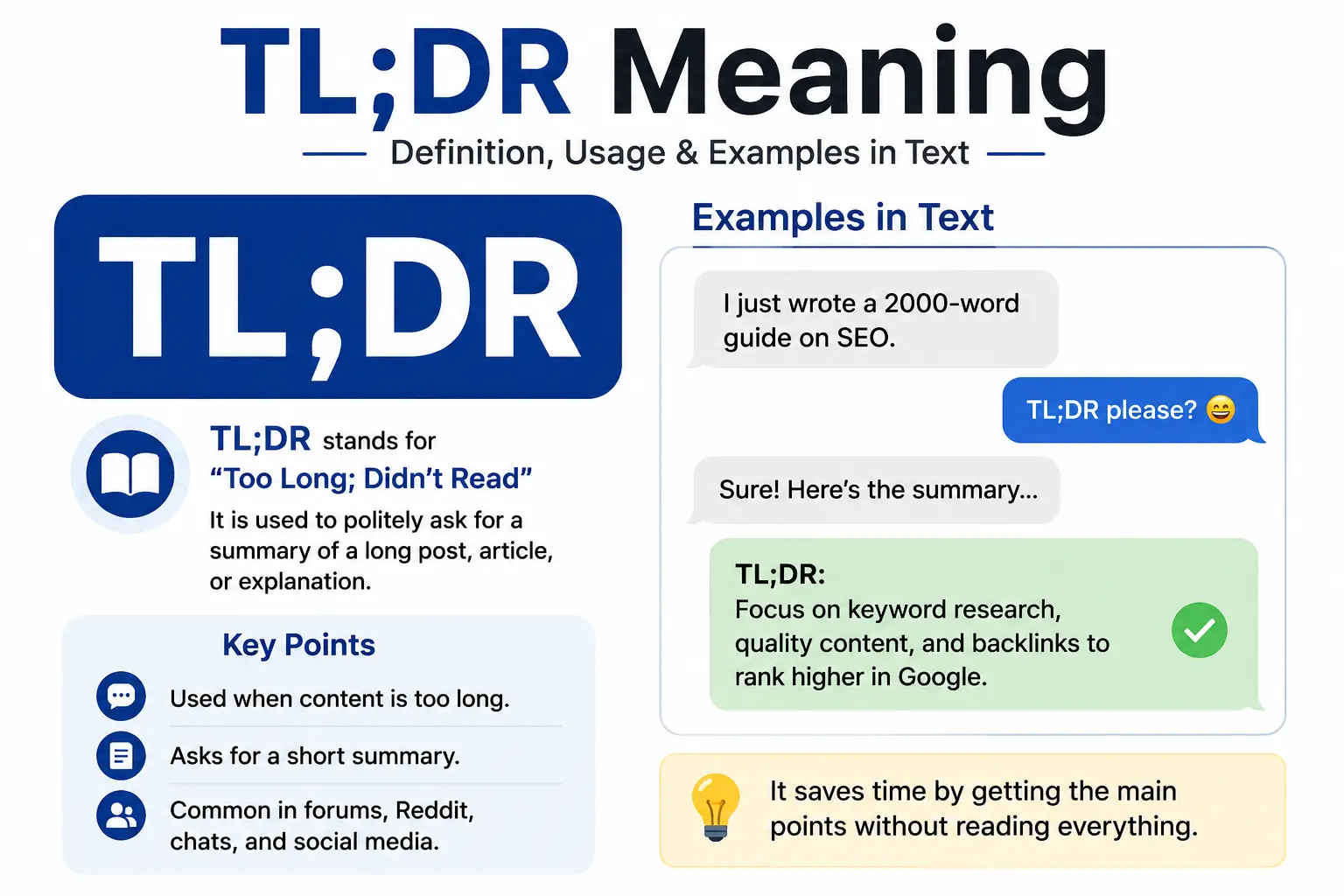
The tldr meaning is simple. It stands for “too long, didn’t read.” People use it to give a short summary before a long piece of writing.
This guide is for anyone who has ever felt confused by internet abbreviations. You will learn where TLDR came from, how people use it today, and how to write your own.
Quick Answer
TLDR means “too long; didn’t read.” It is used before a short summary of a longer text. Writers add a TLDR so readers can get the main point fast, without reading every word.
Table of Contents
The History of TLDR Meaning
TLDR did not start as a nice thing to say. It actually began as a complaint.
Origin: A Programmer’s Complaint
In the early 2000s, online forums were full of long text posts. Some posts were so long that readers got bored halfway through. People started typing “tl;dr” as a joke. It meant, “This post was too long, so I didn’t read it.”
The term became popular on sites used by programmers and tech workers. These communities loved short, direct language. TLDR fit perfectly.
Evolution Timeline
Here is how TLDR changed over time:
| Time Period | How TLDR Was Used |
| Early 2000s | A joking complaint about long forum posts |
| Mid 2000s | Used to poke fun at people who wrote too much |
| 2010s | Adopted as a helpful summary tool by writers |
| Today | A normal part of emails, articles, and social posts |
Over time, TLDR changed from an insult into a helpful writing tool. Now, adding a TLDR to your own writing is seen as considerate, not lazy.
How to Use TLDR
TLDR works in many types of writing. Here are three common situations.
Scenario 1: Email Opening
Long work emails can be hard to read. Adding a TLDR at the top helps busy readers get the point fast.
Example: “TLDR: The meeting moved to Friday at 2 PM. Please confirm by Wednesday.”
The reader now knows the most important detail immediately.
Scenario 2: Article Summary
Bloggers and news writers often place a tldr meaning near the top of long articles. It works like a quick answer box.
Example: “TLDR: Drinking enough water each day helps your body work better and improves focus.”
Readers who are in a hurry can grab the main idea and move on.
Scenario 3: Video Content
Some YouTube creators write a tldr meaning in their video description. It tells viewers what the video covers before they watch.
Example: “TLDR: This video shows three easy ways to save money on groceries.”
This helps viewers decide if the video is worth their time.
Test Your TLDR Knowledge
What does TLDR stand for?
TLDR stands for “too long; didn’t read.” It is used to introduce a short summary of a longer piece of writing. If you remember this phrase, you will always know what TLDR means when you see it online.
Similar Internet Slang
TLDR is not the only short-form phrase online. Here are a few related terms:
| Term | Meaning |
| ELI5 | “Explain like I’m 5” — asking for a very simple explanation |
| IMO | “In my opinion” |
| FYI | “For your information” |
| SMH | “Shaking my head” — often used to show disbelief or disappointment. If you want to learn more about this one, check out our full SMH meaning guide. |
| BRB | “Be right back” |
These short phrases all share one goal. They save time for both the writer and the reader.
Common Mistakes People Make with TLDR
Even simple slang can be used the wrong way. Here are common mistakes:
- Making the TLDR too long. A TLDR should be one or two sentences, not a whole paragraph.
- Placing it in the wrong spot. A TLDR belongs at the top, not buried at the end.
- Leaving out the main point. A TLDR should answer the biggest question the text raises.
- Using it as an insult. Saying “tldr” as a reply to someone’s message can feel rude. Use it carefully in conversations.
Tips for Writing a Great TLDR
Writing a clear tldr meaning takes a little practice. Here are expert tips to help:
- Read your full text first. Know what the main point is before summarizing it.
- Keep it under 30 words. Short and clear works best.
- Answer “what happened” or “what should I know.” Focus on the core message.
- Avoid extra details. Save examples and explanations for the full text.
- Place it right after the title. Readers should not have to search for it.
Quick Checklist
- ✔ Is it one or two sentences?
- ✔ Does it cover the main point?
- ✔ Is it placed near the top?
- ✔ Does it avoid confusing words?
If you can check all four boxes, your TLDR is ready.
Frequently Asked Questions
What does TLDR mean in a text message?
In a text message, tldr meanings the sender is giving a short summary of a longer story or explanation. It helps the reader understand the point quickly.
Is TLDR rude to use?
It depends on the context. Adding a tldr meaning to your own long writing is helpful, not rude. But replying “tldr” to someone else’s message can feel dismissive.
How do you write a TLDR?
Read the full text first. Then write one or two short sentences that explain the main point. Place it at the very top of your writing.
What is the difference between TLDR and a summary?
A TLDR is a very short version of a summary. A regular summary can be several sentences or a paragraph. A tldr meaning is usually just one or two lines.
Can TLDR be used in school or work writing?
TLDR is casual language. It works well in emails and blog posts, but it should be avoided in formal essays or official reports.
Where did the term TLDR come from?
tldr meaning started on internet forums in the early 2000s. People used it to joke about posts that were too long to read.
Is TLDR still used in 2026?
Yes. tldr meaning is still widely used in emails, articles, videos, and social media posts today.
Writing Your Own TLDR
If you have a long message, email, or article, try writing a tldr meaning before you send it. Ask yourself: “If someone only read one sentence, what should it say?”
Start with that one sentence. Place it at the top. Then let the rest of your writing explain the details. This small habit makes your writing easier to read and more respectful of your reader’s time.
Conclusion
Now you know the full tldr meaning. It stands for “too long; didn’t read,” and it is used to give readers a short summary before a longer piece of writing.
You learned where TLDR came from, how to use it in emails, articles, and videos, and how to write a clear one yourself. You also learned common mistakes to avoid.
The next time you write something long, try adding your own tldr meaning at the top. It is a small habit that makes a big difference for your readers.