Have you ever had a moment where something suddenly clicked, and you understood something important that had confused you for a long time?
Maybe it happened during a quiet walk, in the middle of a conversation, or even in a dream. One second things felt unclear, and the next second, everything made sense. There’s a specific word for that sudden burst of understanding, and it captures something far more powerful than just a regular idea.
Understanding epiphany meaning helps you describe those powerful, sudden moments of realization with real precision. This guide is for curious readers, students, and anyone who has experienced or heard about this feeling and wanted a clear explanation. By the end, you will know exactly what it means, where it came from, and how it’s typically used.
Quick Answer
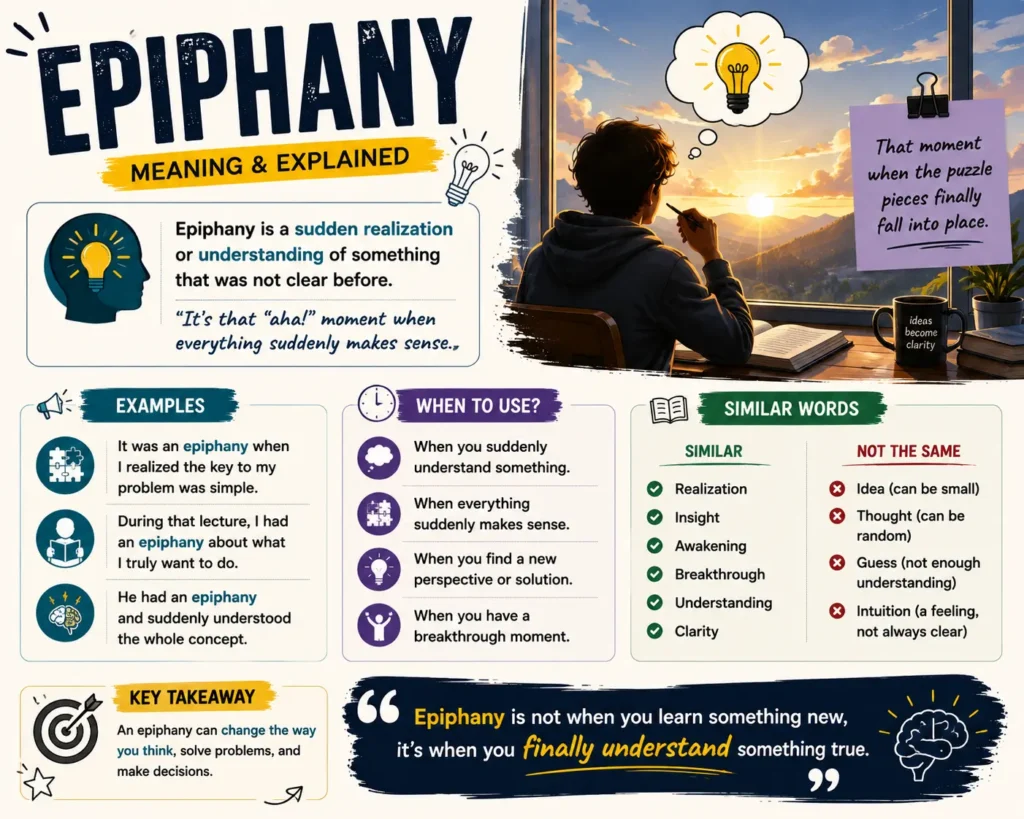
An epiphany meaning is a sudden, powerful realization or moment of clear understanding, often about something important in life. It usually arrives unexpectedly, feeling like a flash of insight rather than a slow, gradual process. The word can describe both everyday realizations and deeply meaningful, life-changing moments.
Table of Contents
What Does Epiphany Mean?
This word describes a sudden, powerful realization, often bringing clarity about something that felt confusing or unclear just moments before.
It usually arrives unexpectedly, without any obvious warning, and often feels emotionally significant, not just intellectually interesting. The insight can be small, like suddenly understanding a tricky math concept, or massive, like realizing exactly what you want to do with your entire life.
Here is an easy way to picture it. Imagine struggling with a difficult decision for weeks, feeling stuck and unsure. Then, out of nowhere, while doing something completely unrelated like washing dishes, the answer suddenly feels obvious and clear. That flash of sudden clarity captures exactly what this word describes.
It’s worth noting that this word usually implies real significance. A small, forgettable thought wouldn’t typically earn this label. It’s reserved for realizations that feel genuinely important or transformative in some way.
Where Does the Word Come From?
Words often carry fascinating histories, and this one traces back to ancient Greek.
It comes from the Greek word “epiphaneia,” meaning “manifestation” or “appearance,” which itself combines “epi,” meaning “upon” or “toward,” with “phainein,” meaning “to show” or “to appear.” Put together, the original idea was something suddenly appearing or becoming visible, which closely matches the modern meaning of a sudden flash of understanding.
That Greek origin explains why the word carries such a significant, almost dramatic weight. It isn’t just about a small idea appearing. It’s about something important suddenly becoming clear and visible, as if it had been hidden just out of sight the whole time.
This Word in Religious Tradition
This word also has a specific, well-known meaning within Christian tradition, referring to a celebrated event and holiday.
In this context, the word refers to the manifestation, or revealing, of Jesus Christ to the world, traditionally celebrated on January 6th. This religious holiday specifically commemorates the visit of the Magi, who traveled to see the infant Jesus, representing his recognition beyond his immediate community.
Is the Religious Meaning the Same as the Everyday Meaning?
Not exactly, though they’re closely connected. Both meanings share the core idea of something significant suddenly being revealed or understood. The everyday, more common use describes a personal flash of insight, while the religious use refers to a specific historical and spiritual event within Christian tradition.
This Word vs Realization: What Is the Difference?
These two words are related, but they aren’t quite interchangeable.
A realization can be reached gradually, through careful thought, research, or slow reflection over time. This word specifically implies suddenness and real emotional weight, arriving quickly and often unexpectedly, rather than through a slow, deliberate process.
Here is a table to help make the difference clear:
| Feature | This Word | Realization |
| Speed of understanding | Sudden, quick | Can be slow or gradual |
| Emotional weight | Usually significant | Can be minor or major |
| Common trigger | Unexpected, often unrelated moment | Deliberate thought or research |
| Sense of surprise | Almost always present | Not necessarily |
Both words describe gaining new understanding, but this word specifically points to a fast, surprising, emotionally significant flash of insight, rather than a slow, steady conclusion.
How These Moments Actually Happen
Psychologists and researchers have studied how sudden insights tend to occur, and a few common patterns show up again and again.
During unrelated activities. Many people report sudden insights while doing something completely unrelated to the problem, like showering, walking, or driving, when the mind isn’t actively focused on solving anything.
After stepping away from a problem. Taking a break from actively trying to solve something often allows the brain to keep processing in the background, sometimes leading to a sudden burst of clarity later.
Following a period of confusion or struggle. These sudden realizations often follow a stretch of genuine difficulty or uncertainty, making the eventual clarity feel especially powerful by contrast.
Through unexpected connections. Sometimes a completely unrelated piece of information suddenly connects two ideas that hadn’t seemed related before, sparking sudden understanding.
Understanding this pattern helps explain why these moments often feel like they come out of nowhere, even though the mind may have actually been working on the problem the entire time, just below conscious awareness.
Examples in a Sentence
Seeing this word in real sentences helps the meaning click faster. Here are several everyday examples.
Example 1 “She had a sudden epiphany meaning while driving home, realizing exactly what career path felt right for her.”
Example 2 “His epiphany meaning came in the middle of the night, and he woke up knowing exactly how to fix the broken code.”
Example 3 “The character’s epiphany meaning in the final chapter completely changed how he treated the people around him.”
Example 4 “I had a small epiphany meaning about my own habits after reading that one paragraph.”
Example 5 “The scientist described her epiphany meaning as the missing piece that finally connected years of confusing research.”
Notice how this word almost always appears alongside a clear “before and after” contrast, confusion followed by sudden clarity. That contrast is part of what gives the word its emotional weight.
Common Mistakes People Make With This Word
Even a well-known word like this one gets misused sometimes. Here are a few mistakes worth clearing up.
Mistake 1: Using it for minor, forgettable thoughts. A quick, small idea about what to eat for lunch doesn’t usually deserve this word. It’s reserved for something with genuine significance or emotional weight.
Mistake 2: Assuming it always happens instantly, with no buildup. While the moment itself feels sudden, it often follows a longer period of unconscious thinking or genuine struggle, even if that process wasn’t obvious at the time.
Mistake 3: Confusing it with a simple fact you learned. Learning a new fact isn’t quite the same as this word. It specifically implies a shift in understanding, not just gaining new information.
Mistake 4: Overusing it in everyday conversation. Because this word carries real significance, using it too casually for every small realization can weaken its impact over time.
Expert Tips for Recognizing and Using Insight
Psychologists and writers alike share a few simple tips for recognizing and capturing these moments effectively.
- Pay attention during unrelated activities. Sudden insight often shows up during quiet, unfocused moments, like walking or showering.
- Write it down immediately. These flashes of clarity can fade quickly, so capturing the thought right away helps preserve it.
- Give yourself breaks from hard problems. Stepping away, rather than forcing an answer, often allows the mind to keep working in the background.
- Reserve the word for genuinely significant moments. Save it for realizations that carry real emotional or practical weight.
- Reflect on what led up to the moment. Understanding the confusion or struggle that came before often makes the insight feel even more meaningful.
These small habits help both writers and everyday thinkers recognize, capture, and describe these powerful moments accurately.
Why Sudden Understanding Matters
Moments of sudden clarity shape how people make decisions, change habits, and understand themselves more deeply.
Recognizing and naming a powerful realization can carry real emotional benefits, because putting clear language to a sudden shift in understanding often helps people act on that insight, rather than letting it fade away unexamined.
That idea of sudden clarity connects to something bigger too. Some people spend years carrying confusing, unresolved feelings about a relationship or a decision, waiting for that same kind of clarity to finally arrive. That is exactly what The Unsent Project is about: a space where people finally share honest, unsent messages, often after finally understanding exactly what they needed to say all along.
If you are curious, you can learn how the project actually works, including how these personal messages get submitted and shared with others. Many people also ask whether the project is real, safe, and legit before getting involved, which is a fair and sensible question.
Each shared message is often paired with a color, and it turns out the colors mean something specific about the feeling behind the words. The project also has a meaningful past, and you can read about the history of The Unsent Project to see how it first began.
If this kind of honest storytelling interests you, there are also other alternatives to The Unsent Project worth exploring. And if you ever want to share your own words, you can always submit your message here.
Small, precise words help capture sudden clarity in everyday communication too. A quick OFC, short for “of course,” settles something instantly, while SMH captures real frustration in three letters. A short TLDR sums up something long, and typing SOS makes urgency instantly clear. Understanding a platonic friendship, solving a personal enigma, learning what it means to be demisexual or celibate, noticing submissive or condescending behavior, checking someone’s ETA, avoiding a pedantic correction, adding an honest caveat to a promise, understanding an offer that’s contingent on something else, spotting truly diabolical intentions, valuing real fidelity in a relationship, recognizing a grifter before it’s too late, understanding a life of reckless debauchery, naming a heavy feeling of ennui, sharing something only certain people will fully understand, saying inshallah about hopeful future plans, sending a quick wtw check-in, describing a truly surreal moment, sharing an opinion with a quick imo, staying nonchalant about big news, or asking a simple ASL question all rely on the same basic skill: finding the right words the moment clarity finally arrives.
Frequently Asked Questions
What does epiphany mean in simple words? It means a sudden, powerful realization or moment of clear understanding, often about something important.
Is an epiphany meaning always religious? No. While the word has a specific meaning within Christian tradition, it’s most commonly used to describe an everyday personal moment of sudden insight.
Where does the word epiphany meaning come from? It comes from Greek, meaning “manifestation” or “appearance,” originally describing something suddenly becoming visible or clear.
Can an epiphany meaning be about something small? Yes, though the word usually implies real significance, whether the realization is life-changing or simply meaningful in a smaller, personal way.
Why do epiphanies often happen during unrelated activities? Stepping away from actively trying to solve a problem often allows the brain to keep processing in the background, sometimes leading to sudden clarity later.
Is an epiphany meaning the same as a realization? They’re closely related, but this word specifically implies suddenness and emotional weight, while a realization can happen slowly and gradually.
What is Epiphany as a religious holiday? It’s a Christian holiday, traditionally celebrated on January 6th, commemorating the revealing of Jesus Christ to the world through the visit of the Magi.
Can writers use epiphanies in stories? Yes, very often. A character’s epiphany is a common storytelling device, marking a turning point where a character suddenly understands something important.
Conclusion
Now you understand the true epiphany meaning: a sudden, powerful realization or flash of clear understanding, often about something genuinely important.
Whether it arrives during a quiet walk, in the middle of a conversation, or completely out of nowhere, this word captures one of the most memorable, meaningful kinds of human experience. The next time everything suddenly clicks into place, you’ll know exactly the right word to describe it.