Have you ever seen a comment or text that started with “iirc” and wondered exactly what your friend was trying to say?
Maybe it showed up right before someone shared a fact they weren’t totally sure about. Maybe it appeared in a group chat, softening a statement that could have sounded more certain than it actually was. This short abbreviation shows up constantly online, and once you understand it, you’ll immediately catch the honest, careful tone behind it.
Understanding iirc meaning helps you read texts, comments, and online discussions with the right level of confidence. This guide is for anyone who has seen the term and wanted a clear, simple explanation. By the end, you will know exactly what it stands for, where it came from, and how to use it naturally.
Quick Answer
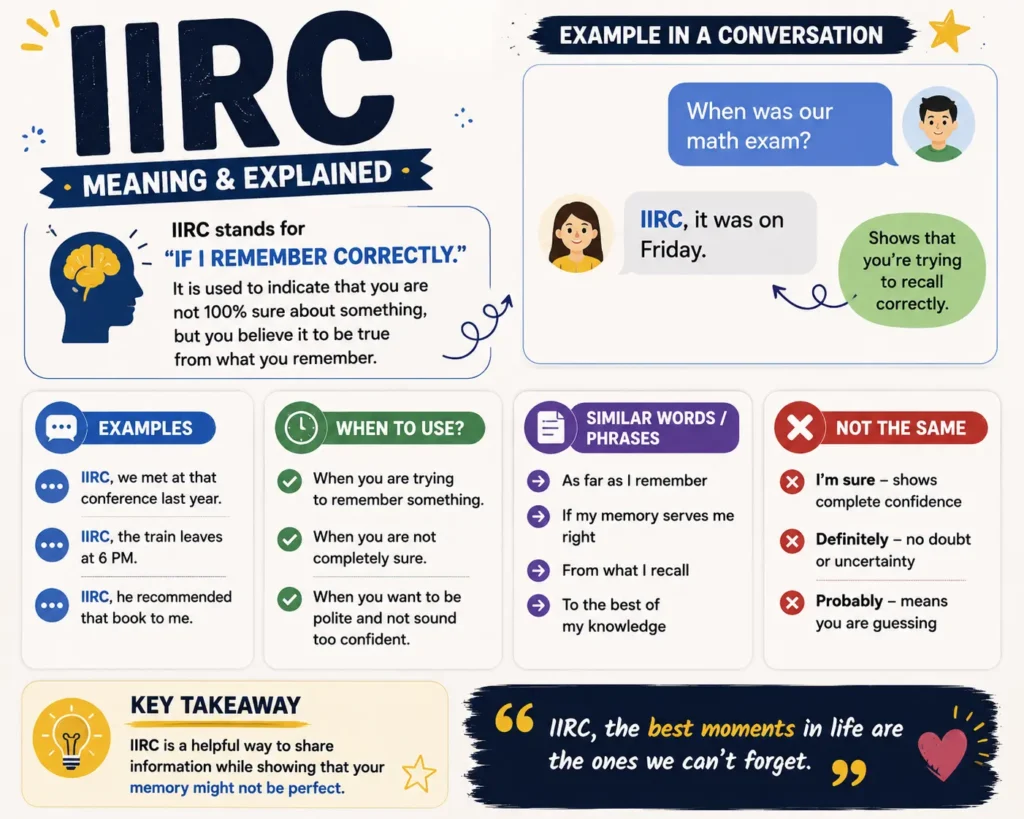
IIRC stands for “If I Recall Correctly.” People use it to signal that what they’re about to say is based on memory, not a confirmed fact, and might not be perfectly accurate. It’s a quick, honest way to share information while admitting there’s a chance you could be slightly wrong.
Table of Contents
What Does IIRC Stand For?
This abbreviation stands for “If I Recall Correctly.”
It’s a short, honest way of letting someone know that a statement comes from memory, rather than something you’ve double-checked or confirmed. Adding this small phrase before a fact or detail signals humility right from the start, letting the reader know there’s a small chance of a mistake.
Here is an easy way to picture it. Imagine someone commenting, “iirc, that movie came out in 2015.” That short abbreviation immediately signals: this is a memory, not a guaranteed fact. It softens the statement and invites correction, rather than sounding like a confident, checked answer.
It’s worth noting that this abbreviation works well in both casual conversations and slightly more serious discussions, like debates, trivia, or fact-based comment threads.
Where Did This Abbreviation Come From?
Abbreviations like this one grew naturally out of early internet forums and chat platforms, where people needed quick ways to communicate honestly and efficiently.
Because typing was slower on many early platforms, and because online conversations often involved sharing facts or details from memory, users developed shorthand phrases that clearly signaled uncertainty without needing a long explanation. This particular abbreviation became especially popular because it solved a real, common problem: letting people share helpful information honestly, without claiming to be completely certain.
As texting and social media grew, this abbreviation carried over naturally, remaining just as useful and widely recognized today as it was in early online forums.
Is IIRC meaning Only Used Online?
Mostly, yes, though the underlying phrase, “if I recall correctly,” is also commonly spoken out loud in everyday conversation. The shortened, abbreviated version specifically belongs to texting, comments, and online writing.
How to Use This Abbreviation in Text and Online
Using this abbreviation well comes down to placement and honesty.
It typically appears at the very beginning of a sentence, immediately signaling that a personal memory, rather than a confirmed fact, is coming next. It can also appear in the middle or end of a sentence, offering a similar softening effect after the detail has already been shared.
This abbreviation works especially well in situations involving facts, dates, names, or details you’re fairly confident about but haven’t specifically checked. It’s a simple way to stay helpful while remaining honest about the limits of your own memory.
Similar Uncertainty Phrases
This abbreviation shares a lot in common with other phrases people use to signal uncertainty, though small differences in tone do exist.
“I think” is a broader, more general way to express uncertainty about almost anything. “Correct me if I’m wrong” invites direct correction more explicitly. This particular abbreviation feels a bit more specific, focused on memory rather than general uncertainty or opinion.
Here is a table comparing a few similar phrases:
| Phrase | Focuses On | Common Setting |
| IIRC | Memory-based facts | Texts, comments, online discussions |
| I think | General uncertainty or opinion | Casual conversation |
| Correct me if I’m wrong | Inviting direct correction | Discussions, debates |
| AFAIK | Limits of personal knowledge | Texts, comments, forums |
All of these phrases share the same basic goal: communicating honestly about the limits of what someone actually knows or remembers.
Examples of This Term Used in a Sentence
Seeing this abbreviation in real sentences helps the meaning click faster. Here are some everyday examples.
Example 1 “Iirc, the meeting got moved to Thursday, but you should double-check.”
Example 2 Comment on a trivia post: “iirc meaning that actor also played the villain in the sequel”
Example 3 Text message: “iirc meaning your birthday is next week, right?”
Example 4 Group chat: “iirc meaning we already paid the deposit for that trip”
Example 5 Forum comment: “iirc meaning the update fixed that bug, but I could be thinking of a different version”
Notice how this abbreviation almost always appears right alongside a specific fact or detail, immediately signaling that the information comes from memory, not confirmed research.
Common Mistakes People Make With This Term
Even a simple, common abbreviation like this one gets misused sometimes. Here are a few mistakes worth clearing up.
Mistake 1: Using it before something you’re completely certain about. Adding this abbreviation before a well-confirmed fact can create unnecessary doubt about information you actually know for sure.
Mistake 2: Assuming it excuses being consistently inaccurate. While it signals honest uncertainty, repeatedly sharing incorrect information, even with this abbreviation attached, can still affect how much people trust what you say.
Mistake 3: Overusing it in every single sentence. Adding it to nearly every statement in a longer message can feel repetitive, rather than genuinely clarifying which specific details are uncertain.
Mistake 4: Confusing it with similar-looking abbreviations. Because texting shorthand can look similar across different terms, double-checking context helps avoid mixing this one up with something else entirely.
Expert Tips for Using It Naturally
Communication experts and casual internet users alike tend to agree on a few simple habits that help this abbreviation land well.
- Use it when sharing genuine memories, not guesses. This keeps the abbreviation accurate and meaningful.
- Place it right before the uncertain detail. This keeps the signal clear and easy to understand.
- Don’t rely on it to avoid fact-checking entirely. It’s meant to add honesty, not replace verifying important information when accuracy really matters.
- Pair it with a quick note if needed. Adding “but I could be wrong” alongside it can add extra clarity in more serious conversations.
- Keep it casual. Like most texting shorthand, it fits comments, texts, and casual writing better than formal documents.
These small habits help this abbreviation feel genuine and useful, rather than just an automatic habit.
Why Honest Uncertainty Matters in Communication
Clearly signaling uncertainty helps conversations stay honest and trustworthy, especially in text-based communication where tone and confidence can be easily misread.
Being upfront about the limits of memory or knowledge can carry real emotional benefits, because honest communication builds trust and reduces the chance of spreading confidently stated, but ultimately incorrect, information.
That idea of honest, careful communication connects to something bigger too. Some people hold back honest feelings for years, worried about not remembering every detail perfectly or saying something wrong. That is exactly what The Unsent Project is about: a space where people finally share honest, unsent messages, even when memory or wording isn’t perfectly precise.
If you are curious, you can learn how the project actually works, including how these personal messages get submitted and shared with others. Many people also ask whether the project is real, safe, and legit before getting involved, which is a fair and sensible question.
Each shared message is often paired with a color, and it turns out the colors mean something specific about the feeling behind the words. The project also has a meaningful past, and you can read about the history of The Unsent Project to see how it first began.
If this kind of honest storytelling interests you, there are also other alternatives to The Unsent Project worth exploring. And if you ever want to share your own words, you can always submit your message here.
Clear, honest communication shows up in plenty of other short phrases too. A quick OFC, short for “of course,” settles something instantly, while SMH captures real frustration in three letters. A short TLDR sums up something long, and typing SOS makes urgency instantly clear. Understanding a platonic friendship, solving a personal enigma, learning what it means to be demisexual or celibate, noticing submissive or condescending behavior, checking someone’s ETA, avoiding a pedantic correction, adding an honest caveat to a promise, understanding an offer that’s contingent on something else, spotting truly diabolical intentions, valuing real fidelity in a relationship, recognizing a grifter before it’s too late, understanding a life of reckless debauchery, naming a heavy feeling of ennui, sharing something only certain people will fully understand, saying inshallah about hopeful future plans, sending a quick wtw check-in, describing a truly surreal moment, sharing an opinion with a quick imo, staying nonchalant about big news, recognizing a sudden epiphany, avoiding naive trust, understanding how SMS messages actually travel, emphasizing something with ISTG, joking about being a masochist for choosing something hard, or asking a simple ASL question all rely on the same basic idea: honest, clear words that say exactly what you mean, and exactly how sure you are.
Frequently Asked Questions
What doesiirc meaning stand for? It stands for “If I Recall Correctly,” a quick way of signaling that a statement is based on memory, not a confirmed fact. iirc meaning is one of the most common uncertainty abbreviations online.
Is it the same as saying “I think”? They’re similar, but this abbreviation specifically points to memory, while “I think” can express uncertainty about almost anything, including opinions.
Where did it come from? It grew out of early internet forums and chat platforms, where people needed quick, honest ways to signal uncertainty about facts from memory.
Is it okay to use it in professional writing? It’s best kept casual. Like most texting shorthand, it fits comments, texts, and casual writing better than formal or professional communication.
Does using it mean I shouldn’t double-check my facts? Not necessarily. It’s a good habit for casual conversation, but important or serious information is often still worth verifying separately.
Can it be used for things other than facts, like feelings or opinions? It’s specifically meant for memory-based details, so it fits best with facts, dates, or events rather than personal opinions or feelings.
Is it rude to correct someone after they use it? No, not at all. Using this abbreviation actually invites gentle correction, since the person is already signaling they might be wrong.
What’s a similar abbreviation to IIRC? AFAIK, meaning “as far as I know,” serves a similar honest, uncertainty-signaling purpose to iirc meaning in casual texting and online writing.
Conclusion
Now you understand the true iirc meaning: “If I Recall Correctly,” a quick, honest way of sharing information from memory while admitting there’s room for error.
This small abbreviation plays a real role in keeping online conversations honest and trustworthy. The next time you see it in a comment or text, or want to use it yourself, you’ll know exactly what it means, and exactly how to use it naturally.