Have you ever heard someone say a person “has a calm aura,” or joked that they “lost aura points”? The word “aura” pops up everywhere lately, but it actually carries a few different meanings.
Understanding the aura meaning helps you use the word correctly, whether you are talking about someone’s personality, a medical symptom, or the newest slang trend online.
This guide is for anyone curious about the word. Maybe you saw “aura” used online. Maybe someone described a feeling around a place or person using this word. Either way, you are in the right place.
By the end of this guide, you will fully understand the aura meaning, where it comes from, how it is used in medicine, and how it became one of today’s most popular slang words.
Quick Answer
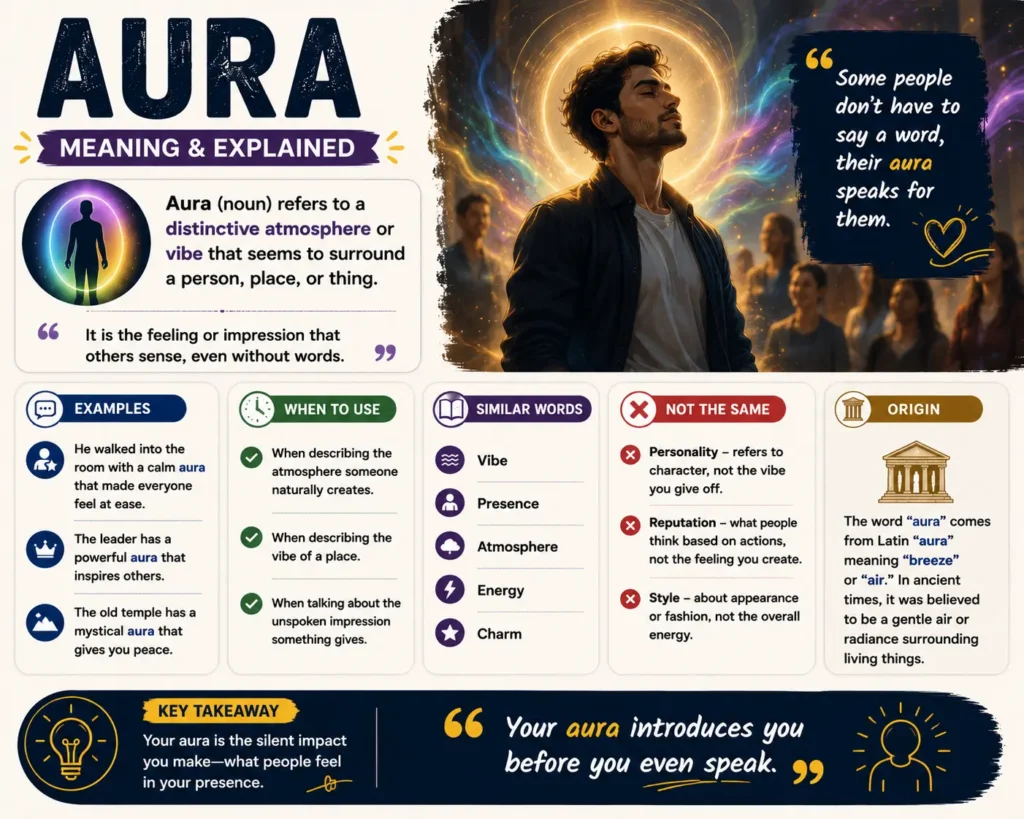
“Aura” describes a distinct feeling or atmosphere that seems to surround a person, place, or thing. It can describe a personality vibe, like a calm or confident aura. It also has a medical meaning, describing a warning sensation before a migraine or seizure. Recently, it has become popular slang for someone’s overall coolness or charisma.
Table of Contents
What Does “Aura” Mean?
Let’s start with the basics. The aura meaning centers on one core idea: a feeling that surrounds someone or something.
At its simplest, an aura is the overall vibe a person, place, or object seems to give off. It is not something you can touch or measure. It is more like an impression, a mood, or an atmosphere that others sense.
For example, some people describe walking into a quiet library and feeling a peaceful aura. Others might describe a confident coworker as having a strong, commanding aura.
The word also has more specific meanings in medicine and, more recently, in internet slang. Knowing all three helps you understand the word wherever you see it.
Where Does the Word “Aura” Come From?
Every word has a history. Learning where “aura” comes from helps explain its meaning today.
The word comes from the Latin word aura, meaning “breeze” or “breath of air.” That Latin word came from the Greek word aura, which also referred to a gentle wind or breath.
Originally, the word described something light and invisible, like air moving softly around something. Over time, English speakers began using it to describe an invisible feeling or presence surrounding a person or place, much like that gentle, unseen breeze.
This is why “aura” still feels a little mysterious today. It describes something you can sense, but never quite see or touch.
Aura in Everyday Conversation
Beyond formal definitions, “aura” is very common in casual, everyday talk. Here is how it typically shows up.
- Describing personality: “She has such a warm, welcoming aura.”
- Describing a place: “The old library had a peaceful aura.”
- Describing an emotional impression: “There was a tense aura in the room after the argument.”
- Describing confidence or presence: “He walked in with a powerful aura.”
In each case, “aura” points to a feeling that is hard to explain in exact words, but easy to sense.
The Medical Meaning of Aura
Beyond everyday conversation, “aura” also has an important medical meaning.
In medicine, an “aura” refers to early warning symptoms that happen before a migraine or seizure. These symptoms can include seeing flashing lights, noticing strange smells, feeling tingling sensations, or experiencing brief confusion.
For many people who experience migraines, an aura acts like a signal. It lets them know a headache may be coming soon, giving them a chance to rest, find a quiet space, or take medication if their doctor has recommended one.
Safety Note: If you experience new or unusual symptoms like this, especially with strong headaches or sudden vision changes, it is a good idea to talk to a doctor to understand what might be causing them.
The Trending Slang Meaning of Aura
In recent years, “aura” has become extremely popular online, especially among younger generations, with a slightly different meaning.
In slang, “aura” often describes someone’s overall coolness, charisma, or social confidence. People sometimes talk about “aura points,” almost like an invisible scorecard for how impressive or embarrassing someone’s actions are.
- Doing something impressively smooth or confident might “add aura points.”
- Doing something awkward or embarrassing might “lose aura.”
- Someone with strong natural confidence might be described as having “high aura” or simply “aura.”
This modern slang use connects back to the word’s original meaning. It is still about an invisible impression someone gives off, just now measured playfully, almost like a game.
Aura vs. Similar Words
Some words feel close to “aura,” but they are not exactly the same. This table clears up the differences.
| Word | Simple Meaning | Example |
| Aura | An overall feeling or impression surrounding someone or something | “He has a calm, confident aura.” |
| Vibe | A very similar, casual word for a feeling or mood | “This place has a relaxed vibe.” |
| Presence | How noticeable or impactful someone feels in a room | “She has a strong presence at meetings.” |
| Charisma | A specific kind of charm that draws people in | “His charisma made him instantly likable.” |
“Aura” and “vibe” are very close in casual conversation. “Charisma” and “presence” are more specific, focusing directly on social charm and impact.
Aura in Real Life: Example Sentences
Seeing this word in real sentences helps it stick. Here are examples across its different meanings.
Everyday personality use:
- The new teacher has such a friendly aura.
- There was a calm aura in the room during meditation.
Medical use:
- She gets a visual aura before most of her migraines.
- His doctor asked if he noticed any aura symptoms before the seizure.
Slang use:
- That comeback was so smooth, he definitely gained aura.
- Tripping in front of everyone cost him major aura points.
Common Mistakes People Make
Even confident speakers mix this word up sometimes. Here are common mistakes worth avoiding.
- Mistake 1: Assuming “aura” only refers to something spiritual. While some people use it in spiritual contexts, it is also a common everyday and medical term.
- Mistake 2: Confusing the medical and slang meanings. A migraine aura is a physical symptom, while slang “aura” is playful and social, describing charisma or coolness.
- Mistake 3: Treating slang “aura” as an exact number or score. “Aura points” is a playful, informal idea, not a real or measurable system.
- Mistake 4: Assuming everyone uses the word the same way. The meaning can shift a lot depending on whether it is used casually, medically, or as internet slang.
Expert Tips for Using Aura Correctly
Here are a few tips to help you use this word naturally and correctly.
- Use context clues to figure out which meaning fits, personality, medical, or slang.
- In casual conversation, “aura” and “vibe” can often be used interchangeably.
- If discussing migraines or seizures, remember “aura” refers to specific warning symptoms, not a general mood.
- In slang, keep “aura meaning points” playful and lighthearted, since it is meant as a fun expression, not a serious system.
Myths About Auras
A few common myths about this word are worth clearing up.
- Myth: Auras are scientifically proven to be visible colors around people. Fact: While some belief systems describe auras as visible energy fields, this is not something supported by mainstream science. The everyday and medical meanings of “aura” are separate from this idea.
- Myth: Slang “aura” is only used by teenagers. Fact: While it became popular through younger online communities, people across many age groups now use the term casually.
- Myth: A migraine aura meaning always includes visual symptoms. Fact: While seeing flashing lights is common, auras can also involve smell, touch, or brief confusion, without any visual changes at all.
Related Words You Might Want to Learn Next
If this guide helped, here are more word meanings worth exploring:
- Curious what sapiosexual means? Learn about attraction driven by intelligence.
- Wondering what solace means? Learn about this word for comfort during hard times.
- Curious what a ditto is? Learn how that word works in conversation.
- Wondering what iirc means in a text? Learn how that abbreviation works too.
- Curious what a masochist is? Discover the word’s real definition.
- Not sure what istg means in texting? We break it down.
- Curious what imo means in a text? Learn how that abbreviation works too.
- Wondering what wtw means? See how that texting greeting compares.
- Learn what sms stands for and how it relates to texting.
- Curious what naive means? Discover this common describing word.
- Wondering what an epiphany is? Learn about this sudden moment of clarity.
- Not sure what nonchalant means? We explain it simply.
- Curious what makes something feel surreal? Discover the word’s dreamlike meaning.
- Wondering what iykyk means in modern slang? Learn how that phrase works too.
- Curious what smh means in a text? We break it down.
- See what tldr meaning stands for and when to use it.
- Learn what sos really means in messages and real emergencies.
- Curious what asl means in a chat? We explain it clearly.
- Find out the friendly meaning behind ofc in texts.
- Wondering what eta stands for? Learn it here.
- Curious about the inshallah meaning behind this widely used phrase? Discover its roots.
- Wondering what ennui means? Discover this word for deep boredom.
- Not sure what debauchery means? We explain it clearly.
- Curious what a grifter is? Learn where that word comes from.
- Learn the fidelity meaning behind staying true and loyal.
- Wondering what makes something diabolical? Discover the word’s dramatic meaning.
- Learn what a caveat is and why people add them to statements.
- Curious what it means when someone is condescending? Learn how that tone works.
- Explore the celibate meaning and how it describes a personal choice.
- Curious what it means for something to be contingent on something else? Find out here.
- Explore the platonic meaning behind close, non-romantic relationships.
- Not sure what demisexual means? We explain it simply.
- Learn what submissive means in everyday language.
- Wondering what an enigma is? Learn what makes something mysterious.
- Curious what it means to be pedantic? Learn how that word works too.
More From Unsent Project Pro
Words help us express feelings we do not always say out loud. That idea is at the heart of The Unsent Project. If you are curious, take a look:
- New here? Start with what The Unsent Project actually is.
- Curious how it works? Read how The Unsent Project actually works.
- Want to know if it can be trusted? See is The Unsent Project real, safe, and legit.
- Ever wondered about the colors on the messages? Read what the colors mean in The Unsent Project.
- Interested in why people find it healing? Learn about the emotional benefits of sharing unsent messages.
- Curious how it all began? Read the history of The Unsent Project.
- Looking for similar sites? See our list of best Unsent Project alternatives.
- Ready to share your own words? You can submit yours here.
FAQ
1. What is the simplest aura meaning? It describes a feeling or impression that seems to surround a person, place, or thing, like their overall vibe or presence.
2. What does aura meaning in slang? In slang, “aura” describes someone’s coolness, confidence, or charisma, often talked about playfully using “aura meaning points.”
3. What does aura meaning medically? In medicine, an aura refers to early warning symptoms, like flashing lights or tingling, that happen before a migraine or seizure.
4. Where does the word aura come from? It comes from the Latin and Greek words for “breeze” or “breath of air,” describing something invisible but felt.
5. Is “aura” the same as “vibe”? They are very similar in casual conversation, both describing a general feeling or mood.
6. What does it mean to “lose aura”? In slang, this usually means doing something awkward or embarrassing that lowers someone’s perceived coolness.
7. Can a place have an aura, not just a person? Yes. Places, like a quiet library or a lively concert venue, can also be described as having a distinct aura.
8. Is migraine aura always visual? No. While flashing lights are common, aura symptoms can also include smell, touch, or brief confusion.
9. Is aura a scientifically measurable thing? The medical meaning refers to real, documented symptoms. The idea of a visible colored energy field is a belief in some traditions, not something confirmed by mainstream science.
10. Why did “aura” become such popular slang recently? It spread quickly through social media as a fun, casual way to describe confidence, coolness, and social presence.
Conclusion
So, what is the aura meaning at its core? It describes an invisible feeling or impression surrounding someone or something, whether that shows up in everyday conversation, medical symptoms, or today’s popular slang.
Understanding all three meanings helps you use this word confidently, no matter where you hear it.
Next time someone mentions an “aura,” you will know exactly which meaning fits the moment.