Have you ever felt strong dislike toward someone, even after a fight was over? That deep, lasting feeling has a name. It is called animosity.
The animosity meaning goes beyond a simple bad mood. It describes a real, ongoing feeling. This guide is for anyone who has heard this word and wants a clear, simple explanation.
By the end, you will know:
- The simple animosity meaning
- How it is different from anger
- Real examples in everyday life
- Healthy ways to handle animosity
Quick Answer
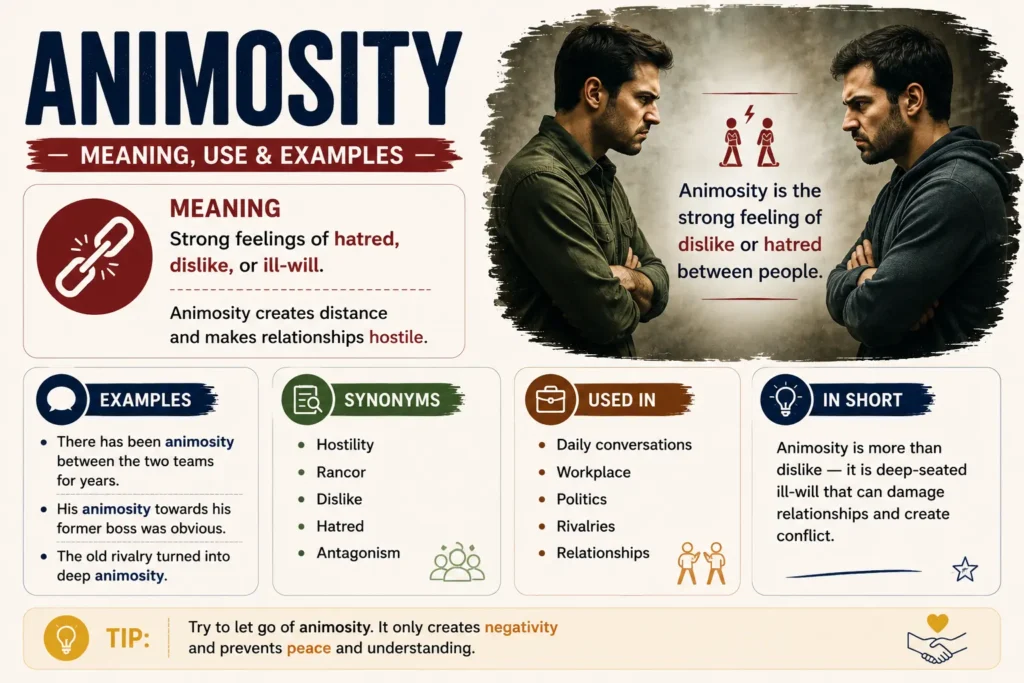
Animosity means strong dislike or hostility toward someone. It is deeper than simple anger. It often lasts a long time and can grow between people, groups, or even countries. animosity meaning usually comes from hurt feelings, unfair treatment, or ongoing conflict.
Table of Contents
What Does Animosity Mean?
At its core, animosity meaning is a strong feeling of dislike or hostility toward someone. It is not a small annoyance. It runs deeper and often lasts longer than a quick burst of anger.
animosity meaning can grow between two people. It can also grow between groups, teams, or even entire countries. It usually comes from real hurt, unfair treatment, or unresolved conflict.
Animosity Meaning in Simple English
Let’s simplify this even more.
animosity meaning = strong, lasting dislike toward someone.
It is the feeling behind phrases like “bad blood” or “there’s tension between them.” When animosity exists, people usually avoid each other, argue often, or feel uneasy around one another.
Animosity vs. Anger: What’s the Difference?
This is one of the most common questions people have. Anger and animosity feel related, but they are not the same.
- Anger is often quick. It can come and go within minutes or hours.
- Animosity is slower and longer-lasting. It can stay for weeks, months, or even years.
Here is a simple comparison table:
| Feature | Anger | Animosity |
| How long it lasts | Short-term | Long-term |
| How it builds | Quickly, from one event | Slowly, from repeated events |
| How it feels | Hot, sudden | Cold, steady |
| Common cause | A single incident | Ongoing conflict or hurt |
Think of anger like a sudden storm. Animosity is more like a long, cold winter that settles in and stays.
Where Does Animosity Come From?
The word “animosity” comes from Latin. It is related to the Latin word “animus,” which relates to spirit, feeling, or intention. Over time, English speakers used “animosity” to describe strong, hostile feelings between people.
Understanding this origin helps explain why the word feels so personal. Animosity is not random. It grows from real emotional history between people or groups.
Examples of Animosity in Everyday Life
- “There has been animosity between the two coworkers since the disagreement last year.”
- “The animosity between the rival teams was obvious during the game.”
- “Years of animosity between the neighbors started over a simple fence dispute.”
- “She tried to hide her animosity, but her tone gave it away.”
These examples show something important. Animosity often starts with one moment, but it can grow bigger over time if it is never addressed.
Animosity in Relationships
Animosity can appear in friendships, families, and romantic relationships. It often builds slowly, through repeated misunderstandings or unresolved arguments.
Common Signs in Relationships
- Avoiding certain topics to prevent conflict
- Speaking to each other less warmly than before
- Feeling tense during conversations
- Bringing up old arguments during new disagreements
What to Do About It
- Talk honestly about what caused the hurt feelings.
- Avoid blaming language; focus on how you feel instead.
- Give the relationship time and patience to heal.
- Consider talking to a trusted person or counselor if animosity feels stuck.
Animosity Between Groups and Nations
Animosity is not only personal. It can also exist between larger groups, like:
- Rival schools or sports teams
- Political groups with different beliefs
- Communities with a long shared history of conflict
- Countries with a history of disagreement or war
This kind of animosity often builds over generations. It can be shaped by history, culture, and repeated conflict, making it harder to resolve quickly.
Why This Matters
Understanding group animosity helps explain many real-world conflicts in the news. It is rarely about just one event. It is usually built from a long history of tension.
Why Do People Feel Animosity?
Animosity usually grows from one or more of these causes:
- Unfair treatment – Feeling wronged by someone.
- Betrayal – Trust being broken.
- Repeated conflict – Small disagreements piling up over time.
- Competition – Rivalry that turns personal.
- Miscommunication – Misunderstandings that are never cleared up.
Myth to Avoid
Some people believe animosity always means someone did something seriously wrong. That is not always true. Sometimes animosity grows from small misunderstandings that were never talked through.
Signs That Someone Feels Animosity
- Cold or distant behavior
- Sarcastic or sharp comments
- Avoiding eye contact or conversation
- Bringing up past conflicts often
- A tense tone, even during normal conversations
Recognizing these signs early can help prevent animosity from growing stronger over time.
How to Handle Animosity in a Healthy Way
Feeling animosity toward someone is a normal human experience. What matters most is how it is handled.
Expert Tips
- Notice the feeling without judging yourself for having it.
- Try to understand where the feeling started.
- Communicate calmly instead of avoiding the person completely.
- Give yourself time; animosity does not usually disappear overnight.
- Focus on what you can control, like your own reactions.
A Note on Safety
If animosity ever grows into ongoing conflict that feels unsafe, threatening, or abusive, it is important to reach out to a trusted adult, counselor, or professional for support.
Quick Checklist
- [ ] Have I identified what caused this feeling?
- [ ] Have I talked honestly about it, if it’s safe to do so?
- [ ] Am I giving myself time instead of forcing a quick fix?
- [ ] Do I need outside support to work through this?
Common Mistakes People Make With Animosity
Mistake 1: Confusing Animosity With a Simple Bad Mood
A bad mood usually passes quickly. Animosity is deeper and often tied to a specific person or group.
Mistake 2: Ignoring It Completely
Ignoring animosity does not always make it disappear. It can quietly grow stronger over time if it is never addressed.
Mistake 3: Assuming Animosity Can Always Be Fixed Quickly
Since animosity often builds slowly, it also tends to heal slowly. Patience matters just as much as effort.
Synonyms and Opposite Words
Common Synonyms
- Hostility
- Resentment
- Bitterness
- Ill will
- Antagonism
Opposite Words
- Friendship
- Goodwill
- Affection
- Harmony
Knowing these opposite words can help you notice the goal when working through animosity: moving from tension toward understanding, even if full friendship is not always possible.
More Words Worth Knowing
Animosity is a strong emotional word, and it connects naturally with other feeling-based words. If this topic resonated with you, you might also enjoy the resonate meaning, poignant meaning, and ennui meaning, a very different feeling of tiredness rather than tension.
Sometimes animosity hides behind a calm outer appearance. Learn more about that idea in facade meaning and jaded meaning, which describes feeling worn out or unimpressed after repeated disappointment.
If you’re curious about other emotionally rich or historically deep words, check out eunuch meaning, revenant meaning, ether meaning, sabbatical meaning, and namaste meaning, a word about respect rather than conflict.
Some people reflect on tension in their lives the same way they reflect on repeating numbers. If that sounds familiar, see the 666 angel number meaning, which also touches on finding balance.
Writing down animosity or hurt feelings privately, instead of confronting someone directly, can sometimes help process emotions safely. This is close to the idea behind The Unsent Project, a space for messages that are never sent. A few related guides:
- Curious if it’s worth trying? See is the Unsent Project real, safe, and legit.
- Colors can express complicated feelings too. Learn what the colors mean in the Unsent Project.
- Writing things down has real value. Read the emotional benefits of this kind of reflection.
- Want to know where the idea began? Check out the history of the Unsent Project.
- Looking for similar spaces? Try these Unsent Project alternatives.
- Curious how it works? Here’s how the Unsent Project actually works.
- Want to share your own reflection? You can submit your story here.
Words describing tension, dishonesty, or difficult behavior are also worth knowing, such as redacted meaning (information hidden or removed), touche meaning (acknowledging a clever point, often in an argument), albeit meaning (a formal word for “although”), grifter meaning (someone who tricks others), diabolical meaning (very evil or wicked), and debauchery meaning (excessive indulgence).
Personality and behavior words often connect to animosity too, such as pedantic meaning, condescending meaning, patronize meaning, facetious meaning, unhinged meaning, masochist meaning, hubris meaning, naive meaning, enigma meaning, and surreal meaning.
Relationship words are useful too, since animosity often ties into how people connect (or disconnect), including platonic meaning, demisexual meaning, sapiosexual meaning, fidelity meaning, monogamy meaning, celibate meaning, and submissive meaning.
Other reflective words worth knowing include ethereal meaning, aura meaning, epiphany meaning, solace meaning, manifest meaning, and nonchalant meaning.
A few practical, everyday words round things out too: caveat meaning, contingent meaning, in lieu of meaning, endeavor meaning, blue collar meaning, ethos meaning, et al. meaning, per diem meaning, their meaning, smut meaning, FUPA meaning, elope meaning, godspeed meaning, selah meaning, and inshallah meaning.
And when tension turns into a quick, honest text, these shorthand terms come in handy too: SMH meaning, TLDR meaning, SOS meaning, ASL meaning, OFC meaning, ETA meaning, IYKYK meaning, WTW meaning, IMO meaning, SMS meaning, ISTG meaning, IIRC meaning, DITTO meaning, OTOE meaning, WYLL meaning, HUZZ meaning, AFK meaning, ICYMI meaning, FWIW meaning, MIA meaning, and AWOL meaning.
Frequently Asked Questions
1. What is the simplest animosity meaning? It means a strong, lasting dislike or hostility toward someone.
2. Is animosity the same as hate? They are similar, but “hate” is often stronger and more extreme. Animosity is usually more focused on ongoing tension or dislike.
3. Can animosity go away over time? Yes, especially with honest communication and time. It often fades slower than anger, but it can improve.
4. What causes animosity between people? Common causes include unfair treatment, betrayal, repeated conflict, and miscommunication.
5. Is it normal to feel animosity toward someone? Yes, it is a normal human emotion. What matters most is how it is handled.
6. Can animosity exist between countries? Yes. Long-term tension between nations is often described using this word, especially when built from historical conflict.
7. How is animosity different from a grudge? A grudge is often about one specific event. Animosity can be broader and may build from multiple experiences over time.
8. What should I do if I feel animosity toward someone I care about? Try to understand the cause, communicate honestly if it feels safe, and give the relationship time to heal.
The Takeaway
The animosity meaning points to something deeper than a passing bad mood. It describes real, lasting tension, often built from hurt, unfair treatment, or unresolved conflict.
Recognizing animosity, in yourself or others, is the first step toward handling it in a healthy way. The next time you notice this feeling, take a moment to understand where it comes from, and consider what small step could help ease the tension.