Have you ever heard a song, and it just felt right? Like it understood you? That feeling has a name. It is called resonating. Understanding the resonate meaning can help you talk about your feelings better. It can also help you understand books, music, and even science.
This guide is for anyone who has heard the word “resonate” and wondered what it truly means. Maybe a friend said, “That story really resonates with me.” Maybe you read it online. Either way, you are in the right place.
By the end of this guide, you will know:
- The simple resonate meaning
- How to use “resonate” in a sentence
- Where the word comes from
- Common mistakes people make
- How “resonate” connects to feelings, sound, and even unsent messages
Quick Answer
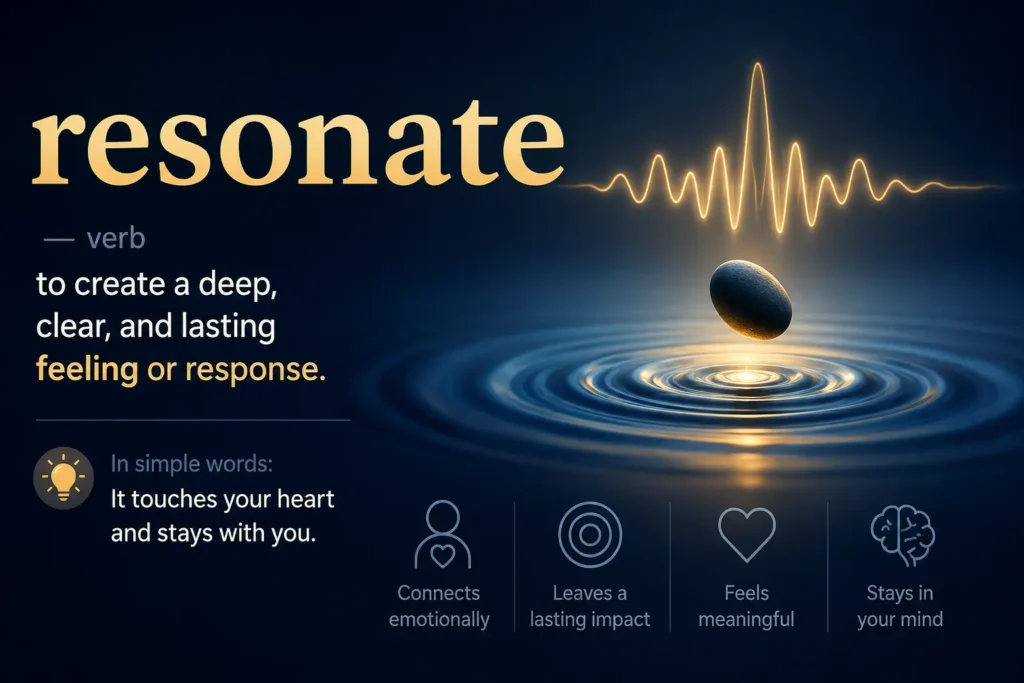
resonate meaning to strike a chord with someone. It means something feels deeply true or familiar. It can also mean a sound that keeps ringing or vibrating. When a song, story, or idea “resonates” with you, it connects with your feelings in a strong way.
Table of Contents
What Does Resonate Mean?
The simple resonate meaning is this: something feels true or important to you. It matches your own feelings or experience.
Think about a movie. Maybe a character goes through something you also went through. You watch it, and you feel understood. That is the movie resonating with you.
The word can also describe sound. A guitar string vibrates. That vibration can make a room feel full of sound. That is also called resonating.
So “resonate” has two main jobs:
- It describes strong feelings.
- It describes sound and vibration.
Both meanings share one idea. Something is echoing. It keeps coming back. It fills the space around it.
Resonate as a Verb: The Full Definition
“Resonate” is a verb. A verb is an action word. It tells you what something does.
Here are the two core definitions:
- To produce or be filled with a deep, clear sound that continues. Example: The bell resonated through the old church.
- To have a strong, personal effect on someone’s feelings or beliefs. Example: Her speech resonated with the whole audience.
Notice something important. In both cases, resonate meaning is not a quiet, small action. It is big. It spreads out. It lasts.
That is the heart of the resonate meaning. It is never a tiny, forgettable moment. It is something that lingers.
Where Does the Word “Resonate” Come From?
Words have histories, just like people do. Knowing where a word comes from can help you remember its meaning.
“Resonate” comes from an old Latin word. That word meant “to sound again” or “to echo.” Think about a canyon. You shout, and the sound comes back to you. That echo is a kind of resonance.
Over time, English speakers used this idea for more than just sound. They started using it for feelings too. If an idea “echoes” inside you, if it keeps coming back to your mind, then it resonates.
This is why the word feels so powerful. It carries the idea of an echo. Something said once, but felt again and again.
Resonate vs. Related Words
Some words are close to “resonate,” but they are not exactly the same. Here is a simple comparison table.
| Word | Simple Meaning | How It’s Different from Resonate |
| Resonate | Feels deeply true or vibrates strongly | Focuses on connection or sound that lasts |
| Relate | You understand or share something | Weaker; does not always mean deep feeling |
| Echo | A sound repeats | Only about sound, not feelings |
| Vibrate | Something shakes fast | Physical only, no emotional meaning |
| Strike a chord | Something feels emotionally true | Very close to resonate, but more casual |
This table shows something important. “Resonate” is a stronger word than “relate.” When something merely relates to you, it might just be similar. When something resonates, it hits deeper.
How to Use “Resonate” in a Sentence
Using “resonate” correctly is easy once you see the pattern. It almost always follows this structure:
[Something] resonates with [someone].
Here are simple examples:
- The song resonates with teenagers.
- Her advice resonated with me.
- This message will resonate meaning with anyone who has felt lonely.
- The teacher’s words resonated with the whole class.
You can also use “resonate” without “with,” especially for sound:
- The music resonated through the hall.
- His voice resonated across the stadium.
Beginner Tip
If you are not sure whether to use “resonate,” ask yourself: Does this feel deep, lasting, or emotional? If yes, “resonate” probably fits.
Examples of Resonate in Real Life
Let’s look at real situations where “resonate” makes sense.
Example 1: Music A sad song plays on the radio. You just went through a breakup. The lyrics feel like they were written about you. That song resonates with your life right now.
Example 2: A Speech A speaker talks about working hard even when things are difficult. Someone in the crowd has been struggling at their job. The speech resonates with them personally.
Example 3: A Book A character in a story feels left out at school. A young reader who also feels left out reads the book. The story resonates deeply.
Example 4: Sound A big bell rings in a tower. The sound keeps ringing for several seconds. It resonates through the whole town.
Notice the pattern. In every emotional example, there is a match. Something in the outside world matches something inside a person.
Why Do Some Things Resonate With Us More Than Others?
This is a great question, and it has a simple answer: personal experience.
Something resonates when it connects to what you have already felt or lived through. Two people can hear the exact same song. One person cries. The other feels nothing. Why? Because their experiences are different.
Here is a simple breakdown of why resonance happens:
- Shared experience – You have been through something similar.
- Timing – You hear or read something at the right moment in your life.
- Honesty – The message feels real, not fake.
- Simplicity – Simple, clear words often resonate meaning more than complicated ones.
Myth to Avoid
Some people think only sad or emotional things can resonate. That is not true. A funny joke can resonate meaning if it matches your exact sense of humor. A simple idea, like “be kind to yourself,” can resonate meaning too.
Common Mistakes People Make With “Resonate”
Even smart writers mix up this word sometimes. Here are common mistakes and how to fix them.
Mistake 1: Using “resonate” for small, unimportant things Wrong: “This pencil resonates with me.” Better: “This pencil is fine.” Fix: Save “resonate” for things with real emotional or physical impact.
Mistake 2: Forgetting the word “with” Wrong: “This song resonates me.” Right: “This song resonates with me.”
Mistake 3: Overusing the word in writing If every sentence says something “resonates,” the word loses its power. Use it only when you truly mean deep connection.
Expert Tips for Using “Resonate” Correctly
- Use “resonate” when talking about feelings, values, or beliefs.
- Use it for sound that lasts, like music or echoes.
- Do not use it for small, everyday facts.
- Pair it with “with” when talking about people.
- Read your sentence out loud. If it sounds too strong for the situation, choose a simpler word instead.
Quick Checklist
- [ ] Does the situation involve real emotion or connection?
- [ ] Am I using “with” correctly?
- [ ] Am I avoiding overuse in the same paragraph?
- [ ] Does the sentence sound natural when read aloud?
If you checked all four boxes, you are using “resonate” the right way.
Resonate and Emotional Words: A Bigger Word Family
The word “resonate” often shows up next to other emotional and expressive words. Learning these words together can help you build a stronger vocabulary for talking about feelings.
For example, some people feel something resonate so strongly that they write it down, even if they never plan to send it. This is very close to the idea behind The Unsent Project, where people share private messages they never sent.
If you want to explore more words tied to feelings and communication, here are some helpful guides:
- Sometimes a message resonates so much that people want to know is the Unsent Project real, safe, and legit before sharing their own story.
- Colors can carry emotional meaning too, similar to resonance. Learn about what the colors mean in the Unsent Project.
- Writing down unsent feelings has real value. Read about the emotional benefits of this kind of expression.
- Curious how it all began? Check out the history of the Unsent Project.
- Want other places to share unsent thoughts? See these Unsent Project alternatives.
- Wondering about the process itself? Here’s how the Unsent Project actually works.
- Ready to share your own resonant message? You can submit your story here.
Feelings are not the only thing that can resonate. Certain words themselves carry emotional weight. Here are a few worth knowing:
- Ethereal meaning – something delicate and almost dreamlike, often used to describe feelings that resonate softly.
- Aura meaning – the feeling or energy someone gives off.
- Epiphany meaning – a sudden moment of understanding, often paired with something that resonates.
- Solace meaning – comfort during a hard time.
- Manifest meaning – making something real through belief and action.
- Nonchalant meaning – staying calm even when something could resonate strongly.
- Ennui meaning – a tired, empty feeling, almost the opposite of resonance.
- Surreal meaning – something so strange it barely feels real.
- Hubris meaning – too much pride, which can block a message from resonating honestly.
- Naive meaning – trusting too easily, without much life experience yet.
Some emotional or relationship words also connect closely to how deeply things resonate between people:
- Platonic meaning – a close but non-romantic bond.
- Demisexual meaning – needing an emotional connection before attraction grows.
- Sapiosexual meaning – finding intelligence attractive.
- Fidelity meaning – staying loyal and true.
- Monogamy meaning – having one partner at a time.
- Celibate meaning – choosing not to be sexually active.
- Submissive meaning – letting someone else take the lead.
Online slang can carry emotional shortcuts too. When feelings resonate fast, people often type fast:
- SMH meaning – shaking your head, usually in disbelief.
- TLDR meaning – “too long, didn’t read.”
- SOS meaning – a call for help.
- ASL meaning – short for “age, sex, location.”
- OFC meaning – short for “of course.”
- ETA meaning – estimated time of arrival.
- IYKYK meaning – “if you know, you know.”
- WTW meaning – “what’s the word” or “what’s up.”
- IMO meaning – “in my opinion.”
- SMS meaning – a text message.
- ISTG meaning – “I swear to God.”
- IIRC meaning – “if I recall correctly.”
- DITTO meaning – agreeing with what was just said.
- OTOE meaning – a texting shorthand some readers look up.
- WYLL meaning – another common chat term.
- HUZZ meaning – slang used in casual chats.
- AFK meaning – “away from keyboard.”
- ICYMI meaning – “in case you missed it.”
- FWIW meaning – “for what it’s worth.”
- MIA meaning – “missing in action.”
- AWOL meaning – absent without permission.
Some words describe personality or behavior. These can resonate strongly when we recognize them in ourselves or others:
- Pedantic meaning – overly focused on small details.
- Condescending meaning – talking down to someone.
- Facetious meaning – joking when a serious answer is expected.
- Diabolical meaning – very evil or wicked.
- Grifter meaning – someone who tricks others for gain.
- Masochist meaning – enjoying pain or hardship.
- Debauchery meaning – excessive indulgence.
- Unhinged meaning – acting wild or out of control.
- Enigma meaning – a mystery, hard to understand.
- Caveat meaning – a warning attached to a statement.
- Contingent meaning – depending on something else happening first.
- Blue collar meaning – jobs involving manual labor.
- Patronize meaning – treating someone as less capable.
- Endeavor meaning – a serious attempt or effort.
- Godspeed meaning – wishing someone luck on a journey.
- Elope meaning – marrying secretly and suddenly.
- Selah meaning – a pause for reflection.
- Inshallah meaning – “if God wills it.”
- Ethos meaning – the guiding beliefs of a person or group.
- In lieu of meaning – instead of something.
- Et al. meaning – “and others.”
- Per diem meaning – a daily allowance.
- Their meaning – a possessive word people often misuse.
- Smut meaning – explicit or indecent content.
- FUPA meaning – a slang body term.
Every one of these words tells a small story. Just like “resonate,” each one carries feeling, history, and meaning packed into a few letters.
Frequently Asked Questions
1. What is the simplest resonate meaning? It means something feels deeply true, familiar, or emotionally powerful to you.
2. Is “resonate” a positive word? Usually, yes. It often describes something meaningful or moving. But it can also describe a sound, which is neutral.
3. Can an object resonate, or only people? Objects can resonate too, especially with sound. A drum, bell, or guitar can resonate physically.
4. What is a simple synonym for resonate? “Strike a chord” is a close, simple synonym.
5. How do I use resonate in a sentence about school? Example: “The teacher’s lesson on kindness resonated with the whole class.”
6. Why do songs resonate so strongly with people? Music often connects with memories and emotions, which makes it a common source of resonance.
7. Is resonate the same as relate? No. “Relate” means you understand something. “Resonate” means it affects you deeply.
8. Can something resonate with a large group of people? Yes. A speech, movie, or message can resonate with an entire audience at once.
9. Where did the word resonate originally come from? It comes from an old Latin word meaning “to sound again” or “to echo.”
10. Is it grammatically correct to say “resonates with me”? Yes, this is the most common and correct way to use the word.
Conclusion
The resonate meaning is simple once you break it down. It means something echoes inside you. It feels true. It feels familiar. It lasts longer than a normal moment.
Whether it’s a song, a speech, a story, or even a private unsent message, resonance happens when the outside world matches something inside us.
Now that you understand what resonate truly means, try using it the next time something touches you deeply. Notice what resonates with you today, and why.