Have you ever heard someone say, “Don’t get complacent”? It sounds like a warning. But what does it actually mean?
The complacent meaning describes a feeling many people experience without even noticing it. This guide is for anyone who has heard the word and wants a clear, simple explanation.
By the end, you will know:
- The simple complacent meaning
- How it’s different from being calm or confident
- Real examples in school, work, and life
- Simple ways to avoid becoming complacent
Quick Answer
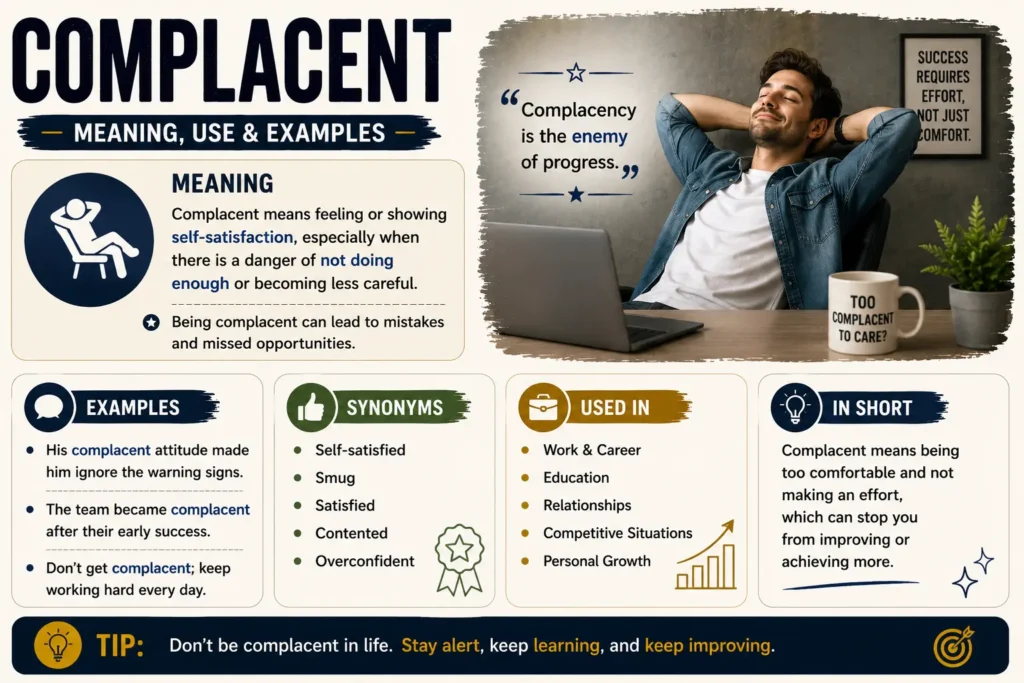
Complacent means feeling so satisfied with how things are that you stop trying to improve or stay careful. A complacent meaning person may ignore small problems or risks because things seem fine for now. It is often used as a gentle warning against becoming too comfortable.
Table of Contents
What Does Complacent Mean?
At its core, complacent describes a person who feels so comfortable or satisfied that they stop paying close attention or trying to improve. It often comes with a hidden risk: things may not stay perfect forever, even if they seem fine right now.
The word usually carries a small warning tone. Being complacent is not exactly relaxed or confident. It suggests overlooking something important because everything currently feels okay.
Complacent Meaning in Simple English
Let’s simplify this even more.
Complacent = too comfortable to notice or fix small problems.
Imagine a student who stops studying because they did well on one test. They may become complacent, assuming good results will continue without more effort.
Complacent vs. Complaisant: What’s the Difference?
These two words look and sound almost the same, which causes a lot of confusion.
- Complacent means overly satisfied and not paying enough attention.
- Complaisant means eager to please others or go along with what they want.
Here is a simple comparison table:
| Word | Simple Meaning | Example |
| Complacent | Too comfortable, not alert | “He became complacent after early success.” |
| Complaisant | Eager to please others | “She was complaisant, always agreeing with the group.” |
Expert Tip
A simple trick to remember the difference: “Complacent” is close to “content,” meaning too satisfied. “Complaisant” is close to “compliant,” meaning agreeable.
Where Does the Word Complacent Come From?
“Complacent” comes from Latin. It is related to the word “complacere,” meaning “to please greatly.” Over time, the meaning shifted in English toward describing someone who feels overly satisfied, often at the cost of staying alert or careful.
This history helps explain the word’s tone. It is not about being lazy on purpose. It is about comfort quietly leading to less attention or effort.
Signs of Complacency
Recognizing complacency early can help prevent bigger problems later. Common signs include:
- Assuming things will always go well without extra effort
- Skipping steps that used to feel important
- Ignoring small warning signs or feedback
- Feeling “too comfortable” to double-check details
- Losing motivation after early success
Examples of Complacent in a Sentence
- “The team became complacent after winning several games in a row.”
- “Don’t get complacent just because sales are good this month.”
- “He grew complacent in his job and stopped learning new skills.”
- “Being complacent about safety rules can lead to accidents.”
Complacency in School and Work
In School
Students sometimes become complacent after doing well on an assignment or test. They may assume future success without realizing continued effort is still needed.
What to do about it:
- Set new goals after each success, rather than stopping.
- Review mistakes even after good grades.
- Stay curious about improving, not just maintaining.
In Work
Complacency can affect employees and even entire companies. A business that stops innovating because it’s doing well right now may fall behind competitors later.
What to do about it:
- Regularly review processes, even when things are going smoothly.
- Stay open to feedback, even during successful periods.
- Encourage ongoing learning, not just short-term results.
Complacency in Relationships
Complacency doesn’t only apply to school or work. It can appear in friendships and relationships too.
For example, someone might stop putting effort into a relationship simply because things feel stable. Over time, this can quietly create distance, even without any single big conflict.
What to Do About It
- Continue showing appreciation, even during calm periods.
- Check in with loved ones regularly, not just during problems.
- Avoid assuming a relationship will stay strong without ongoing care.
Why Does Complacency Happen?
Complacency often comes from a very human reaction to success or stability. Common causes include:
- Early success – Feeling like the hard part is over.
- Comfort – Getting used to a routine that feels safe.
- Lack of feedback – Not hearing about small issues before they grow.
- Overconfidence – Assuming skills or results will stay the same automatically.
Myth to Avoid
Some people think complacency only affects lazy or careless people. That is not true. Even hardworking, talented people can become complacent after a long streak of success, simply because comfort naturally lowers alertness over time.
How to Avoid Becoming Complacent
Expert Tips
- Set new, small goals regularly, even during successful periods.
- Ask for honest feedback often, not just when something goes wrong.
- Reflect on what is working, and why, instead of assuming it will continue automatically.
- Stay curious and open to learning, even in areas where you already feel skilled.
Quick Checklist
- [ ] Am I still paying close attention, even though things are going well?
- [ ] Have I asked for feedback recently?
- [ ] Am I setting new goals, or coasting on old success?
- [ ] Have I checked in on relationships or responsibilities I’ve been neglecting?
Common Mistakes People Make With Complacent
Mistake 1: Confusing It With Being Calm
Being calm is healthy. Being complacent involves ignoring important details because of that calm. The two are related but not the same.
Mistake 2: Mixing Up Complacent and Complaisant
As covered earlier, these words look similar but mean very different things. Double-checking usage helps avoid embarrassing mix-ups in writing.
Mistake 3: Assuming Complacency Is Always Obvious
Complacency often builds quietly. It is not always dramatic or easy to notice right away, which is part of why it can be risky.
Synonyms and Opposite Words
Common Synonyms
- Self-satisfied
- Unconcerned
- Smug
- Overconfident
Opposite Words
- Alert
- Vigilant
- Motivated
- Attentive
Knowing these opposite words can help guide healthy habits, aiming for alertness and continued effort, even during comfortable times.
More Words Worth Knowing
Complacency often connects to bigger ideas about effort, awareness, and change. If this topic resonated with you, you might also enjoy the resonate meaning, ennui meaning (a tired, empty feeling, different from complacency but sometimes related), and nonchalant meaning (staying calm on the surface).
Avoiding complacency often means paying attention to balance in life, similar to ideas explored in the 666 angel number meaning, which also touches on avoiding overdoing or underdoing things.
Complacency can sometimes hide behind a confident outer image. Learn more about that idea in facade meaning and jaded meaning, a feeling of being tired or unimpressed after repeated experience.
If you enjoy learning about words with deep histories, like complacent, check out eunuch meaning, revenant meaning, ether meaning, sabbatical meaning, and namaste meaning.
Fiction often warns against complacency through cautionary stories. If you enjoy that idea, see dystopian meaning, which explores imagined worlds shaped by ignoring warning signs, and don’t tread on me meaning, a phrase about staying alert and standing your ground.
Complacency at work is a common struggle, especially during a comfortable routine. If that connects to your daily life, WFH meaning explains a common modern work setup where staying motivated takes extra effort.
Writing down goals or worries privately, instead of letting them fade quietly, can help avoid complacency. This is close to the idea behind The Unsent Project, a space for messages that are never sent. A few related guides:
- Curious if it’s worth trying? See is the Unsent Project real, safe, and legit.
- Colors can express feelings about comfort and change too. Learn what the colors mean in the Unsent Project.
- Writing things down has real value. Read the emotional benefits of this kind of reflection.
- Want to know where the idea began? Check out the history of the Unsent Project.
- Looking for similar spaces? Try these Unsent Project alternatives.
- Curious how it works? Here’s how the Unsent Project actually works.
- Want to share your own reflection? You can submit your story here.
Relationship complacency can quietly build tension over time, connecting to words like animosity meaning (strong, lasting dislike) if left unaddressed.
Other reflective and emotional words worth knowing include ethereal meaning, aura meaning, epiphany meaning, solace meaning, manifest meaning, surreal meaning, naive meaning, enigma meaning, and poignant meaning.
Personality and behavior words also connect to complacency, since staying alert often means noticing traits like pedantic meaning, condescending meaning, patronize meaning, facetious meaning, unhinged meaning, diabolical meaning, grifter meaning, debauchery meaning, masochist meaning, and hubris meaning, a word about excessive pride that often leads to complacency.
Relationship and identity words are common searches too, including platonic meaning, demisexual meaning, sapiosexual meaning, fidelity meaning, monogamy meaning, celibate meaning, and submissive meaning.
A few practical, everyday words round things out too: caveat meaning, contingent meaning, in lieu of meaning, endeavor meaning (a word about serious effort, the opposite of complacency), blue collar meaning, ethos meaning, et al. meaning, per diem meaning, their meaning, smut meaning, FUPA meaning, elope meaning, godspeed meaning, selah meaning, inshallah meaning, touche meaning, redacted meaning, albeit meaning, and APY meaning.
And when a wake-up-call moment turns into a quick text, these shorthand terms are handy too: SMH meaning, TLDR meaning, SOS meaning, ASL meaning, OFC meaning, ETA meaning, IYKYK meaning, WTW meaning, IMO meaning, SMS meaning, ISTG meaning, IIRC meaning, DITTO meaning, OTOE meaning, WYLL meaning, HUZZ meaning, AFK meaning, ICYMI meaning, FWIW meaning, MIA meaning, and AWOL meaning.
Frequently Asked Questions
1. What is the simplest complacent meaning? It means feeling too comfortable or satisfied to notice or fix small problems.
2. Is complacent meaning a negative word? Usually, yes. It carries a mild warning, suggesting someone should pay more attention or effort.
3. What is the difference between complacent meaning and complaisant? “Complacent” means overly satisfied and unalert. “Complaisant” means eager to please others.
4. Can a whole team or company be complacent? Yes. Complacency can affect groups, not just individuals, especially after a period of success.
5. Is being calm the same as being complacent? No. Calm is a healthy state. complacent meaning specifically involves overlooking something important because of that comfort.
6. How can I avoid becoming complacent? Set new goals regularly, ask for feedback, and stay curious, even during successful or stable periods.
7. Where does the word complacent meaning come from? It comes from Latin, related to a word meaning “to please greatly,” which shifted over time to describe overly comfortable satisfaction.
8. Can complacency affect relationships? Yes. Assuming a relationship will stay strong without ongoing effort is a common form of relationship complacency.
The Takeaway
The complacent meaning points to a very human pattern: getting so comfortable that we stop paying close attention or trying to improve. It can happen in school, work, relationships, or daily life.
Recognizing complacency early is the first step toward staying alert and motivated, even during good times. The next time things feel especially comfortable, take a moment to check in, and make sure that comfort hasn’t quietly turned into complacency.