Quick Answer
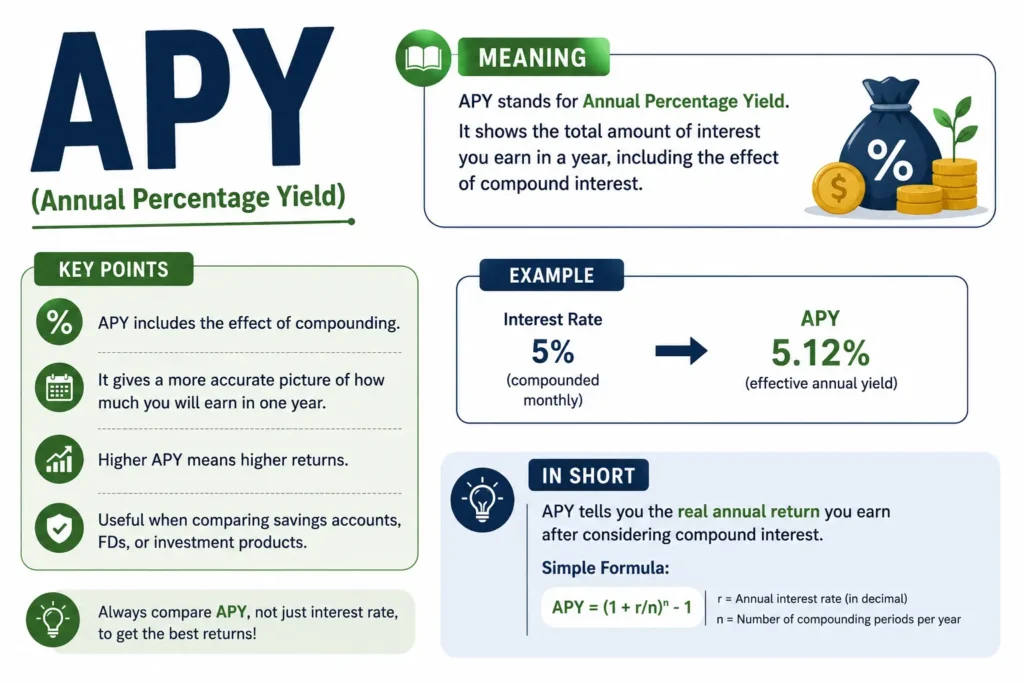
APY meaning: APY stands for Annual Percentage Yield. It tells you how much money your savings account earns in one year, including interest on interest. The higher the APY, the more money you earn. Banks show APY so you can compare accounts and pick the best one for your money.
Table of Contents
What Does APY Mean?
Let’s start with the basics.
APY is short for Annual Percentage Yield.
It is a number. This number shows how much extra money a bank account can earn in one full year.
Banks use apy meaning on savings accounts. They also use it on money market accounts and CDs (certificates of deposit).
Here is the simple part. When you put money in a bank, the bank pays you a little extra money over time. This extra money is called interest. APY shows you the total interest you could earn in a year.
The bigger the APY, the more money you earn. That is why APY is so important.
Why APY Matters to You
You might be thinking, “Why should I care about this?”
Here is why.
Imagine you have two piggy banks. One piggy bank gives you $2 extra every year. The other gives you $5 extra every year. Which one would you pick?
Of course, you would pick the one that gives you more money.
APY helps you do exactly that with real bank accounts. It lets you compare accounts side by side. You can quickly see which bank pays you more for keeping your money there.
This matters whether you are:
- Saving for a new bike
- Saving for college
- Building an emergency fund
- Growing money for the future
A higher APY means your savings grow faster, without you doing any extra work.
How APY Is Different From Interest Rate
Many people mix up APY with a plain “interest rate.” They sound alike, but they are not the same.
Interest rate is the basic rate a bank pays you.
APY includes something extra. It includes compounding.
Compounding means you earn interest on your interest. Let’s break that down with an easy example.
Say you have $100 in a savings account.
- The bank pays you $5 in interest.
- Now you have $105.
- Next time, the bank pays interest on the full $105, not just the first $100.
That little extra bit of interest, earned on your interest, adds up over time. APY shows you this full picture. A plain interest rate does not.
So, APY is almost always a little higher than the basic interest rate, because it includes compounding.
How Does APY Work?
APY works using three main parts:
- The interest rate – the basic rate the bank offers.
- How often interest compounds – daily, monthly, or yearly.
- Time – APY always shows earnings for one full year.
The more often your interest compounds, the more your money grows. Daily compounding usually earns you a bit more than yearly compounding, even if the interest rate looks the same.
Banks calculate APY for you. You do not have to do the math yourself. You just look at the number and compare it to other banks.
APY vs. APR: What’s the Difference?
This is one of the most confusing parts for many people. APY and APR sound almost the same, but they mean very different things.
| Term | Stands For | Used For | Includes Compounding? |
| APY | Annual Percentage Yield | Savings accounts (money you earn) | Yes |
| APR | Annual Percentage Rate | Loans and credit cards (money you pay) | No |
APY tells you how much you earn.
APR tells you how much you pay, like on a loan or credit card.
Here is a simple way to remember it:
- APY = Yield = You gain money.
- APR = Rate = You are charged money.
Keeping these two separate helps you avoid confusion when reading bank offers.
How to Calculate APY (Simple Steps)
You usually do not need to calculate APY yourself. Banks show it clearly. But it helps to understand how it works.
Here is the basic formula, explained in plain words:
- Start with the interest rate as a decimal (like 0.05 for 5%).
- Divide it by how many times it compounds in a year.
- Add 1 to that number.
- Multiply that number by itself, once for each time it compounds in a year.
- Subtract 1 from the result.
- Turn it back into a percentage.
This sounds tricky. That is okay. Most people never do this math by hand. Online calculators and bank websites do it instantly.
What you really need to know: more compounding periods usually mean a slightly higher APY, even with the same interest rate.
Real-Life Examples of APY
Let’s look at some easy examples.
Example 1: Basic Savings Account
You put $1,000 in a savings account with a 4% APY.
After one year, you would have about $1,040.
Example 2: Comparing Two Banks
- Bank A offers 3% APY.
- Bank B offers 4.5% APY.
If you put $1,000 in each, Bank B gives you more money by the end of the year. Bank B is the better choice for growing your savings.
Example 3: A Certificate of Deposit (CD)
A CD is a type of savings account where you agree to leave your money for a set time, like one year. CDs often offer a higher APY than regular savings accounts, because you promise not to touch the money early.
These examples show why checking the APY before opening an account really pays off.
What Is a Good APY?
This is a question a lot of people ask.
A “good” APY depends on the current economy. Rates change over time. But here are some general tips:
- A regular checking account often has an APY close to 0%.
- A normal savings account might offer a small APY.
- A high-yield savings account usually offers a much higher APY than a normal one.
- CDs often offer some of the highest APYs, especially for longer terms.
Expert Tip: Always compare APY rates from a few different banks before choosing one. Online banks often offer higher APY than traditional banks, because they have lower costs.
Common Mistakes People Make With APY
Let’s look at mistakes people often make, so you can avoid them.
Mistake 1: Confusing APY with APR As we covered above, these are very different. Mixing them up can lead to bad money decisions.
Mistake 2: Ignoring fees Some accounts have monthly fees. A high APY does not help much if fees eat away your earnings.
Mistake 3: Forgetting about minimum balances Some accounts need a minimum amount of money to earn the full APY. Falling below that amount can lower your earnings.
Mistake 4: Not checking if the APY is fixed or changes Some APY rates are fixed for a while. Others change with the market. Always check which type you are getting.
Mistake 5: Only looking at the APY number A high APY is good, but also check the bank’s safety, customer service, and any rules attached to the account.
Expert Tips for Using APY
Here are some smart, simple tips:
- Compare multiple banks before opening an account.
- Look for high-yield savings accounts if you want stronger growth.
- Check if the APY is a special “introductory” rate. Some banks offer a high rate for a few months, then lower it.
- Understand compounding frequency. Daily compounding is often slightly better than monthly.
- Review your account yearly. Banks sometimes change their APY rates.
- Use your APY to set savings goals. Knowing your yearly earnings helps you plan ahead.
Myths About APY
Let’s clear up a few myths.
Myth 1: “APY is the same everywhere.” False. APY changes bank to bank, and even account to account within the same bank.
Myth 2: “A high APY means no risk at all.” Not exactly true. While bank savings accounts are usually very safe, always check that your bank is insured, so your money is protected.
Myth 3: “APY never changes.” Many savings accounts have a variable APY. This means it can go up or down over time, based on the economy.
Is APY Always Safe?
In most everyday savings accounts, yes, your money is generally safe.
In many countries, banks are backed by insurance programs. In the United States, for example, the FDIC insures deposits up to a certain limit per bank, per person. This means if something goes wrong with the bank, your money (up to that limit) is protected.
Still, it is smart to:
- Check that your bank is properly insured.
- Read the account terms carefully.
- Ask questions if anything is unclear.
A high APY is exciting, but understanding the safety of your money matters just as much.
Related Terms Worth Knowing
If you’re learning what APY meaning means, you might also run into other short terms and abbreviations while reading online. Building your vocabulary of common terms makes it easier to understand articles, texts, and everyday conversations. For example, you can also check out guides on what SMH means, what TL;DR means, and what SOS means to keep growing your word knowledge.
FAQ
1. What does APY stand for? APY meaning stands for Annual Percentage Yield. It shows how much money a savings account can earn in one year.
2. Is a higher APY always better? Usually yes, but always check fees, minimum balances, and whether the rate is fixed or can change.
3. What is the difference between APY and interest rate? APY meaning includes compounding, meaning interest earned on interest. A plain interest rate does not include this.
4. What is the difference between APY and APR? APY shows money you earn on savings. APR shows money you pay on loans or credit cards.
5. Does APY change over time? Yes, many accounts have a variable APY meaning that can rise or fall with the market.
6. Can I calculate my own APY? Yes, using a formula that includes the interest rate and compounding frequency. Most people use free online calculators instead.
7. What type of account usually has the highest APY? CDs and high-yield savings accounts usually offer higher APY meaning than regular checking or savings accounts.
8. Is my money safe in a high APY account? In most cases yes, especially if the bank is insured. Always confirm your bank’s insurance coverage.
9. Why do online banks often have higher APY? Online banks usually have lower costs than banks with physical branches, so they can offer higher APY meaning to customers.
10. Do all banks calculate APY the same way? The basic idea is the same everywhere, but the actual rate and compounding method can differ from bank to bank.
Conclusion
Now you know the full APY meaning.
APY, or Annual Percentage Yield, shows how much your money can grow in a savings account over one year. It includes compounding, which means you earn interest on your interest.
A higher APY meaning usually means faster savings growth. But smart savers also check fees, minimum balances, and whether the rate is fixed or variable.
The next time you open a savings account, remember to compare APY meaning rates first. It is one of the easiest ways to make your money work harder for you.