You may have heard someone say “namaste” at the end of a yoga class. Maybe you have seen it printed on a mug or a poster. It sounds gentle and calm. But what does it actually mean?
The namaste meaning is more than just a simple hello. It carries real respect and history behind it. This guide is for anyone curious about this word, especially if you want to understand and use it the right way.
By the end of this guide, you will know:
- The true namaste meaning
- Where the word comes from
- How it is used in different cultures
- How to say and use it respectfully
Quick Answer
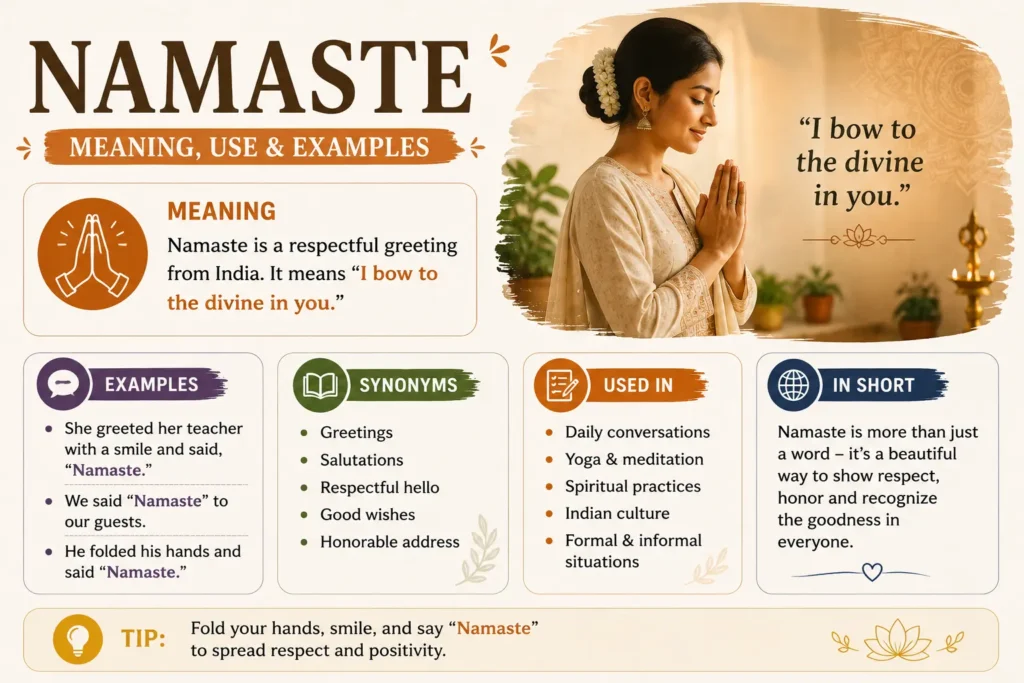
Namaste is a respectful greeting from South Asia. It means something close to “I bow to you.” It shows respect for the other person. It is often said with hands pressed together in front of the chest, along with a small bow of the head.
Table of Contents
What Does Namaste Mean?
At its heart, namaste meaning is a word of respect. It comes from two Sanskrit parts. Sanskrit is an ancient language from South Asia, especially India.
- “Namas” means “bow” or “respect.”
- “Te” means “to you.”
Put together, namaste roughly means “I bow to you” or “greetings to you.”
It is not just a casual “hi.” It carries a feeling of honoring the other person.
Namaste Meaning in Simple English
Let’s make this even simpler.
namaste meaning = “I respect you” or “I greet you with honor.”
When someone says namaste, they are not just saying hello. They are showing that they see and respect the other person.
Where Does the Word Namaste Come From?
namaste meaning comes from Sanskrit, one of the oldest languages in the world. It has been used for thousands of years in South Asia, especially in India and Nepal.
The word appears in old Hindu texts. In many communities, it carries spiritual meaning, not just a friendly one.
One common idea connected to namaste meaning is this: the greeting honors something good and true inside the other person. Some people explain it as “the good in me honors the good in you.”
This is a beautiful idea, but it is worth knowing it is one popular explanation, not the only historical definition. At its most basic root, namaste meaning simply means a respectful greeting or bow.
How Namaste Is Used Traditionally
In India, Nepal, and other South Asian countries, namaste is used every day. It is not only for special or spiritual moments. People say it when:
- Greeting a family member
- Meeting someone new
- Greeting an elder with extra respect
- Saying goodbye
It works much like “hello” and “goodbye” combined, but with a layer of politeness built in.
Example in a Sentence
- “She greeted her grandmother with a warm namaste.”
- “He said namaste meaning and gently bowed his head.”
Namaste in Yoga Culture
Outside of South Asia, many people first hear “namaste” in yoga classes. Yoga itself began in ancient India, so many yoga traditions carry Sanskrit words, including namaste.
In many yoga classes, the teacher says namaste at the end of class. This is meant as a respectful closing, thanking the group and honoring the shared practice.
Why This Matters
Understanding this history helps explain why the word feels different depending on where you hear it. In its original setting, it is a full daily greeting. In yoga spaces outside its home culture, it often becomes a closing word of respect.
How to Say and Do Namaste Correctly
Saying namaste meaning usually involves both words and a gesture.
Steps:
- Bring your palms together in front of your chest, like a soft prayer position. This gesture is called “Anjali Mudra.”
- Slightly bow your head.
- Say “namaste” gently and sincerely.
Pronunciation
Namaste is pronounced “nuh-muh-STAY.”
Expert Tip
The gesture matters as much as the word. Saying namaste without any gesture is fine too, especially in casual conversation, but the hand and head gesture is a meaningful, traditional way to show respect.
Namaste in Different Cultures and Languages
Namaste is most closely tied to Hindu and Indian culture, but similar respectful greetings and gestures also exist in Nepal, and in Buddhist and Jain traditions found across South Asia.
Here is a simple comparison table to show how namaste compares with other greetings:
| Greeting | Origin | Simple Meaning |
| Namaste | Sanskrit (South Asia) | “I bow to you” |
| Aloha | Hawaiian | Love, peace, greeting |
| Shalom | Hebrew | Peace |
| Salaam | Arabic | Peace |
| Hello | English | General greeting |
This table shows something important. Many cultures have greetings that mean more than just “hi.” Namaste fits into this same beautiful pattern.
Common Mistakes People Make With Namaste
Mistake 1: Treating It Only as a Yoga Word
Namaste existed long before yoga studios spread around the world. It is a full daily greeting in South Asian culture, not just a yoga phrase.
Mistake 2: Saying It Casually Without Understanding It
Some people use namaste as a joke or a trendy phrase, without knowing its respectful meaning. This can feel disrespectful to people from the cultures where it began.
Mistake 3: Overexplaining or Inventing Meanings
Because namaste sounds mysterious to some people, it is sometimes given exaggerated or made-up spiritual meanings online. Sticking to accurate, respectful explanations is the safest and most honest approach.
Is It Okay for Everyone to Say Namaste?
This is a common and fair question.
Namaste is generally seen as a welcoming greeting, and many people from South Asian cultures are happy to share it. At the same time, like any word borrowed from another culture, it is worth using it thoughtfully.
Best Practices
- Use it as a genuine greeting or sign of respect, not as a joke.
- Learn a little about where it comes from, like you are doing now.
- Avoid using it to seem “exotic” or trendy without understanding it.
- If you are unsure, a warm smile and a simple “hello” are always respectful too.
A Balanced View
Opinions vary here. Some people feel comfortable with anyone using namaste respectfully. Others feel it should mainly be used within the cultures it comes from. Being aware of both views, and choosing to use the word with care and respect, is the most thoughtful approach.
Expert Tips for Using Namaste Respectfully
- Learn the correct pronunciation before using it.
- Pair it with the traditional hand gesture when appropriate.
- Use it sincerely, not sarcastically.
- If you are new to the word, it is okay to simply say “hello” instead, especially outside of yoga or cultural settings.
Quick Checklist
- [ ] Am I using namaste with genuine respect?
- [ ] Do I understand its cultural background?
- [ ] Am I pronouncing it correctly?
- [ ] Am I avoiding using it as a joke?
Namaste vs. Other Greetings
Namaste stands out because it combines a spoken word with a physical gesture. Many everyday greetings, like “hi” or “hey,” do not include this.
It is closer in spirit to a respectful bow than a casual wave. This is part of why it feels special, even to people encountering it for the first time.
More Words Worth Knowing
Understanding a word’s true origin, like namaste, often makes it more meaningful. The same is true for other words with rich histories or emotional weight. If you enjoyed learning where namaste comes from, you might also like eunuch meaning, revenant meaning, and sabbatical meaning, which also carry deep historical roots.
Respectful words often connect to bigger feelings too. If namaste’s meaning resonated with you, you may enjoy the resonate meaning, poignant meaning, and touche meaning.
Some readers who reflect on greetings and respect also enjoy exploring how numbers carry meaning too, like the 666 angel number meaning.
Sometimes people write down feelings they cannot say out loud, even respectful or grateful ones. This is close to the idea behind The Unsent Project, a space for private, unsent messages. A few related guides:
- Curious if it’s worth trying? See is the Unsent Project real, safe, and legit.
- Colors can carry cultural and emotional meaning too. Learn what the colors mean in the Unsent Project.
- Writing honestly has real value. Read the emotional benefits of this kind of reflection.
- Want to know where the idea began? Check out the history of the Unsent Project.
- Looking for similar spaces? Try these Unsent Project alternatives.
- Curious how it works? Here’s how the Unsent Project actually works.
- Want to share your own reflection? You can submit your story here.
Words that show respect or careful thought are also worth knowing when you’re being mindful in conversation, such as facade meaning (a false outer appearance, the opposite of sincerity), jaded meaning (feeling tired or unimpressed), redacted meaning (information that has been hidden or removed), albeit meaning (a formal word for “although”), and APY meaning (a financial term, unrelated but commonly searched).
Other meaningful and reflective words include ethereal meaning, aura meaning, epiphany meaning, solace meaning, manifest meaning, ennui meaning, surreal meaning, nonchalant meaning, naive meaning, and enigma meaning.
Relationship and identity words are also popular searches, including platonic meaning, demisexual meaning, sapiosexual meaning, fidelity meaning, monogamy meaning, and celibate meaning, along with submissive meaning.
Personality and behavior words also come up often in respectful conversation, such as pedantic meaning, condescending meaning, patronize meaning, facetious meaning, unhinged meaning, diabolical meaning, grifter meaning, debauchery meaning, masochist meaning, and hubris meaning.
A few practical, everyday words are also worth bookmarking: caveat meaning, contingent meaning, in lieu of meaning, endeavor meaning, blue collar meaning, ethos meaning, et al. meaning, per diem meaning, their meaning, smut meaning, FUPA meaning, elope meaning, godspeed meaning, selah meaning, and inshallah meaning.
And when a respectful greeting turns into a quick text, these shorthand terms are handy too: SMH meaning, TLDR meaning, SOS meaning, ASL meaning, OFC meaning, ETA meaning, IYKYK meaning, WTW meaning, IMO meaning, SMS meaning, ISTG meaning, IIRC meaning, DITTO meaning, OTOE meaning, WYLL meaning, HUZZ meaning, AFK meaning, ICYMI meaning, FWIW meaning, MIA meaning, and AWOL meaning.
Frequently Asked Questions
1. What does namaste literally mean? It comes from Sanskrit and roughly means “I bow to you” or “greetings to you.”
2. Is namaste a religious word? It has spiritual roots in Hindu tradition, but it is used broadly as a respectful daily greeting in many South Asian communities.
3. How do you pronounce namaste? It is pronounced “nuh-muh-STAY.”
4. Do you have to do a hand gesture when saying namaste? Not always, but the traditional gesture, palms together with a small bow, adds extra respect and meaning.
5. Is it disrespectful for non-South Asian people to say namaste? Not necessarily. Using it sincerely and respectfully is generally welcomed, though understanding its background matters.
6. Why do yoga teachers say namaste at the end of class? It is used as a respectful closing, honoring the shared practice, since yoga originated in South Asia.
7. Is namaste only used in yoga? No. It is a full daily greeting in South Asian culture, used far beyond yoga studios.
8. What is a simple way to explain namaste to a child? You can say it means “I see you and I respect you,” said with a gentle bow.
The Takeaway
The namaste meaning goes far beyond a trendy yoga phrase. It is a respectful greeting rooted in South Asian culture and language, meaning something close to “I bow to you.”
Understanding where namaste comes from helps you use it with more care and appreciation. The next time you hear or say namaste, remember the respect behind it, and try using it, or the gesture that goes with it, the next time you want to greet someone warmly.