Have you ever heard someone say, “That’s just a facade”? It can sound confusing at first. The word looks strange too, with that little mark under the “c.”
The facade meaning is actually simple once you break it down. This guide is for anyone who has seen or heard the word “facade” and wants a clear, easy explanation.
By the end, you will know:
- The simple facade meaning
- How the word is used for buildings and for people
- Real examples in sentences
- Common mistakes to avoid
- Similar and opposite words
Quick Answer
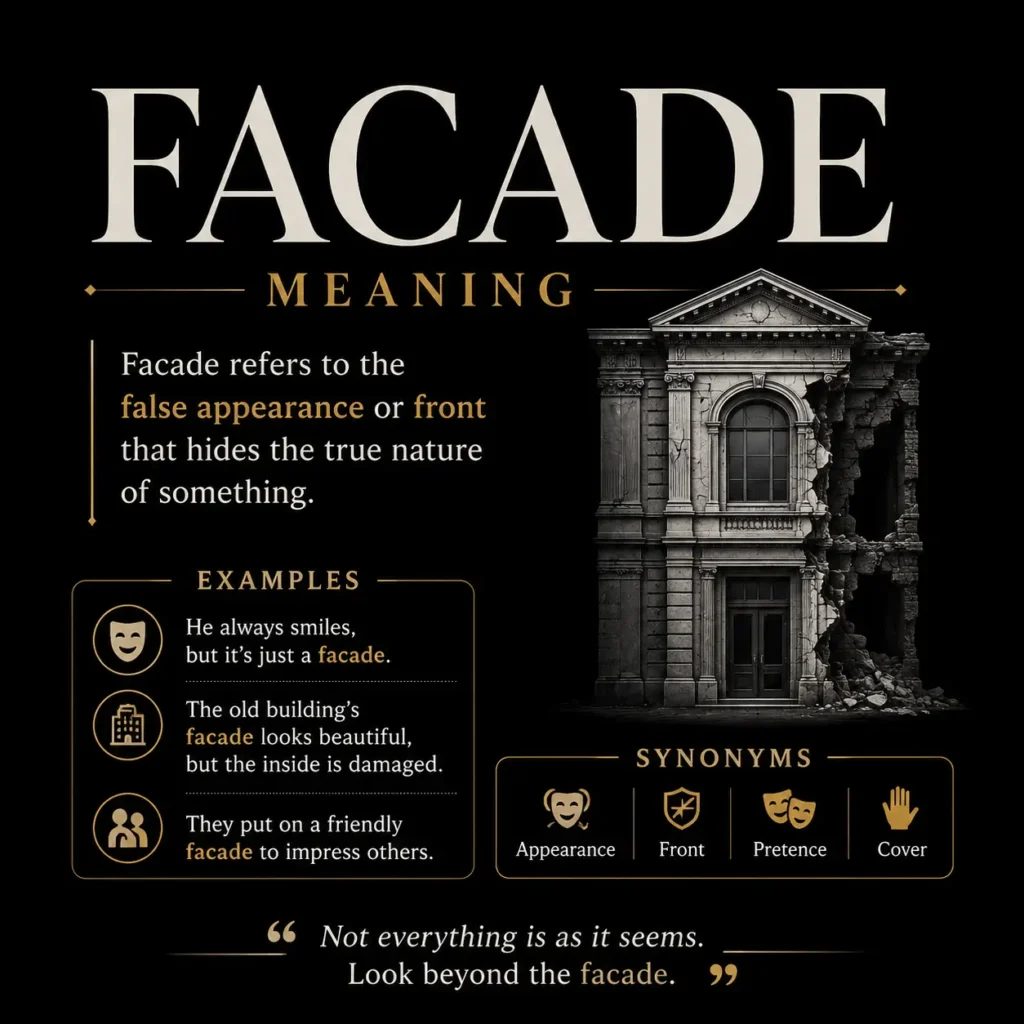
Facade means the front, outer part of something. For a building, it is the front wall. For a person, it means a false appearance. A facade hides what is really behind it, whether that is a building’s structure or someone’s true feelings.
Table of Contents
What Does Facade Mean?
At its core, facade means the outside face of something. Picture a house. The facade is the wall you see from the street. It is the part that faces the world.
But the word has grown a second meaning too. People use “facade” to describe a person acting calm or happy on the outside, while feeling something very different on the inside.
Both meanings share one idea. A facade is what you see first. It is not always what is really there.
Facade Meaning in Simple English
Let’s make this even easier.
Facade = the front, or the outside look.
That’s it. Whether it’s a building or a person, a facade is the part that faces you first. What is behind that front might be different.
Think of it like a stage curtain. The curtain looks nice from the audience. But you cannot see what is happening backstage until it opens.
The Two Main Meanings of Facade
Facade as the Front of a Building
In architecture, which is the study and design of buildings, “facade” almost always means the front wall. This is usually the side that faces the street.
Example: “The old library has a beautiful stone facade.”
This meaning is neutral. It is not good or bad. It is simply a fact about a building’s design.
Facade as a False Appearance
The second meaning is about people, not buildings. It describes when someone hides their true feelings behind a calm or happy outer appearance.
Example: “She smiled through the whole meeting, but it was just a facade. Inside, she was upset.”
This meaning often carries a little sadness or tension. It suggests effort. Keeping up a facade can be tiring.
What to Do When You See a Facade
If you notice someone might be putting up a facade, here are gentle steps:
- Ask how they are really doing, with care.
- Give them space if they are not ready to share.
- Avoid pushing too hard. Trust takes time.
- Listen more than you talk.
Examples of Facade in Everyday Life
Facade in a Sentence
- “The building’s facade was covered in ivy.”
- “He kept a confident facade during the interview, even though he felt nervous.”
- “Behind her cheerful facade, she was exhausted.”
Facade in Relationships
Sometimes people keep a facade in relationships to avoid conflict. For example, a couple might act happy in public while struggling privately. This is common, but it can create distance over time if never addressed.
Facade in Social Situations
At school or work, people sometimes put on a facade meaning to fit in. A student might act confident on the outside while feeling unsure inside. This is a very human habit, especially in new or stressful situations.
Facade in Business and Work
In business, a facade can also apply to companies. A company might appear successful on the outside while facing real struggles inside. This is why trust and honesty matter so much in business relationships.
Facade Meaning in Different Contexts
Facade in Architecture
This is the original and most literal use. Architects study a building’s facade meaning for style, materials, and design. A facade can be modern, historic, decorated, or plain.
Facade in Literature
Writers often use “facade” to show a character who is not what they seem. A confident character might have a facade hiding fear or sadness underneath. This adds depth to a story.
Facade in Everyday Conversation
In daily talk, people often use “facade” casually, like:
- “Don’t fall for his facade, he’s not that tough.”
- “She finally dropped the facade and told the truth.”
Facade as a Metaphor
A metaphor is when a word represents something bigger than its literal meaning. “Facade” is a strong metaphor for hiding.
What Does It Mean to Put Up a Facade?
“Putting up a facade” means choosing to show a certain image, while hiding your true feelings. It is often not about lying. It can simply be about protecting yourself.
Why Do People Put Up a Facade?
People maintain a facade for many reasons:
- They feel embarrassed about their real emotions.
- They want to appear strong for others.
- They are not ready to talk about what is happening.
- They fear being judged.
Myth to Avoid
Some people think keeping a facade always means someone is being dishonest or manipulative. That is not always true. Often, it is simply a way of coping, especially during a hard time.
A Note on Safety
If someone’s facade hides serious struggles, like ongoing sadness or distress, gently encouraging them to talk to a trusted adult, friend, or professional is a caring and safe step.
Synonyms for Facade
Common Synonyms
- Front
- Appearance
- Mask
- Pretense
- Exterior
- Image
Facade vs. Appearance
“Appearance” is a broader word. It just means how something looks. “Facade” suggests that the look might be hiding something different underneath.
Facade vs. Pretence
“Pretence” (or pretense) means acting like something is true when it is not. It is close to facade, but facade focuses more on the outer image, while pretence focuses on the act of pretending.
Facade vs. Front
“Front” is very similar to facade and is often used the same way in casual speech. Example: “He put up a tough front” means almost the same as “He put up a tough facade.”
Here is a simple comparison table:
| Word | Focuses On | Common Use |
| Facade | The outer image or wall | Buildings and hidden feelings |
| Appearance | General outward look | Anything visible |
| Pretence | The act of faking something | Behavior and speech |
| Front | A protective outer image | Mostly casual, spoken English |
Opposite Words of Facade
- Reality
- Truth
- Authenticity
- Sincerity
If a facade is the outer image, these opposite words point to what is real and true underneath.
Where Does the Word Facade Come From?
“Facade” comes from French. In French, “façade” also means the front of a building. It comes from an older Italian word meaning “face.”
That connection makes sense. A facade truly is like the face of a building. It is the first thing people notice.
How the Meaning of Facade Has Changed
Originally, the word was used only for buildings. Over time, English speakers began using it for people too. This happened because the idea fits so well. Just like a building’s face does not show what is inside, a person’s calm expression does not always show their true feelings.
How to Use Facade Correctly
When to Use Facade
Use “facade” when talking about:
- The outer wall of a building
- Someone hiding their true feelings
When Not to Use Facade
Avoid using “facade” for small, everyday things that are not really hidden. Saying “My shoes are a facade” would not make sense, since shoes are not hiding anything deeper.
Common Grammar Patterns
- “[Someone] put up a facade.”
- “[Someone] kept a facade of [emotion].”
- “The building’s facade is [description].”
- “Behind the facade, [true feeling].”
Common Mistakes People Make With Facade
Confusing Facade With Similar Words
Some people confuse “facade” with “facet,” which means a part or feature of something, like “one facet of her personality.” These words are not related in meaning.
Using Facade in the Wrong Context
Another mistake is using “facade” for something obviously fake, rather than something hidden. For example, calling a costume a “facade” is incorrect. A costume is meant to be seen as pretend, while a facade is meant to look real.
Expert Tip
If you are unsure whether “facade” fits, ask: Is something true being hidden behind an outer image? If yes, “facade” is likely correct.
Facade Meaning in Popular Expressions
Behind the Facade
This phrase means looking past the outer appearance to see what is truly happening. Example: “Behind the facade, he was struggling.”
Maintain a Facade
This means continuing to hide true feelings, often for a long time. Example: “She maintained a calm facade throughout the difficult year.”
Put Up a Facade
This means choosing to show a certain image to others. Example: “He put up a brave facade for his younger siblings.”
Frequently Asked Questions
1. What is the simplest meaning of facade? It means the outer front of something, whether that is a building or a person’s true feelings.
2. What is an example of a facade? A calm smile hiding real stress is a common example of a personal facade. A building’s front wall is a literal example.
3. Can facade mean a fake personality? Not exactly a fake personality, but it can describe hiding real emotions behind a calmer or happier outer appearance.
4. Is facade a positive or negative word? It is usually neutral for buildings, but slightly negative or bittersweet when describing hidden feelings, since it suggests effort or discomfort.
5. What is another word for facade? “Front” is a simple, common synonym.
6. What does behind the facade mean? It means looking past someone’s outer appearance to understand what they truly feel or experience.
7. Is facade only used for people and buildings? Mostly, yes, though it can also describe organizations, like a company that appears successful while struggling internally.
8. How do you pronounce facade? It is pronounced “fuh-SAHD.”
More Words Worth Knowing
Facade often connects to feelings people keep hidden, so it pairs naturally with other emotional and expressive words. If a message about someone’s true feelings resonates with you, you might enjoy the resonate meaning too.
Some people notice their own facade slipping during reflective moments, similar to noticing repeating numbers. If that sounds familiar, see the 666 angel number meaning, which also touches on balance between outer appearance and inner needs.
Writing down what’s really behind your own facade, even privately, can help. This is close to the idea behind The Unsent Project, a place where people write messages they never send. A few related guides:
- Wondering if it’s worth trying? See is the Unsent Project real, safe, and legit.
- Colors can express real feelings, much like dropping a facade. Learn what the colors mean in the Unsent Project.
- There are real emotional benefits to letting your guard down and writing honestly.
- Curious about its origins? Read the history of the Unsent Project.
- Looking for similar outlets? Try these Unsent Project alternatives.
- Want to know the process? Here’s how the Unsent Project actually works.
- Ready to drop your own facade, even briefly? You can submit your story here.
Other words describe feelings people hide behind a calm facade, such as ennui meaning (a tired, empty feeling), solace meaning (comfort during a hard time), epiphany meaning (a sudden moment of clarity), aura meaning (the energy someone gives off), ethereal meaning (something delicate and dreamlike), manifest meaning (making something real through belief), and nonchalant meaning (staying calm on the surface, which is close to keeping a facade).
Personality words also connect closely to the idea of a facade, since they describe how people present themselves: pedantic meaning, condescending meaning, patronize meaning, facetious meaning, unhinged meaning, diabolical meaning, grifter meaning, debauchery meaning, masochist meaning, hubris meaning, naive meaning, enigma meaning, and surreal meaning.
Relationships are another place where a facade can appear, since people sometimes present a certain image of their bond to others. Related guides include platonic meaning, demisexual meaning, sapiosexual meaning, fidelity meaning, monogamy meaning, celibate meaning, and submissive meaning.
A few more everyday words worth knowing, useful for describing situations behind someone’s facade: caveat meaning (a small warning), contingent meaning (depending on something else), in lieu of meaning (instead of), endeavor meaning (a serious effort), blue collar meaning (manual labor jobs), ethos meaning (guiding beliefs), et al. meaning (and others), per diem meaning (a daily allowance), their meaning (a commonly confused possessive word), smut meaning, FUPA meaning, elope meaning, godspeed meaning, selah meaning, and inshallah meaning.
And when someone finally drops their facade, they might send a quick, honest message using shorthand like SMH meaning, TLDR meaning, SOS meaning, ASL meaning, OFC meaning, ETA meaning, IYKYK meaning, WTW meaning, IMO meaning, SMS meaning, ISTG meaning, IIRC meaning, DITTO meaning, OTOE meaning, WYLL meaning, HUZZ meaning, AFK meaning, ICYMI meaning, FWIW meaning, MIA meaning, and AWOL meaning.
The Takeaway
The facade meaning comes down to one simple idea: the outer front, whether that belongs to a building or a person’s hidden feelings.
A facade can be as harmless as a decorated wall, or as meaningful as someone quietly hiding a hard day behind a smile. Understanding facade meaning helps you notice both.
The next time you hear “facade,” think about what might be behind it. And if you ever catch yourself keeping one up, remember it is okay to let it down with someone you trust.