Have you ever met someone or ended up somewhere by pure chance, and thought, “This felt like it was meant to happen”?
Maybe it was meeting a best friend through a random mix-up. Maybe it was ending up in the exact right place at the exact right time. There’s a beautiful, poetic word people reach for to describe that feeling, one that carries a sense of fate and destiny far deeper than simple luck.
Understanding kismet meaning helps you describe those fated, meant-to-be moments with real precision. This guide is for curious readers, hopeless romantics, and anyone who has heard the word without ever getting a full explanation. By the end, you will know exactly what it means, where it came from, and how to use it correctly.
Quick Answer
kismet meaning refers to fate or destiny, especially the sense that certain events, meetings, or outcomes were meant to happen, beyond anyone’s control. It’s often used romantically to describe a meeting or relationship that felt destined, but it can apply to any situation that feels guided by something bigger than pure coincidence.
Table of Contents
What Does Kismet Mean?
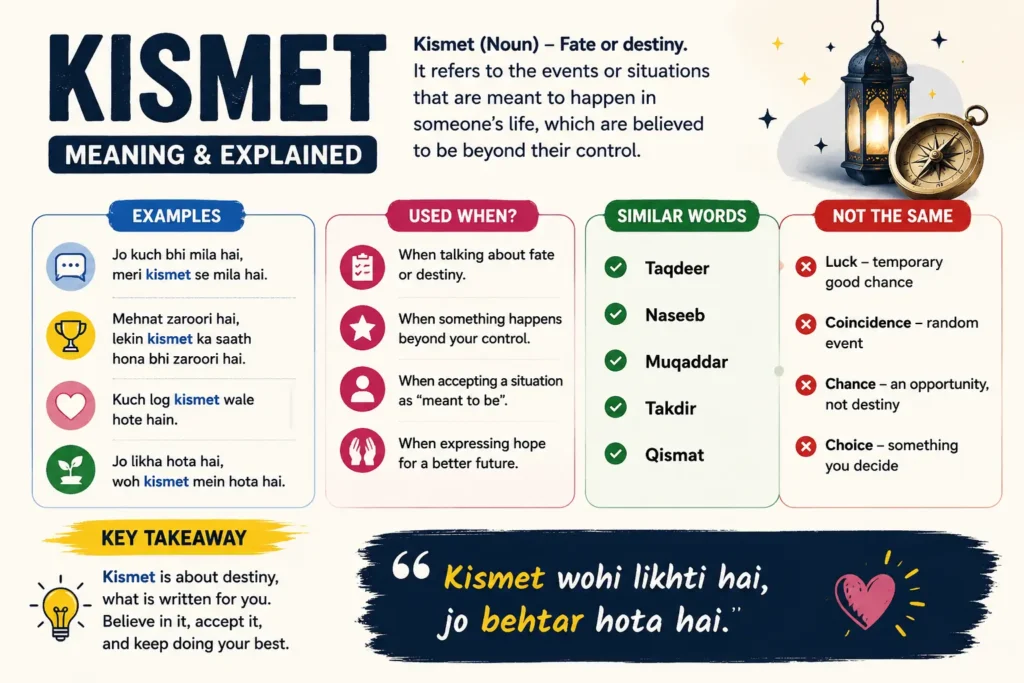
This word refers to fate or destiny, particularly the feeling that certain events were somehow always meant to happen.
It often describes situations that feel too perfectly timed or too meaningful to be pure chance, like meeting someone important through a strange coincidence, or ending up exactly where you needed to be without any clear plan. The word carries a warm, almost magical quality, suggesting the universe had a hand in shaping the outcome.
Here is an easy way to picture it. Imagine missing your usual train, only to end up sitting next to someone who becomes a lifelong friend on the next one. That strange, meaningful timing, missing the first train leading directly to something wonderful, captures exactly what this word describes.
It’s worth noting that this word usually carries a positive, hopeful tone. It’s rarely used to describe something negative or unwanted, focusing instead on meaningful, often joyful moments that feel destined.
Where Does the Word Come From?
Words often carry fascinating histories, and this one traces back to Turkish, Arabic, and Persian roots.
It comes from the Turkish word “kısmet,” which itself derives from the Arabic word “qisma,” meaning “portion,” “lot,” or “fate,” ultimately rooted in the idea of a person’s destined share in life. As the word traveled through different languages and cultures, it kept its core meaning of fate or destiny, eventually entering English with that same poetic, fateful quality intact.
That layered history across multiple cultures and languages helps explain why the word carries such a rich, almost mystical feeling, connecting the idea of fate across centuries and continents.
This Word vs Coincidence: What Is the Difference?
These two ideas are related, but they carry very different implications.
A coincidence simply describes two events happening at the same time or in a related way, without any implied deeper meaning or purpose behind it. This word specifically implies that an event was meant to happen, suggesting fate or destiny guided the outcome, rather than pure random chance.
Here is a table to help make the difference clear:
| Feature | This Word | Coincidence |
| Implies deeper meaning | Almost always | Not necessarily |
| Suggests fate or destiny | Yes | No |
| Common emotional tone | Warm, meaningful | Neutral or surprising |
| Common setting | Relationships, life-changing moments | Any unrelated, random overlap |
Both ideas describe unexpected timing, but this word adds a layer of meaning and purpose that a simple coincidence doesn’t necessarily carry.
Is It the Same as Luck?
Not quite, though the two ideas overlap in some ways.
How Does Fate Differ From Simple Luck?
Luck generally describes random, unpredictable outcomes, good or bad, without any implied deeper purpose. This word specifically points toward fate and destiny, suggesting a meaningful, almost guided outcome, rather than pure randomness. Someone might call a random cash prize “lucky,” but they’d more likely use this word to describe meeting their soulmate through an unlikely, meaningful chain of events.
Examples in a Sentence
Seeing this word in real sentences helps the meaning click faster. Here are several everyday examples.
Example 1 “They both ended up at the same coffee shop on the same rainy afternoon, pure kismet, they later joked.”
Example 2 “Getting that job right after moving to the city felt like kismet.”
Example 3 “She always believed their meeting was kismet, not just a random coincidence.”
Example 4 “Finding the old photo the same week I thought about him felt like kismet.”
Example 5 “Call it kismet meaning or just good timing, but everything seemed to fall perfectly into place that week.”
Notice how this word almost always appears alongside a meaningful, often unlikely sequence of events. That pattern reflects the word’s deep connection to fate and destiny, rather than ordinary luck.
Signs Something Might Be Kismet
Sometimes it helps to see clear signs of when this word truly fits. Here are common signs people associate with this feeling.
- An unlikely meeting or event that ends up shaping something meaningful.
- A strong feeling that something was “meant to happen,” beyond simple explanation.
- Multiple small coincidences lining up around one significant outcome.
- A sense of timing that feels too perfect to be random.
- A lasting, meaningful connection that grew from a completely unplanned moment.
If several of these signs apply, many people would describe the situation using this word, even if it can’t be proven or explained logically.
Common Mistakes People Make With This Word
Even a poetic word like this one gets misused sometimes. Here are a few mistakes worth clearing up.
Mistake 1: Using it for minor, everyday coincidences. Running into a coworker at the grocery store usually doesn’t carry enough weight for this word. It’s typically reserved for something more meaningful or significant.
Mistake 2: Assuming it always refers to romance. While it’s commonly used romantically, this word can describe any fateful moment, including friendships, career opportunities, or major life changes.
Mistake 3: Confusing it with simple good luck. As shown earlier, luck implies randomness, while this word specifically implies fate or destiny guiding the outcome.
Mistake 4: Overusing it until it loses its impact. Because this word carries real emotional and poetic weight, using it too often for small moments can weaken its meaning over time.
Expert Tips for Using It Correctly
Writers and English teachers often share a few simple tips for using poetic, meaningful vocabulary words like this one well.
- Reserve it for genuinely meaningful moments. Save this word for situations that feel truly significant, not everyday coincidences.
- Pair it with a specific story or detail. Explaining exactly what made a moment feel fated helps the word land with real emotional impact.
- Use it thoughtfully in writing. It fits beautifully in personal essays, romantic writing, or reflective storytelling.
- Avoid overusing it in the same piece. A word this poetic works best when it isn’t repeated too often.
- Respect its cultural roots. Understanding the word’s Turkish, Arabic, and Persian history adds real depth when using it thoughtfully.
These small habits help writers and speakers use the word with real precision, instead of applying it to any small, everyday overlap in timing.
Why People Are Drawn to the Idea of Fate
Words describing fate and destiny hold real emotional power, helping people find meaning in life’s most surprising, unplanned moments.
Believing in meaningful timing and connection can carry real emotional benefits, because finding purpose in unexpected moments often brings comfort, hope, and a deeper sense of meaning to life’s more uncertain chapters.
That idea of meaningful, fated connection ties into something bigger too. Some people spend years wondering “what if,” about a meeting, a relationship, or a moment that felt fated but never fully played out the way they hoped. That is exactly what The Unsent Project is about: a space where people finally share honest, unsent messages, often reflecting on connections that once felt like fate.
If you are curious, you can learn how the project actually works, including how these personal messages get submitted and shared with others. Many people also ask whether the project is real, safe, and legit before getting involved, which is a fair and sensible question.
Each shared message is often paired with a color, and it turns out the colors mean something specific about the feeling behind the words. The project also has a meaningful past, and you can read about the history of The Unsent Project to see how it first began.
If this kind of honest storytelling interests you, there are also other alternatives to The Unsent Project worth exploring. And if you ever want to share your own words, you can always submit your message here.
Fate and meaningful connection show up in small, everyday communication too. A quick OFC, short for “of course,” settles something instantly, while SMH captures real frustration in three letters. A short TLDR sums up something long, and typing SOS makes urgency instantly clear. Understanding a platonic friendship, solving a personal enigma, learning what it means to be demisexual or celibate, noticing submissive or condescending behavior, checking someone’s ETA, avoiding a pedantic correction, adding an honest caveat to a promise, understanding an offer that’s contingent on something else, spotting truly diabolical intentions, valuing real fidelity in a relationship, recognizing a grifter before it’s too late, understanding a life of reckless debauchery, naming a heavy feeling of ennui, sharing something only certain people will fully understand, saying inshallah about hopeful future plans, sending a quick wtw check-in, describing a truly surreal moment, sharing an opinion with a quick imo, staying nonchalant about big news, recognizing a sudden epiphany, avoiding naive trust, or asking a simple ASL question all rely on the same basic idea: finding meaning and connection in the words we choose.
Frequently Asked Questions
What does kismet meaning in simple words? It means fate or destiny, especially the feeling that certain events or meetings were meant to happen.
Is kismet meaning only used for romantic situations? No. While it’s often used romantically, it can describe any fateful moment, including friendships, careers, or major life changes.
Where does the word kismet meaning come from? It comes from Turkish, tracing back further to Arabic and Persian roots, originally connected to the idea of a person’s destined portion or fate.
Is kismet meaning the same as luck? Not quite. Luck implies randomness, while this word specifically implies fate or destiny guiding a meaningful outcome.
Can kismet meaning describe something negative? Rarely. The word almost always carries a warm, positive, hopeful tone, focusing on meaningful and joyful outcomes.
Is it okay to use this word if I don’t believe in fate? Yes. Many people use the word poetically or emotionally, without necessarily believing literally in destiny or fate.
What’s the difference between kismet meaning and coincidence? A coincidence implies no deeper meaning, while this word specifically implies purpose, fate, or destiny behind the timing.
Can kismet meaning apply to something small, or only big life events? While it’s usually reserved for meaningful moments, the size of the event matters less than how significant or fateful it genuinely feels to the person experiencing it.
Conclusion
Now you understand the true kismet meaning: fate or destiny, especially the sense that certain meetings or events were somehow always meant to happen.
This poetic word carries real emotional and cultural weight, connecting fate across centuries and languages. The next time something in your life feels too perfectly timed to be pure coincidence, you’ll know exactly the right word to describe it.