Have you ever watched someone stay completely calm and unbothered in a situation that would stress most people out?
Maybe it was a classmate who shrugged off a huge grade like it was nothing. Maybe it was a coworker who casually mentioned amazing news without any excitement in their voice at all. There’s a specific word for that cool, relaxed, unbothered attitude, and it shows up constantly in everyday conversation and writing.
Understanding nonchalant meaning helps you describe that calm, easygoing energy clearly, whether you’re talking about a person, a reaction, or a whole vibe. This guide is for students, curious readers, and anyone who has heard the word without ever getting a full explanation. By the end, you will know exactly what it means, where it came from, and how to use it correctly.
Quick Answer
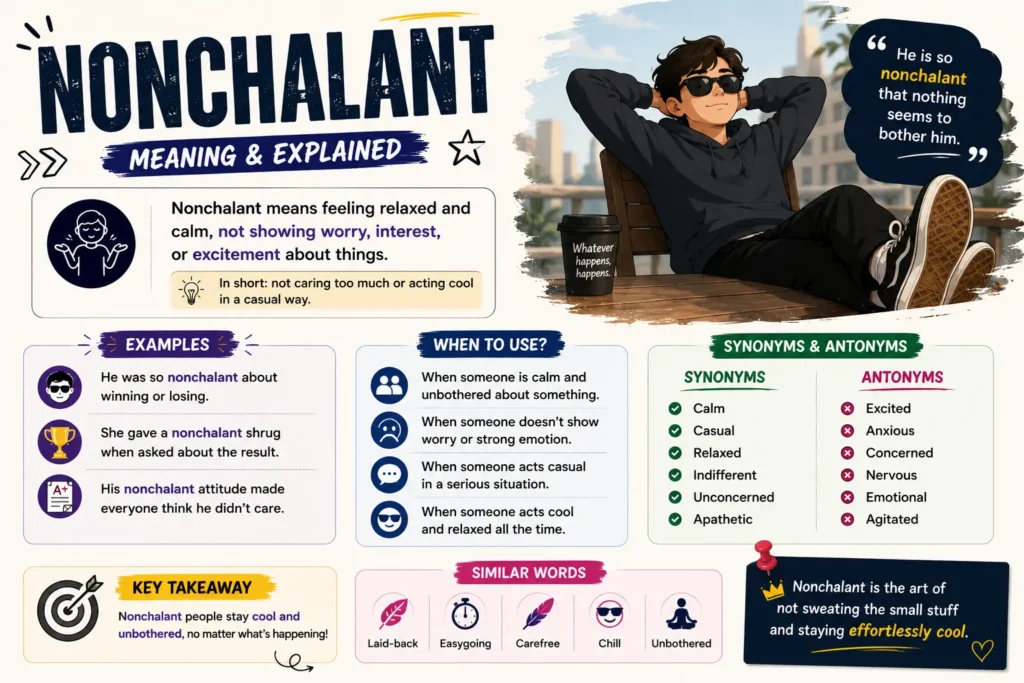
nonchalant meaning describes someone who appears calm, relaxed, and unbothered, especially in a situation where excitement, worry, or stress might be expected. It suggests a cool, easygoing attitude, whether that coolness is genuine or just a carefully maintained appearance. The word carries a sense of effortless calm.
Table of Contents
What Does nonchalant meaning?
This word describes someone who appears calm, relaxed, and unbothered, especially in a moment when strong emotion might be expected.
It often applies to reactions that seem almost too casual for the situation, like staying completely unbothered after big news, good or bad. The word captures a specific kind of effortless coolness, as if nothing could really shake the person’s composure.
Here is an easy way to picture it. Imagine someone finding out they won a huge prize, and simply shrugging and saying, “Oh, cool,” before going right back to what they were doing. That relaxed, almost too-casual reaction captures exactly what this word describes.
It’s worth noting that this word usually describes a specific reaction or moment, rather than someone’s entire personality. A person can seem completely unbothered in one moment, while feeling genuinely excited or stressed underneath.
Where Does the Word Come From?
Words often carry interesting histories, and this one traces directly back to French.
It comes from the French word “nonchalant,” which itself combines “non,” meaning “not,” with “chalant,” from the verb “chaloir,” meaning “to care” or “to be concerned.” Put together, the original idea was something close to “not caring” or “unconcerned,” which closely matches the modern meaning today.
That French origin explains why this word feels a little more elegant or sophisticated than simpler alternatives like “chill” or “relaxed.” It carries a certain effortless, almost stylish quality baked directly into its history.
This Word vs Calm: What Is the Difference?
These two words are related, but they aren’t quite interchangeable.
“Calm” is a broader term describing a peaceful, steady emotional state in general. This word specifically implies an outward appearance of not caring or not being affected, often in a moment where reacting strongly would seem more natural or expected.
Here is a table to help make the difference clear:
| Feature | This Word | Calm |
| Implies indifference | Often, yes | Not necessarily |
| Tied to a specific reaction | Usually, yes | Can describe a general state |
| Can seem intentional or stylish | Frequently | Rarely |
| Common setting | A reaction to news or events | General emotional state |
Both words describe a lack of visible stress or excitement, but this word carries a specific edge of seeming unbothered, almost on purpose, rather than simply being peaceful.
Is This Attitude Always Genuine?
Not necessarily. Sometimes this calm, unbothered appearance is completely genuine, but other times it’s a carefully maintained front, hiding real excitement, nervousness, or stress underneath.
Can Someone Fake Being Nonchalant?
Yes, absolutely. People often deliberately act this way to seem cool, confident, or unaffected, even when they’re genuinely nervous or excited inside. This deliberate, performed version of the attitude is extremely common, especially in social situations where appearing too eager or emotional might feel uncomfortable.
Examples in a Sentence
Seeing this word in real sentences helps the meaning click faster. Here are several everyday examples.
Example 1 “She gave a nonchalant meaning shrug when asked about the surprise party, even though she’d been planning it for weeks.”
Example 2 “He walked into the interview with a nonchalant meaning confidence that put everyone at ease.”
Example 3 “Despite failing the test, he seemed strangely nonchalant meaning about the whole situation.”
Example 4 “The cat strolled past the dog with a nonchalant meaning flick of its tail, completely unbothered.”
Example 5 “Her nonchalant meaning response to the exciting news left her friends wondering if she’d even heard the announcement.”
Notice how this word almost always appears alongside a moment where a bigger emotional reaction might be expected. That contrast, calm reaction against an emotional situation, gives the word its distinctive flavor.
Signs of This Attitude
Sometimes it helps to see this quality broken down into clear, recognizable signs. Here are common signs of this kind of behavior.
- A relaxed, unhurried tone of voice, even during exciting or stressful news.
- Minimal facial expression or body language, even in emotional moments.
- Short, casual responses instead of detailed, excited reactions.
- A general sense of “nothing really fazes me” energy.
- Quickly moving on to another topic, rather than dwelling on big news.
If several of these signs show up together, the word likely applies, whether the calm is completely genuine or carefully performed.
Common Mistakes People Make With This Word
Even a well-known word like this one gets misused sometimes. Here are a few mistakes worth clearing up.
Mistake 1: Assuming it always means someone doesn’t care at all. Sometimes the calm is just a surface reaction, hiding real emotion underneath, rather than genuine indifference.
Mistake 2: Confusing it with rudeness. Appearing unbothered isn’t automatically rude or dismissive. Context usually determines whether the calm reads as cool or careless.
Mistake 3: Overusing it for every calm moment. Regular calmness or general peacefulness doesn’t always need this specific word. It fits best when there’s a real contrast with an expected stronger reaction.
Mistake 4: Mispronouncing the word. It’s pronounced “non-shuh-LAHNT,” with a soft “sh” sound, reflecting its French origin, not a hard “ch” sound.
Expert Tips for Using It Correctly
Writers and English teachers often share a few simple tips for using descriptive vocabulary words like this one well.
- Highlight the contrast. Pair the word with a situation where a bigger reaction might be expected, to make the calm feel meaningful.
- Consider whether the calm is genuine or performed. Both uses are valid, but context should make the intended meaning clear.
- Practice the pronunciation. Getting “non-shuh-LAHNT” right helps the word feel natural in conversation.
- Use it to add subtle character detail. In writing, this word can reveal a lot about a character’s personality or emotional state.
- Avoid overusing it in the same piece. A word this specific works best when it isn’t repeated too often.
These small habits help writers and speakers use the word with real precision, instead of applying it to any ordinary, mildly calm moment.
Why This Kind of Calm Matters
Understanding this attitude helps people read social situations more accurately, noticing the difference between genuine ease and a carefully maintained front.
Recognizing the difference between real calm and performed calm can carry real emotional benefits, because understanding what’s really going on beneath a relaxed surface often helps build deeper, more honest connections with people.
That idea of hidden feelings beneath a calm surface connects to something bigger too. Some people spend years appearing completely unbothered on the outside, while carrying real, unspoken feelings underneath that they’ve never fully expressed. That is exactly what The Unsent Project is about: a space where people finally share honest, unsent messages, often revealing emotions that a calm, easygoing exterior had been quietly hiding for a long time.
If you are curious, you can learn how the project actually works, including how these personal messages get submitted and shared with others. Many people also ask whether the project is real, safe, and legit before getting involved, which is a fair and sensible question.
Each shared message is often paired with a color, and it turns out the colors mean something specific about the feeling behind the words. The project also has a meaningful past, and you can read about the history of The Unsent Project to see how it first began.
If this kind of honest storytelling interests you, there are also other alternatives to The Unsent Project worth exploring. And if you ever want to share your own words, you can always submit your message here.
Small, precise words help capture exactly what’s really going on beneath the surface of everyday communication too. A quick OFC, short for “of course,” settles something instantly, while SMH captures real frustration in three letters. A short TLDR sums up something long, and typing SOS makes urgency instantly clear. Understanding a platonic friendship, solving a personal enigma, learning what it means to be demisexual or celibate, noticing submissive or condescending behavior, checking someone’s ETA, avoiding a pedantic correction, adding an honest caveat to a promise, understanding an offer that’s contingent on something else, spotting truly diabolical intentions, valuing real fidelity in a relationship, recognizing a grifter before it’s too late, understanding a life of reckless debauchery, naming a heavy feeling of ennui, sharing something only certain people will fully understand, saying inshallah about hopeful future plans, sending a quick wtw check-in, describing a truly surreal moment, sharing an opinion with a quick imo, or asking a simple ASL question all rely on the same basic skill: choosing words that capture exactly what’s really happening, on the surface or underneath it.
Frequently Asked Questions
What does nonchalant mean in simple words? It means appearing calm, relaxed, and unbothered, especially in a moment where a stronger reaction might be expected.
Is nonchalant a positive or negative word? It’s fairly neutral. Depending on context, it can describe an admirable, cool composure or a slightly detached, uncaring attitude.
How do you pronounce nonchalant? It’s pronounced “non-shuh-LAHNT,” with a soft “sh” sound, reflecting its French origin.
Is nonchalant behavior always genuine? Not always. Sometimes it’s a real, relaxed reaction, and other times it’s a carefully performed front hiding real emotion underneath.
Where does the word nonchalant come from? It comes from French, combining words meaning “not” and “to care,” originally suggesting a sense of being unconcerned.
What’s the difference between nonchalant and calm? Calm describes a general peaceful state, while this word specifically implies an outward appearance of not being affected by something.
Can nonchalant describe an animal, not just a person? Yes. It’s often used to describe unbothered, relaxed animal behavior, like a cat calmly strolling past something exciting or startling.
Is it rude to act nonchalant about someone else’s exciting news? It can come across that way, depending on tone and context, even if the calm reaction isn’t intended to seem dismissive or uncaring.
Conclusion
Now you understand the true nonchalant meaning: appearing calm, relaxed, and unbothered, especially in a moment where a bigger reaction might be expected.
Whether that calm is completely genuine or carefully maintained, this word captures a very specific, recognizable kind of effortless cool. The next time you notice that unbothered, easygoing energy in yourself or someone else, you’ll know exactly the right word to describe it.