You saw the phrase “per se,” and now you want to know what it means. You are in the right place.
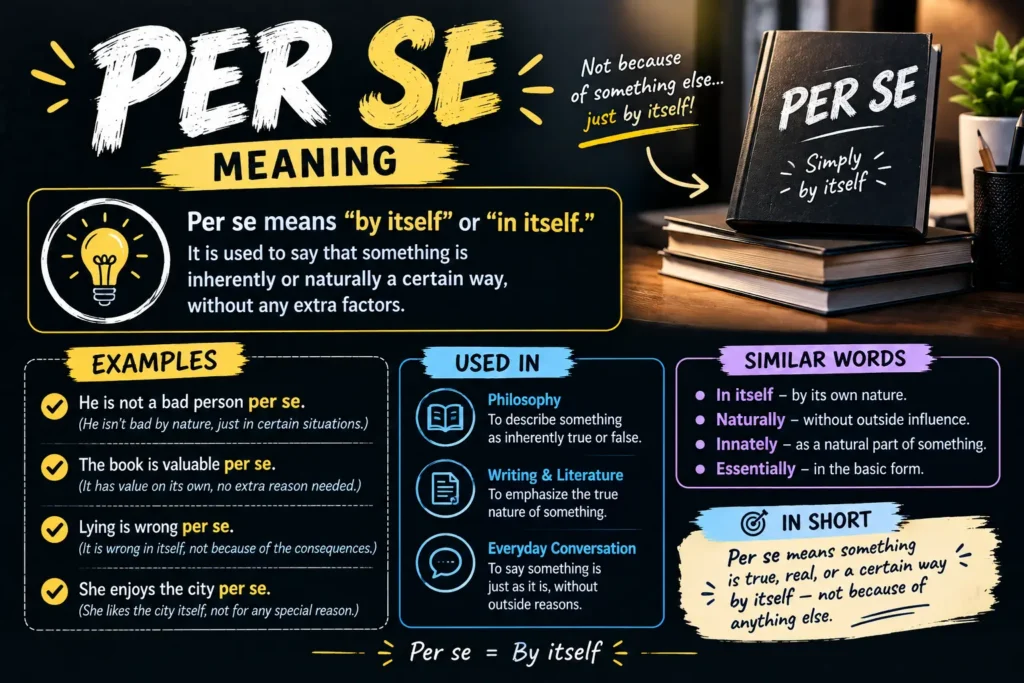
The per se meaning is short and surprisingly useful once you understand it. It means “in itself” or “by itself.” People use it to point out that something is being considered on its own, separate from anything else.
This guide is for anyone who is curious. Maybe you read it in a news article. Maybe you heard a lawyer or teacher use it. Maybe you saw it in a conversation and weren’t quite sure what it added to the sentence. Wherever you found it, by the end of this article, you will understand exactly what it means.
You will learn what “per se meaning” means, where it comes from, how to use it correctly, and how it’s different from similar phrases. You will also see real examples and learn common mistakes people make.
Quick Answer
per se meaning “in itself” or “by itself.” It comes from Latin and is used to point out that something is being judged purely on its own, without considering outside factors. For example, saying something is “not illegal, per se” means it isn’t against the law by itself, even though other issues might still apply.
Table of Contents
What Does Per Se Mean?
Let’s start with the basics.
Per se is an adverb phrase. An adverb describes how, when, or to what extent something happens.
“Per se” means “in itself,” “by itself,” or “as such.” It’s used to isolate one specific thing and consider it completely on its own, separate from anything connected to it.
Think of it like this. Imagine someone says, “The idea isn’t bad, per se, but the timing is wrong.” This means the idea itself is fine when you look at it alone. The problem is something else entirely, the timing, not the idea.
Here is a simple way to remember it:
- per se meaning = by itself + on its own
- It helps separate one specific thing from everything surrounding it.
So the per se meaning always comes back to one idea: judging or describing something purely on its own terms.
Where Does the Phrase “Per Se” Come From?
Phrases have histories, just like people do. Knowing where a phrase comes from can help you remember what it means.
“Per se” comes directly from Latin. Per means “through” or “by,” and se means “itself.” Together, the phrase literally means “by itself” or “through itself.”
Latin was once the language of law, science, and scholarly writing across much of Europe. Many Latin phrases, including “per se,” made their way into English centuries ago and are still used today, especially in legal and formal writing.
Because of this legal history, “per se” still carries a slightly formal or precise tone, even when used in everyday conversation.
How to Use “Per Se” in a Sentence
The best way to understand a phrase is to see it in action. Here are some simple examples.
- “The plan isn’t risky, per se, but it does require a lot of trust.”
- “I’m not upset about the mistake, per se, just the way it was handled.”
- “The movie isn’t bad, per se, it’s just not very memorable.”
- “The rule doesn’t ban the activity, per se, but it does limit how often it can happen.”
Notice a pattern? Every sentence uses “per se” to separate one specific idea from a bigger, more complicated situation.
per se meaning in Legal Language
This is one of the most common places you’ll encounter the phrase.
In law, “per se” describes something that is automatically considered a certain way, just by its own nature, without needing extra proof.
For example, in legal writing, an action might be described as “illegal per se,” meaning it is against the law simply by being that action, no additional circumstances required.
Here’s a simple comparison to make this clearer.
| Legal Phrase | Meaning |
| Illegal per se | Automatically against the law, based on the action alone |
| Negligence per se | An action considered careless by law, simply because it broke a specific rule |
| Not illegal per se | Not automatically against the law on its own, though other factors could still apply |
Expert tip: Legal use of “per se” often signals that a rule applies automatically, without needing to prove extra details about intent or circumstances.
Per Se in Everyday Conversation
Outside of law, “per se” is common in casual and professional conversation, often used to clarify or soften a statement.
People often use it to say, “This one specific thing isn’t the real issue.”
Example: “It’s not the price, per se, it’s the quality that bothers me.”
This everyday use helps speakers separate one part of a situation from the bigger picture, without sounding overly formal or confusing.
Best practice tip: Use “per se” when you want to clarify that you’re judging just one specific part of something, not the whole situation.
Per Se vs. Similar Phrases
People often confuse “per se” with other similar words and phrases. Here is a clear comparison.
| Phrase | Meaning | How it’s different from per se |
| Per se | In itself, by itself | Isolates one specific thing from surrounding factors |
| Essentially | In basic or fundamental terms | Focuses on the core idea, not necessarily isolation |
| Technically | According to strict or literal rules | Focuses on exact rules, not necessarily standalone judgment |
| In and of itself | Considered completely alone | Very similar meaning, but more casual in tone |
| As such | In that specific capacity or role | Focuses on a role or identity, not general isolation |
A common myth is that “per se” and “technically” always mean the same thing. They’re related, but “per se” focuses on isolating one thing, while “technically” focuses on strict literal accuracy.
Common Mistakes People Make
Even careful speakers and writers mix this phrase up sometimes. Here are the most common mistakes.
- Mispronouncing it. Many people say “per say,” which is close, but the correct pronunciation follows its Latin roots closely, sounding like “per-say” or “per-seh,” depending on formal versus casual speech.
- Overusing it in casual writing. Since it has legal and formal roots, using it too often in casual writing can feel stiff or unnatural.
- Confusing it with “essentially.” “Per se” isolates one specific factor, while “essentially” summarizes the core idea of something bigger.
- Using it without a clear point of comparison. “Per se” works best when there’s a clear contrast, like “not bad, per se, but…” Using it without that contrast can feel vague.
Myths About “Per Se”
Let’s clear up a few myths quickly.
- Myth: “Per se” is only used in legal writing. False. It’s common in everyday conversation, especially when clarifying or softening a statement.
- Myth: “Per se” is old-fashioned and rarely used today. False. It remains common in both spoken and written English, including modern conversations and journalism.
- Myth: “Per se” always needs commas around it. Not always required, but many style guides recommend commas for clarity, especially in longer sentences.
Expert Tips for Using “Per Se” Correctly
Here are some quick tips to help you use “per se” the right way.
- Use it to isolate one specific factor from a bigger situation.
- Pair it naturally with a contrast, like “not bad, per se, but…”
- Use commas around it in most sentences for clarity.
- Remember the root idea: by itself. If your sentence isn’t isolating one specific thing, “per se” might not be needed.
A Simple Checklist
Use this checklist before you use “per se” in your own writing.
- [ ] Am I isolating one specific part of a bigger situation?
- [ ] Did I include commas around it for clarity, where appropriate?
- [ ] Could I replace “per se” with “by itself” and keep the same meaning?
- [ ] Am I avoiding overusing it in very casual writing?
If you checked all four boxes, you are using “per se” correctly.
Explore More Word Meanings
If you enjoyed learning about the per se meaning, you might like exploring more everyday words and phrases. Here are a few helpful guides:
- Curious about another common Latin phrase used to soften a statement? Check out albeit meaning.
- Want to understand a Latin phrase used instead of naming every person involved? Read about et al. meaning.
- Interested in a formal phrase often used instead of a full explanation? Explore in lieu of meaning.
- Want a word for adding more unnamed items to a list? See the etc meaning guide.
- Curious about a word describing looking at the whole, connected picture, rather than one isolated part? Read holistic meaning.
Frequently Asked Questions
1. What is the simplest per se meaning? Per se means “in itself” or “by itself,” used to describe something considered purely on its own terms.
2. Where does the phrase “per se” come from? It comes from Latin, combining “per,” meaning “through” or “by,” and “se,” meaning “itself.”
3. How do you pronounce “per se”? It’s typically pronounced “per-say,” following its Latin pronunciation.
4. Is “per se” only used in legal writing? No. While it’s common in legal language, it’s also widely used in everyday conversation and writing.
5. Do you need commas around “per se”? Not always required, but many style guides recommend using commas around it for clarity, especially in longer sentences.
6. What does “illegal per se” mean? It means an action is automatically against the law simply by being that action, without needing extra proof of harm or intent.
7. Is “per se” the same as “technically”? Not exactly. “Per se” isolates one specific factor, while “technically” focuses on strict, literal accuracy.
8. Can “per se” be used in casual conversation? Yes. It’s commonly used to clarify or soften a statement, like “It’s not the price, per se, it’s the quality.”
9. Is “per se” formal or informal? It carries a slightly formal tone due to its legal and Latin origins, but it fits naturally into both formal and casual conversation.
10. What is a simple way to replace “per se” in a sentence? You can often replace it with “by itself,” “in itself,” or “on its own,” while keeping the same meaning.
Conclusion
You now understand the per se meaning from every angle.
per se meaning simply means “in itself” or “by itself.” It comes from Latin, and it’s used to isolate one specific factor from a bigger, more complicated situation. You’ll find it in legal writing, news articles, and everyday conversation alike.
Remember the key idea: judged purely on its own. If you keep that in mind, along with the right punctuation, you will always use the phrase correctly.
The next time you hear “per se,” you won’t just skim past it. You’ll actually know exactly what it means, and you can use it correctly yourself.