You saw “etc.” at the end of a list, and now you want to know what it means. You are in the right place.
The etc meaning is short and useful. It is a small abbreviation that saves you from writing out a long list of things. Instead of naming every single item, you can just add “etc.” at the end.
This guide is for anyone who is curious. Maybe you saw it in a school assignment. Maybe you read it in a recipe or a shopping list. Maybe you just want to know if you are using it correctly. Wherever you found it, by the end of this article, you will understand it fully.
You will learn what “etc.” stands for, where it comes from, how to punctuate it correctly, and how to use it in a sentence. You will also see real examples and learn the most common mistakes people make.
Quick Answer
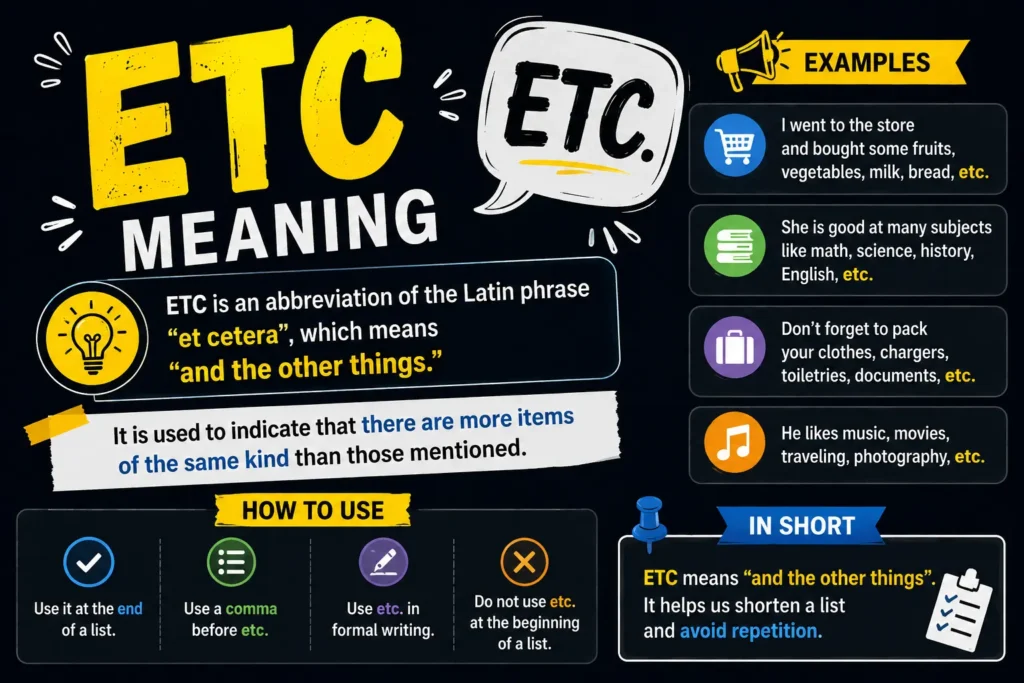
Etc. is a short way of writing “and so on” or “and other things.” It comes from the Latin phrase et cetera, meaning “and the rest.” You use it at the end of a list to show that more similar items could be added, without writing them all out. It always includes a period, since it is an abbreviation.
Table of Contents
What Does Etc. Mean?
Let’s start with the basics.
Etc. is an abbreviation. An abbreviation is a shortened form of a word or phrase.
“Etc.” stands for the Latin phrase et cetera, which means “and the rest” or “and other things.” When you write “etc.” at the end of a list, you are telling the reader that similar items exist, but you are not going to name them all.
Think of it like this. Imagine you are listing your favorite fruits: “I like apples, bananas, oranges, etc.” That last “etc.” tells the reader there are more fruits you like, without forcing you to name every single one.
Here is a simple way to remember it:
- Etc. = and so on + and other things
- It replaces extra list items that would take too long to write out.
So the etc meaning always comes back to one idea: there is more to the list, and the reader can imagine similar examples on their own.
Where Does the Word “Etc.” Come From?
Words have histories, just like people do. Knowing where a word comes from can help you remember what it means.
“Etc.” comes from the Latin words et and cetera. “Et” means “and,” and “cetera” means “the rest” or “the others.” Put together, et cetera literally means “and the rest.”
Latin was once the language of scholars, law, and science across Europe. Many shortened Latin phrases, including “etc.,” made their way into English centuries ago and are still used today.
Because “etc.” comes from two Latin words, some style guides suggest avoiding writing “and etc.,” since that would repeat the word “and” twice.
How Do You Punctuate “Etc.” Correctly?
Getting the punctuation right can be tricky. Here are the key rules.
- Always include a period. Since “etc.” is an abbreviation, it needs a period at the end, even in the middle of a sentence.
- Add a comma before it in a list, if you are following a comma-separated list style. Example: “apples, oranges, bananas, etc.”
- If “etc.” falls in the middle of a sentence, add a comma after it too. Example: “She bought apples, oranges, etc., before heading home.”
- Never write “and etc.” Since “et” already means “and,” writing “and etc.” repeats the same word twice.
Here’s a quick comparison table to make this clearer.
| Situation | Correct | Incorrect |
| End of a sentence | “I need pens, paper, etc.” | “I need pens, paper, etc” |
| Middle of a sentence | “She packed shoes, socks, etc., for the trip.” | “She packed shoes, socks, etc for the trip.” |
| Combining with “and” | “Fruits, vegetables, etc.” | “Fruits, vegetables, and etc.” |
How to Use “Etc.” in a Sentence
The best way to understand a word is to see it in action. Here are some simple examples.
- “Please bring pencils, notebooks, glue, etc., for the art project.”
- “The store sells fruits, vegetables, dairy, etc.“
- “We need to pack sunscreen, towels, snacks, etc., before we leave for the beach.”
- “The recipe requires flour, sugar, eggs, etc.“
Notice a pattern? Every sentence uses “etc.” at the end of a list to suggest that more similar items exist.
When Should You Use “Etc.”?
“Etc.” works best in certain situations. Here are the clearest cases.
- Casual or informal writing, like notes, texts, or personal lists.
- Lists where the remaining items are obvious, like listing school supplies or grocery items.
- Speeding up communication, especially when writing a quick list where naming every item isn’t necessary.
Example: “Bring your ID, ticket, phone, etc., to the airport.”
When Should You Avoid “Etc.”?
There are times when “etc.” doesn’t fit well. Here are common situations to avoid it.
- In formal academic writing, many teachers and professors prefer specific examples instead of a vague “etc.”
- When the remaining items are not obvious. If the reader can’t guess what else belongs on the list, “etc.” feels confusing instead of helpful.
- In legal or technical documents, where vague language can create confusion or legal issues.
Best practice tip: If you’re unsure whether your reader will understand what “etc.” refers to, it’s safer to name at least one or two more specific examples instead.
Etc. vs. Similar Words
People often confuse “etc.” with other similar words and phrases. Here is a clear comparison.
| Word or Phrase | Meaning | How it’s different from etc. |
| Etc. | “And the rest,” used for lists of things | Used only for objects, ideas, or items, not people |
| Et al. | “And others,” used for people, especially in citations | Reserved specifically for referring to additional people |
| And so on | Informal English phrase meaning the same as etc. | More casual, spoken phrasing, without Latin roots |
| I.e. | “That is,” used to clarify or restate something | Explains, rather than extends, a list |
| E.g. | “For example,” used to introduce specific examples | Introduces examples, rather than implying more unnamed items |
A common myth is that “etc.” and “et al.” can be used for the same purpose. That is not true. “Etc.” is for things, while “et al.” is specifically for people.
Common Mistakes People Make
Even careful writers mix this word up sometimes. Here are the most common mistakes.
- Writing “and etc.” This repeats the word “and” twice, since “et” already means “and” in Latin.
- Forgetting the period. Since “etc.” is an abbreviation, it always needs a period, even in the middle of a sentence.
- Using “etc.” for people. “Etc.” is meant for things or items, not people. Use “et al.” for people instead.
- Overusing “etc.” in formal writing. In essays, reports, or professional documents, it’s often better to be specific instead of relying on a vague “etc.”
Myths About “Etc.”
Let’s clear up a few myths quickly.
- Myth: “Etc.” can replace any unfinished list. False. It should only be used when the remaining items are clear and easy to guess.
- Myth: “Etc.” is only used in English. False. Since it comes from Latin, many languages use similar abbreviations or the phrase itself.
- Myth: “Etc.” is unprofessional and should never be used in formal writing. False. It can still be appropriate in formal writing, as long as the remaining list items are obvious to the reader.
Expert Tips for Using “Etc.” Correctly
Here are some quick tips to help you use “etc meaning.” the right way.
- Use it only when the reader can easily guess what else belongs on the list.
- Always include the period, since it is an abbreviation.
- Avoid pairing it with “and,” since that repeats meaning already built into the word.
- Remember the root idea: and the rest. If your list needs more explanation, consider naming an extra example instead of relying on “etc.”
A Simple Checklist
Use this checklist before you use “etc meaning.” in your own writing.
- [ ] Is the rest of my list obvious to the reader?
- [ ] Did I include the period after “etc.”?
- [ ] Did I avoid writing “and etc.”?
- [ ] Am I using it for things, not people?
If you checked all four boxes, you are using “etc.” correctly.
Explore More Word Meanings
If you enjoyed learning about the etc meaning, you might like exploring more everyday words and phrases. Here are a few helpful guides:
- Curious about a similar Latin abbreviation used for people instead of things? Check out et al. meaning.
- Want to understand a short word meaning “nothing” or “zero”? Read about nil meaning.
- Interested in a word describing looking at the whole picture instead of leaving things out? Explore holistic meaning.
- Want to learn a formal Latin-based phrase used instead of a full explanation? See in lieu of meaning.
- Curious about another short, commonly confused abbreviation? Read the albeit meaning guide.
Frequently Asked Questions
1. What is the simplest etc meaning? Etc. means “and the rest” or “and other things.” It is used at the end of a list to suggest more similar items exist.
2. What does “etc meaning” stand for? It stands for the Latin phrase et cetera, meaning “and the rest.”
3. Do you need a period after “etc meaning.”? Yes. Since “etc.” is an abbreviation, it always needs a period, even in the middle of a sentence.
4. Is it correct to write “and etc meaning.”? No. Since “et” already means “and,” writing “and etc.” repeats the same meaning twice.
5. Can “etc.” be used for people? No. “Etc.” is meant for objects, ideas, or items. Use “et al.,” meaning “and others,” when referring to people.
6. Is “etc.” formal or informal? It works in both, but many formal writing styles prefer specific examples over a vague “etc.” unless the remaining items are very obvious.
7. How do you use “etc.” in the middle of a sentence? Add a comma after it, like this: “We packed shoes, socks, etc., before the trip.”
8. Is “etc.” the same as “and so on”? Yes, they mean the same thing. “And so on” is simply a more casual English version of the Latin-based “etc.”
9. Should students use “etc.” in school essays? It depends on the assignment. Many teachers prefer specific examples in essays, so it’s best to check the guidelines before relying on “etc.”
10. Where did the abbreviation “etc.” come from? It comes from Latin, combining “et,” meaning “and,” with “cetera,” meaning “the rest.”
Conclusion
You now understand the etc meaning from every angle.
Etc. simply means “and the rest” or “and other things.” It comes from the Latin phrase et cetera, and it works best when the remaining items on a list are easy for the reader to guess.
Remember the key idea: and so on. If you keep that in mind, along with the correct punctuation, you will always use “etc.” the right way.
The next time you see “etc.” at the end of a list, you won’t just skim past it. You’ll actually know exactly what it means, and you can use it correctly yourself.