Have you ever seen the letters SOS in a movie, a video game, or on a sign? Maybe someone shouted it during an emergency. You probably know it means “help,” but do you know why?
This guide explains the full SOS meaning in a simple way. It’s for kids, students, curious readers, and anyone who wants a clear answer. By the end, you’ll know what SOS stands for, where it came from, and how people use it today.
Quick Answer
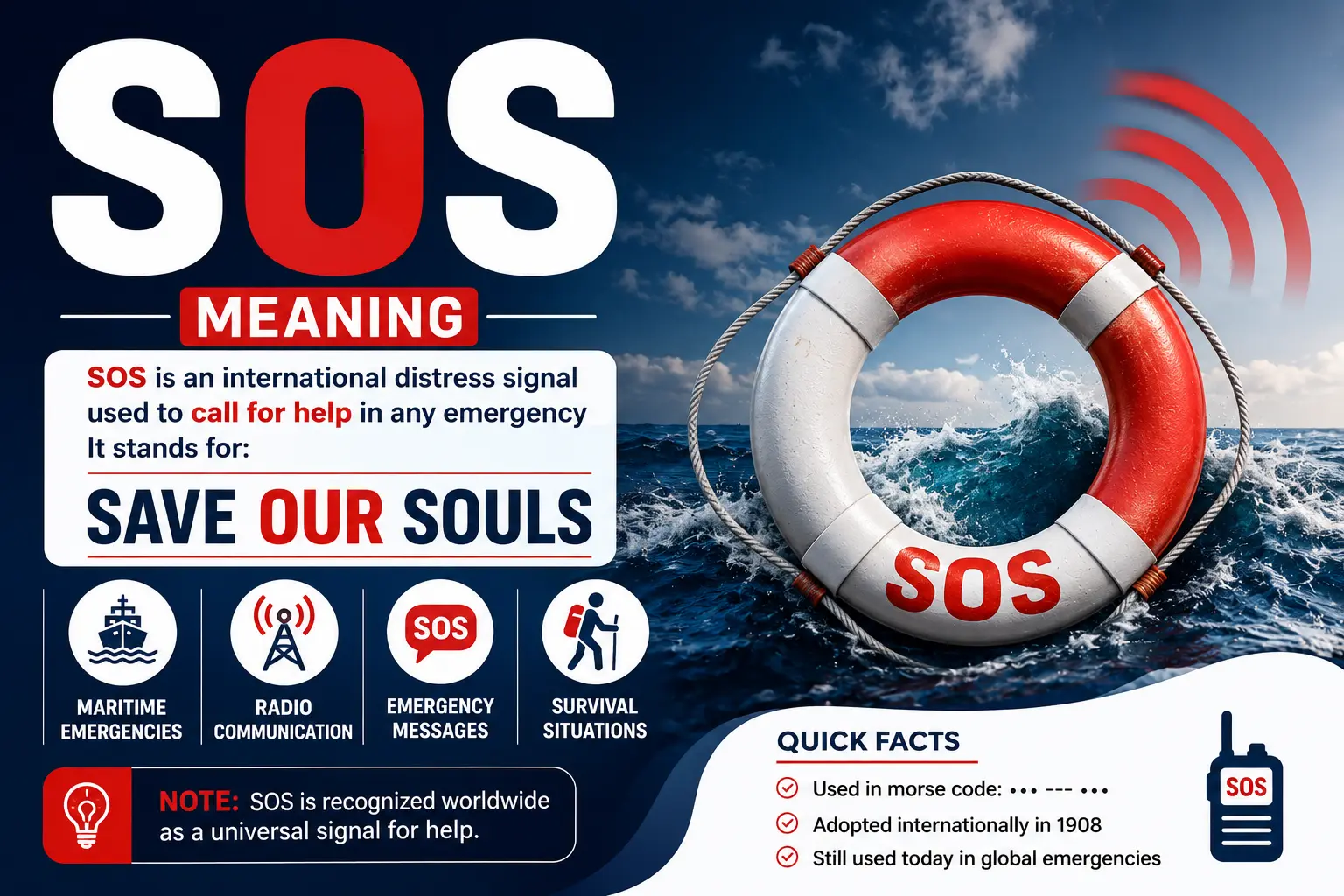
SOS is a distress signal, which means it’s a call for help during an emergency. Many people think SOS stands for words like “Save Our Ship” or “Save Our Souls.” But it doesn’t stand for anything at all. It was chosen because the letters are easy to send and hear in Morse code.
Table of Contents
What Does SOS Meaning Mean?
SOS is a signal that means “I need help right now.” People use it when they are in danger. It could be a sinking ship, a lost hiker, or someone stuck in a storm.
Here’s the surprising part: SOS doesn’t stand for actual words. It is not an acronym, even though many people believe it is. It’s just a simple pattern of letters that is easy to recognize.
This idea might feel strange at first. Most short codes, like TL;DR, stand for real phrases. SOS is different. It was picked for one reason only: it’s easy to send.
Where Did SOS Come From?
SOS comes from the early 1900s. Back then, ships did not have phones or the internet. They used radios that sent messages in Morse code.
Morse code is a way of sending messages using short and long signals. The short signal is called a “dot.” The long signal is called a “dash.”
Before SOS, ships used other distress codes. One popular one was “CQD.” But CQD was harder to send quickly during a scary emergency.
In 1906, countries from around the world met to agree on one simple signal that every ship could use. They chose SOS because of its pattern in Morse code:
- S = three dots
- O = three dashes
- S = three dots
Together, it looks like this: … — …
This pattern repeats the same rhythm twice, so it’s easy to notice even through crackly radio static. That’s why it became the international standard.
Does SOS Stand for Anything?
No. This is the biggest myth about SOS.
Many people believe it stands for:
- “Save Our Ship”
- “Save Our Souls”
- “Send Out Succour”
These phrases were made up after SOS became popular. People created them to help remember the letters. But officially, SOS is not short for anything. It was chosen purely because the Morse code pattern was simple and clear.
Expert Tip: If someone tells you SOS “really” stands for something, you can politely explain that it’s actually just an easy-to-send Morse code pattern, not a real phrase.
How Is SOS Used in Morse Code?
Since SOS started as a Morse code signal, it helps to understand how that works.
Morse code turns letters into sound patterns using dots and dashes:
| Letter | Morse Code |
| S | … (three dots) |
| O | — (three dashes) |
| S | … (three dots) |
When sent by radio, dots sound like quick beeps. Dashes sound like longer beeps. The full SOS signal sounds like:
beep-beep-beep, beeeep-beeeep-beeeep, beep-beep-beep
This pattern is easy to hear, even for someone who doesn’t know Morse code well. That’s exactly why it was chosen as the emergency signal.
You don’t need a radio to send SOS today. People also use:
- Flashlights (three short flashes, three long flashes, three short flashes)
- Whistles (three short blows, three long blows, three short blows)
- Written signs (writing “SOS” in the sand or snow so it can be seen from above)
When Do People Use SOS?
SOS is used only in real emergencies. It should never be used as a joke, because it could confuse rescuers or waste emergency resources.
People send SOS when:
- A ship is sinking.
- A plane has crashed.
- Someone is lost in the wilderness.
- A person is trapped after a natural disaster.
- Someone needs urgent medical help and has no other way to call for it.
Important Safety Note: If you ever need real emergency help, calling your local emergency number (like 911 in the US) is usually faster than sending SOS. SOS is most useful when phones don’t work, such as at sea, in remote areas, or during power outages.
SOS in Everyday Life
SOS isn’t just for ships anymore. Over time, it became a symbol people use in many situations.
Here are common ways people see or use SOS today:
- Phones: Many smartphones have an “Emergency SOS” feature. Pressing a button quickly calls for help and can even share your location.
- Video games: Characters often shout “SOS” when they need backup or rescue.
- Everyday speech: Someone might say, “I’m sending out an SOS for babysitting help this weekend!” This is a lighthearted way of saying they really need help.
- Signs and flags: Hikers or campers sometimes use SOS to signal search-and-rescue teams from far away.
This casual use shows how SOS grew beyond ships and radios. It’s now a universal way to say “I need help,” even outside of Morse code.
Common Mistakes About SOS
Even smart people get a few things wrong about SOS. Here are the most common mistakes:
- Thinking SOS is an acronym. As explained above, it isn’t. It’s a Morse code pattern.
- Writing it as S.O.S. with periods. Since it’s not short for actual words, periods aren’t needed. Just write SOS.
- Confusing SOS with “Mayday.” Mayday is a spoken distress call, mostly used in radio communication for planes and ships. SOS is typically written or signaled, especially in Morse code.
- Using SOS as a joke in serious settings. In emergency contexts (like real radios or beacons), SOS should always be treated seriously.
Myths About SOS
Let’s clear up a few more myths:
Myth: SOS was the first distress signal ever used.
Fact: Ships used other codes, like CQD, before SOS became the standard in the early 1900s.
Myth: SOS is only for sailors.
Fact: While it started at sea, SOS is now used by hikers, campers, and anyone needing emergency help anywhere.
Myth: You need a radio to send SOS.
Fact: You can send SOS using light, sound, or even by writing it somewhere visible, like on the ground.
SOS vs. Other Distress Signals
SOS isn’t the only way to call for help. Here’s how it compares to other common signals:
| Signal | Best Used For | How It’s Sent |
| SOS | Universal emergencies, especially when phones don’t work | Morse code, light, sound, writing |
| Mayday | Spoken emergencies on radio (planes, boats) | Voice, said three times |
| 911 (or local number) | Everyday emergencies with phone access | Phone call |
| Emergency flare | Being seen from far away, especially at sea | Visual (bright light or smoke) |
Pros of SOS:
- Works without electricity or a phone signal.
- Understood around the world.
- Easy to remember and send.
Cons of SOS:
- Slower than a phone call.
- Requires someone nearby to notice or hear it.
- Not useful if no one is around to see or hear the signal.
Expert Tips for Using SOS
If you ever need to send an SOS signal, here are simple steps to remember:
- Stay calm. A clear signal is easier to send when you’re not panicking.
- Use three short signals, three long signals, then three short signals again. This works with light, sound, or even hand claps.
- Repeat the pattern. Sending it once might be missed. Repeat it several times.
- Make it visible or loud. If writing SOS on the ground, make the letters huge so they can be seen from the sky.
- Stay in one place if possible. This makes it easier for rescuers to find you.
Fun Facts About SOS
- The first official use of SOS as a distress call was in 1909, aboard the SS Arapahoe.
- SOS became world-famous after the Titanic disaster in 1912, when the ship used both CQD and SOS to call for help.
- Many people today confuse SOS with acronyms because of pop culture, songs, and movies that treat it like a real phrase.
- Some smartphones automatically detect car crashes and can trigger an SOS-style emergency call without you touching the phone.
Frequently Asked Questions
1. What does SOS actually stand for?
SOS doesn’t stand for anything. It was chosen because its Morse code pattern (three dots, three dashes, three dots) is simple and easy to recognize.
2. Why is SOS three letters?
Three letters made the Morse code pattern short, memorable, and quick to send, even in emergencies.
3. Is SOS still used today?
Yes. While modern technology like GPS and phones are more common, SOS is still recognized worldwide and used in emergency features on smartphones, hiking gear, and emergency beacons.
4. What’s the difference between SOS and Mayday?
SOS is often written or signaled visually or through Morse code. Mayday is spoken aloud, mostly used in radio communication.
5. Can I use SOS as a joke?
It’s best to avoid using SOS in situations where it could be mistaken for a real emergency, especially on radios or emergency devices.
6. How do I send SOS without a phone?
You can use light flashes, whistle blows, or write the letters SOS somewhere large and visible, like on sand, snow, or a rooftop.
7. Where did SOS come from?
SOS was created in the early 1900s as an international distress signal, chosen for its clear and simple Morse code pattern.
8. Does SOS mean the same thing in every country?
Yes. SOS is recognized as a universal distress signal around the world, no matter the language spoken.
Conclusion
So, what’s the real SOS meaning? It’s simple: SOS is a universal call for help. It doesn’t stand for any hidden phrase, no matter what popular myths say. Instead, it was chosen because its Morse code pattern, three dots, three dashes, three dots, is easy to send and impossible to miss.
From ships in the early 1900s to smartphones today, SOS has stayed one of the most recognized emergency signals in the world. Understanding its history and meaning helps you use it correctly and appreciate why such a simple signal became so important.
If you enjoyed learning what a short phrase really means, you might also like discovering the SMH meaning or exploring more everyday abbreviations people use both online and off.