Quick Answer
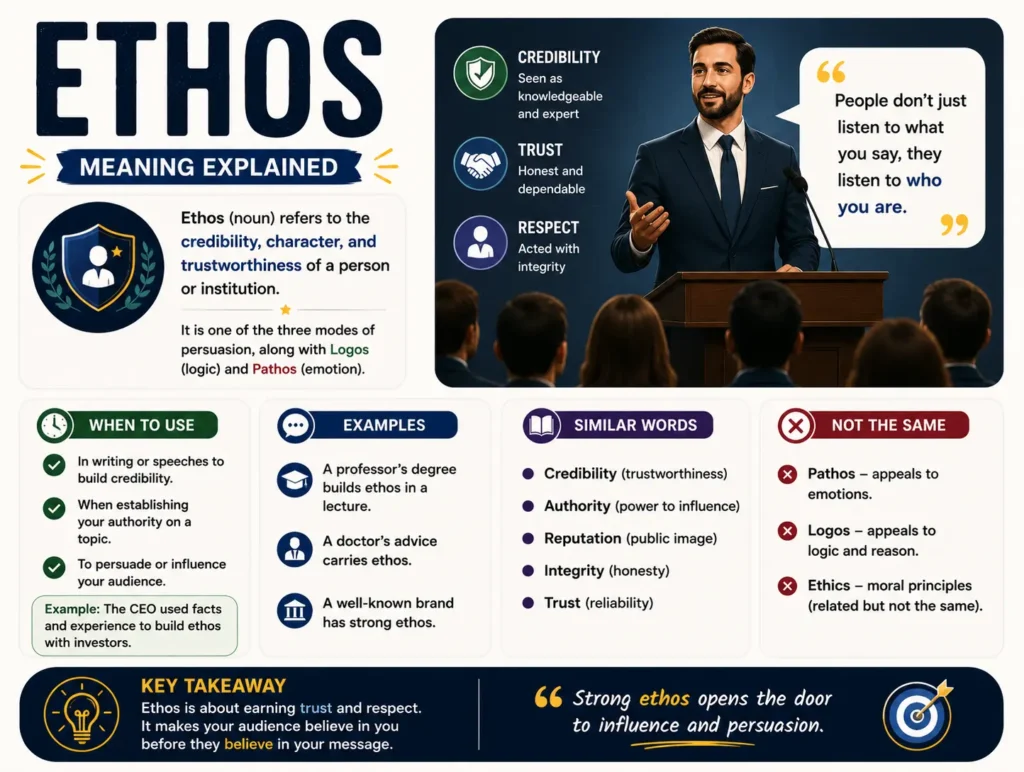
The ethos meaning is all about character and values. ethos meaning is the set of beliefs, ideas, or spirit that guides a person, group, or place. It’s often used to describe what makes someone trustworthy or what a group truly stands for.
Table of Contents
What Does Ethos Mean?
Have you ever heard someone talk about a company’s “ethos” or a team’s “ethos” and wondered what that word actually means? A lot of people search for the ethos meaning because it shows up in schools, businesses, and everyday conversation, but it isn’t always explained clearly.
Here’s the simple version. ethos meaning the character, values, or spirit of a person, group, or place. It’s what someone stands for. It’s the reason people trust them, or don’t.
This guide is for students, writers, and anyone who wants a clear answer. Maybe you read the word in an English class. Maybe you heard a coach talk about “team ethos.” Whatever the reason, you’ll learn exactly what it means and how to use it correctly.
By the end of this guide, you will know:
- What ethos meaning in simple terms
- Where the word comes from
- How it’s different from pathos and logos
- Real examples you can use
- Mistakes to avoid
Let’s start with where this word came from.
Where Does the Word Ethos Come From?
Ethos comes from Ancient Greek. In Greek, ethos meaning “character” or “custom.” The word was closely tied to how a person behaved and what kind of character they showed to others.
The Greek philosopher Aristotle made the word famous. He used ethos meaning as one of three ways a speaker could convince an audience. He believed that if people trusted your character, they were more likely to believe what you said. That idea is still taught in schools today.
Over time, English speakers borrowed the word directly from Greek. Its meaning barely changed. It still points to character, values, and the deeper spirit behind a person or group’s actions.
Ethos, Pathos, and Logos — How They’re Different
If you’ve studied persuasive writing, you may have heard ethos mentioned alongside two other words: pathos and logos. These three ideas work together, but they mean different things.
| Word | What It Means | How It Persuades |
| Ethos | Character and trust | “You can believe me because I’m honest and experienced.” |
| Pathos | Emotion | “This will make you feel something strong.” |
| Logos | Logic and facts | “Here is proof and evidence.” |
Simple way to remember it:
- Ethos = trust
- Pathos = feelings
- Logos = facts
A strong speech or piece of writing often uses all three. But ethos usually comes first, because people need to trust the speaker before they’ll listen closely to feelings or facts.
How Ethos Is Used Today
While ethos started as a term for persuasive speaking, its meaning has grown wider over time. Today, people use it in many everyday situations.
In business: Companies talk about their “ethos” to describe their values and how they treat customers.
In schools: A school might describe its “ethos” as a caring, respectful learning environment.
In sports: A coach might talk about the team’s “ethos,” meaning the shared attitude and work ethic of the players.
In writing: Writers build ethos by showing knowledge, honesty, and fairness, which makes readers trust what they say.
In every case, the word points back to the same idea: the character or guiding spirit behind a person or group.
Examples of Ethos in a Sentence
Seeing a word used in real sentences makes it much easier to understand. Here are simple examples.
- The company’s ethos is built on honesty and fair pricing.
- Our school’s ethos encourages kindness and hard work.
- The coach reminded the team about their ethos of never giving up.
- The doctor’s calm confidence gave her strong ethos with patients.
Notice how ethos always connects to trust, values, or character, never to facts alone or emotions alone.
Common Mistakes People Make
Even careful writers sometimes misuse this word. Here are the most common mistakes.
Mistake 1: Confusing ethos with logic. Ethos is about trust and character, not facts or evidence. That’s logos.
Mistake 2: Confusing ethos with emotion. Ethos is not about making someone feel sad, happy, or excited. That’s pathos.
Mistake 3: Using it only for individuals. Ethos can describe a person, but it can also describe a group, a company, or an entire culture.
Mistake 4: Overusing it in casual writing. Because it’s a formal word, using it too often in everyday writing can sound stiff. Save it for moments when you’re truly discussing values or trust.
Synonyms for Ethos
Synonyms are words that mean almost the same thing. Here are some common ones, depending on how the word is used.
- Character
- Values
- Spirit
- Culture
- Principles
For example, instead of saying “company ethos,” you could say “company values” or “company culture,” depending on the tone you want.
How to Build Ethos in Writing or Speaking
If you’re writing an essay, giving a speech, or even posting online, you can build your own ethos. Here’s how.
1. Show real knowledge. Share facts and details that prove you understand the topic.
2. Be honest. Avoid exaggerating or making things sound better than they are.
3. Stay fair. Acknowledge other viewpoints instead of ignoring them.
4. Use a calm, confident tone. Sounding rushed or overly emotional can weaken trust.
5. Back up claims with sources. This shows readers you’re not just guessing.
These steps are especially useful in school essays, presentations, and any writing meant to persuade.
Expert Tips for Using This Word
- Pair it with real examples. Instead of just saying “our ethos,” explain what that ethos actually looks like in action.
- Don’t overuse it. One clear mention of ethos is often stronger than repeating it several times.
- Remember its Greek roots. Thinking of “character” instead of “ethos” can help you use the word more naturally.
- Use it in the right setting. It fits well in essays, business writing, and speeches, but may sound too formal in casual conversation.
Frequently Asked Questions
1. What is the simplest way to explain the ethos meaning? Ethos means character, values, or the guiding spirit of a person or group. It’s closely tied to trust.
2. Where does the word ethos come from? It comes from Ancient Greek, where it meant “character” or “custom.”
3. What’s the difference between ethos, pathos, and logos? Ethos is about trust and character, pathos is about emotion, and logos is about facts and logic.
4. Can ethos describe a group, not just a person? Yes. Companies, schools, teams, and even entire cultures can have an ethos.
5. Is ethos a formal word? Yes, it’s mostly used in formal writing, speeches, and discussions about values or persuasion.
6. How do I build ethos in my own writing? Show real knowledge, stay honest, acknowledge other views, and back up your claims with sources.
7. Is “team ethos” a common phrase? Yes, it’s commonly used in sports and workplaces to describe shared values and attitude.
8. Is ethos the same as reputation? They’re related but not identical. Reputation is how others see you. Ethos is the actual character and values behind that reputation.
Conclusion
So, what is the ethos meaning? At its core, ethos is about character, values, and trust. It’s the guiding spirit behind a person, team, or organization, and it plays a huge role in how believable or trustworthy they seem to others.
The next time you hear someone mention “ethos,” whether it’s about a company, a school, or a team, you’ll know exactly what they mean. And if you’re writing your own essay or speech, remember that strong ethos starts with honesty, knowledge, and fairness.