Have you ever heard someone say “10-4” on a walkie-talkie, in a movie, or even in a text message? Maybe you weren’t sure what it meant. You are not alone! The 10-4 meaning is simple, and once you know it, you will spot it everywhere.
This guide is for anyone who is curious about this famous phrase. Maybe you heard it from a trucker on the highway. Maybe you saw it on a police show. Maybe a friend texted it to you. By the end of this article, you will know exactly what 10-4 means, where it came from, and how to use it yourself.
Quick Answer
“10-4” means “message received” or “okay, I understand.” People use it to show they heard what someone said. It started as a radio code used by police officers. Today, truck drivers, texters, and everyday people use it too.
Table of Contents
What Does 10-4 Mean?
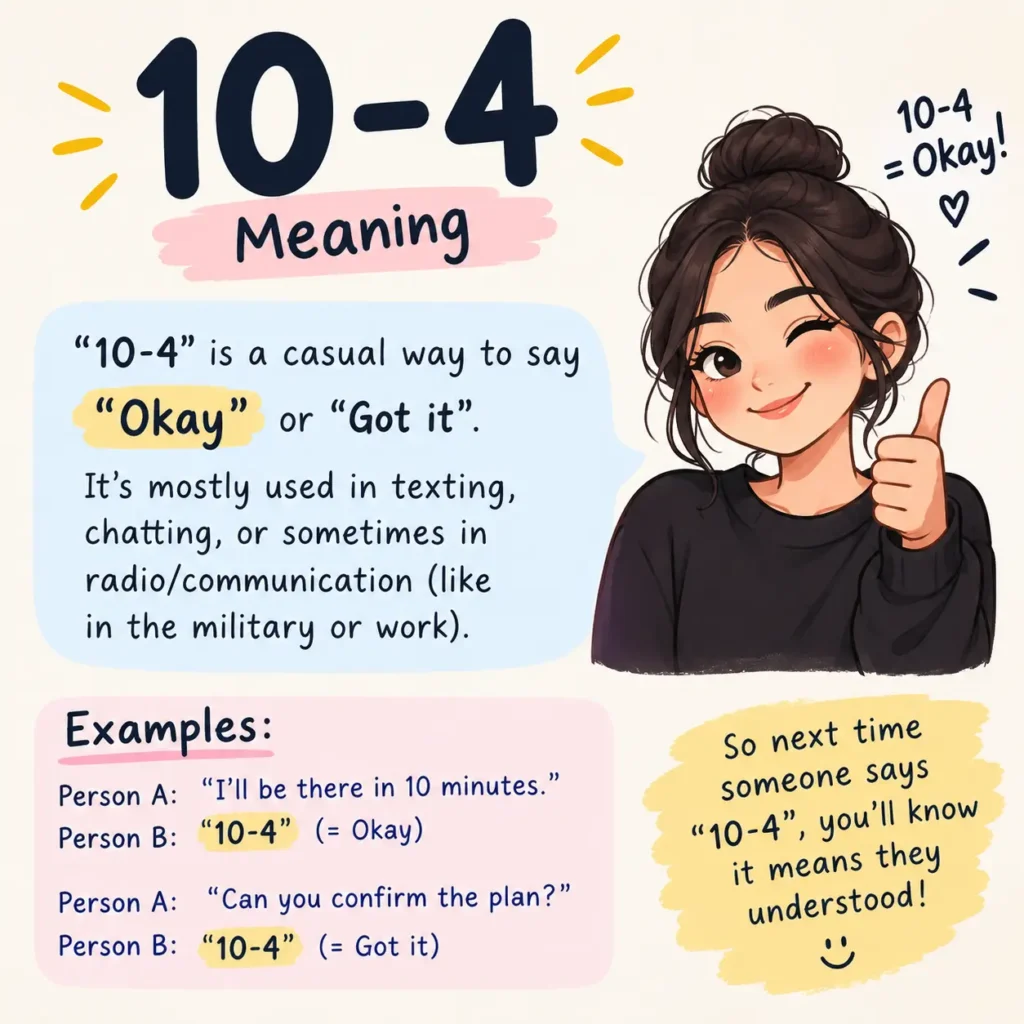
“10-4” means “okay” or “I got your message.”
It is a short way to say, “Yes, I hear you loud and clear.” People say it to let another person know their message came through.
Here is an easy example. Imagine two friends are using walkie-talkies at a park.
Friend 1: “Meet me by the big tree in five minutes.” Friend 2: “10-4!”
Friend 2 is saying, “Okay, I understand. I will be there.”
That is the whole idea. Simple, right? It is a quick way to say “yes” or “understood” without using a lot of words.
The History of the Radio Code
To understand the 10-4 meaning, we need to go back in time. This phrase did not start as slang. It started as a real code used by police officers.
Long ago, police radios were not very good. The sound was often scratchy. Officers could miss the first word of a message. So, police departments came up with a plan. They added the word “ten” before a number. This gave the radio a moment to “warm up” before the important number came through.
This system was called the 10-code system. Each number after “10” had its own special meaning. For example:
- 10-1 meant the signal was weak.
- 10-4 meant “message received” or “okay.”
- 10-20 meant “What is your location?”
Police officers all over the country started using these codes. It helped them talk fast and clear, even with old, noisy radios.
How 10-Codes Came to Be
The 10-code system was created in 1937. A man named Charles “Charlie” Hopper helped build it. He worked for the Illinois State Police. At the time, police radios were brand new technology. They were not perfect. Officers needed a way to communicate clearly, even when the signal was bad.
Hopper’s idea worked so well that police departments across the United States started using it. Over time, other groups picked it up too. Truck drivers, who also used radios called CB radios (short for Citizens Band radios), began using 10-codes on the road.
By the 1970s, 10-4 meaning was not just a police term anymore. It had become a piece of everyday American language. Movies and songs made it even more popular. People who had never touched a police radio started saying “10-4” just for fun.
Why Do People Still Use 10-4 Today?
You might be thinking, “Radios are much better now. Why do people still say 10-4?”
Great question! Here are a few reasons.
It is fast. Saying “10-4” is quicker than saying “I understand your message and I agree.”
It is fun. The phrase has a cool, old-school feel. It reminds people of truckers, police shows, and classic movies.
It is clear. Even today, “10-4” is easy to understand. Almost everyone knows what it means, even if they are not police officers or truck drivers.
It builds community. Truck drivers still use CB radios to talk to each other on long trips. Saying “10-4” is part of their culture. It connects them to other drivers on the road.
Common Ways People Use 10-4
The 10-4 meaning has grown beyond just radios. Here are the most common ways people use it today.
1. On the Road (Truckers and CB Radios)
Truck drivers still use CB radios to talk to each other. If one driver warns another about traffic ahead, the second driver might say “10-4” to show they heard the warning.
2. In Texting and Messaging
Some people type “10-4 meaning” in a text message. It works just like saying “okay” or “got it.”
Example text message: “Can you pick up milk on your way home?” “10-4”
3. In Movies and TV Shows
Police shows and trucker movies use “10-4” all the time. This has helped keep the phrase alive for new generations.
4. At Work
Some workplaces use walkie-talkies, especially in warehouses, construction sites, or event venues. Workers say “10-4” to confirm they heard an instruction.
5. Just for Fun
Many people say “10-4” as a playful way to agree with a friend, even outside of any radio or work setting.
Other Popular 10-Codes You Should Know
The 10-code system has many other numbers besides 10-4 meaning. Here are a few well-known ones.
| Code | Meaning |
| 10-1 | Signal is weak |
| 10-2 | Signal is good |
| 10-4 | Message received / Okay |
| 10-9 | Please repeat your message |
| 10-20 | What is your location? |
| 10-100 | Restroom break |
Not every police department uses the exact same codes. Some cities and states have their own versions. That is one reason many modern police departments have moved to plain language instead of codes. Plain language means officers just say what they mean in normal words, so there is no confusion between departments.
10-4 vs. Other Radio Codes
People sometimes mix up 10-4 with other codes. Here is how it is different.
10-4 vs. Roger “Roger” is another word that means “message received.” It comes from military radio language, not police radio. “10-4” and “Roger” mean almost the same thing. Many people even say “Roger that, 10-4” together for extra clarity.
10-4 vs. Copy “Copy” also means “I understand.” Pilots and military members often use this word. Again, it is very close in meaning to “10-4.”
10-4 vs. Affirmative “Affirmative” means “yes.” It is a bit different from 10-4, because 10-4 can also mean “I heard you,” not just “yes.”
Common Mistakes People Make
Even though 10-4 is simple, people sometimes get it wrong. Here are a few common mistakes.
Mistake 1: Thinking 10-4 always means “yes.” Sometimes it just means “I heard your message,” not “I agree with your message.”
Mistake 2: Using the wrong number. Some people accidentally say “10-4 meaning” or another number, thinking it means the same thing. Each 10-code number has its own separate meaning.
Mistake 3: Assuming every police department uses the same codes. As mentioned earlier, codes can be different from one city to another. This is why many departments now use plain talk instead.
Expert Tips for Using 10-4
If you want to use “10-4” the right way, keep these tips in mind.
- Use it when you want to confirm you heard something, not just to say “yes.”
- Say it clearly and quickly, just like the original radio users did.
- Pair it with “Roger” if you want to sound extra clear, like “Roger, 10-4.”
- Remember it is casual. Save formal replies for formal situations, like official paperwork.
- Have fun with it! It is a fun piece of history you can use in everyday talk.
Myths About 10-4
Myth: 10-4 is only for police officers. Not true. Truckers, event staff, hikers with radios, and regular people use it too.
Myth: 10-4 means “goodbye.” Not true. It simply means “message received.” Some people confuse it with sign-off phrases, but it is not the same thing.
Myth: All 10-codes mean the same thing everywhere. Not true, as we covered above. Codes can change by location.
10-4 in Pop Culture
The phrase “10-4” became extra famous because of trucker movies from the 1970s, like Smokey and the Bandit. These movies showed truckers talking on CB radios, using phrases like “10-4, good buddy.” This made the phrase part of everyday American slang, even for people who never used a radio.
Songs, TV shows, and even video games have used “10-4” to add a fun, old-school trucker or police feel. That is part of why so many people still recognize it today, even though old-style radios are much less common.
Frequently Asked Questions
What does 10-4 meaning in texting? In texting, “10-4 meaning” means “okay” or “got it.” It works the same way it does on the radio.
Where did 10-4 come from? It came from the police 10-code system, created in 1937 by Charlie Hopper for the Illinois State Police.
Is 10-4 still used by police today? Some police departments still use it, but many have switched to plain language to avoid confusion between different code systems.
Do truck drivers still say 10-4? Yes! Many truck drivers still use CB radios and say “10-4” to confirm messages.
What is the difference between 10-4 and Roger? They mean almost the same thing. “10-4” comes from police radio codes, while “Roger” comes from military radio language.
Can I use 10-4 in everyday conversation? Yes, many people use it casually to say “okay” or “understood,” even outside of radio use.
Why do people say “10-4, good buddy”? “Good buddy” was a friendly way truckers greeted each other on CB radios. It became famous through trucker movies and music.
What does 10-20 mean? It means “What is your location?” It is another common code from the same 10-code system.
Conclusion
Now you know the full 10-4 meaning! It started as a simple police radio code in 1937, made to help officers communicate clearly over noisy radios. Today, it means “okay” or “message received,” and people from truck drivers to texters use it every day.